Four Kinds Of Water, Four Different Answers
Water is the most common cause of home insurance claims and the most misunderstood, because a policy does not treat it as one thing.
It distinguishes between sudden plumbing failures and gradual leaks. It excludes flood entirely. It excludes sewer backup unless you added an endorsement. And it covers storm driven water entering through a damaged roof while excluding water entering through a roof that is simply worn out.
Which means the question is never whether water damage is covered. It is where the water came from and how quickly it arrived.
Two tests answer almost every case, and the rest of this article is about applying them.
Test One, Consider The Source
Where the water originated decides which half of the policy you are in.
From inside your home, meaning plumbing, a broken pipe, or an overflowing appliance, and you are likely covered provided the damage was sudden and accidental.
From outside your home, meaning rising water, groundwater, or storm surge, and you are outside a homeowners policy entirely. That is flood, and it requires a separate policy.
From the systems that normally take water out, meaning sewers and sump pumps. When those let water back in, it is treated as a reverse flow or backflow event and it is excluded unless you added coverage.
That third category catches people hardest, because a basement full of water from a backed up drain looks identical to a basement full of water from a burst pipe and is treated completely differently.
Test Two, Sudden Versus Gradual
The single most important concept in water damage claims.
Only water damage that is sudden and accidental is covered by a standard homeowners policy.
Covered. A pipe bursting, a washing machine supply hose failing without warning, a water heater rupturing, a dishwasher suddenly leaking, an appliance overflowing.
Not covered. A pipe fitting slowly leaking behind a wall for months, water seeping through foundation cracks over time, a roof that has been failing for years, and damage from persistent humidity or condensation.
The reasoning is consistent. Insurance responds to unexpected losses rather than functioning as a maintenance plan for gradual decay.
Which means an adjuster's first job on a water claim is determining whether the damage was sudden or whether it developed over time and could have been prevented.
How An Adjuster Tells The Difference
Worth understanding, because the evidence is physical and it is not ambiguous.
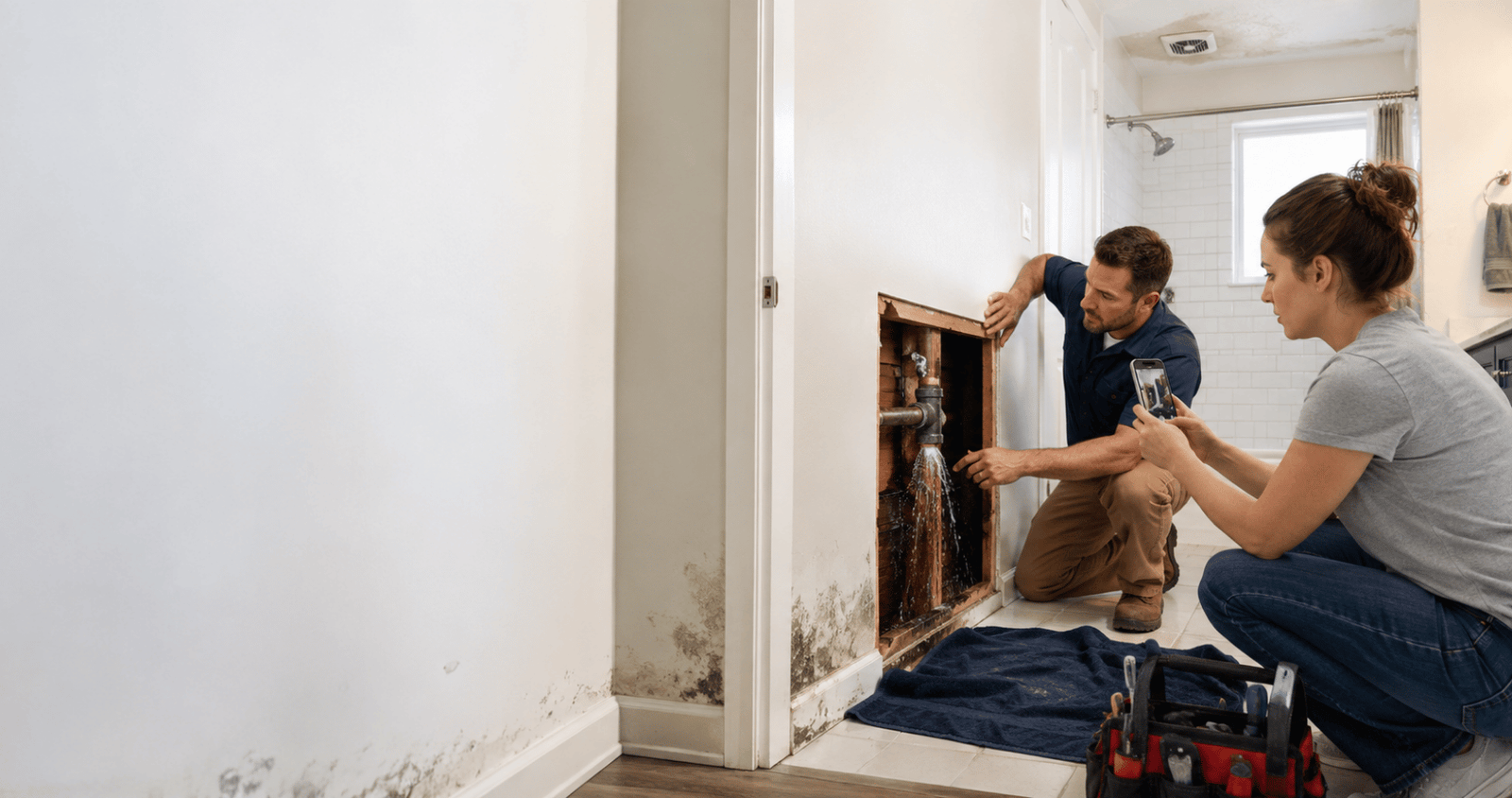
Months of slow leaking leaves a signature. Mold growth, a musty smell with a timeline, water staining spreading behind a wall, and rot in structural material.
None of those appear in the hours after a pipe bursts.
Which is why a homeowner who genuinely did not know about a leak still faces a denial. The question is not whether you knew. It is whether the damage developed gradually, and the wall answers that question regardless of what anyone says.
The financial consequence is substantial. Where a claim is denied as gradual, both the pipe repair and any mold remediation fall to the homeowner, and remediation alone commonly runs into thousands or tens of thousands of dollars.
The Repair Itself Is Not Covered
A distinction that surprises nearly everyone.
Your policy covers the damage the water caused. It does not cover the cost of repairing the source.
So when a washing machine hose bursts and floods a laundry room, the water damage to floors, walls, and belongings is covered. Replacing the broken washing machine is not.
The same applies to the pipe, the water heater, or the dishwasher that failed.
Which produces a practical planning point. Budget for the source repair separately, because the insurance settlement will not include it, and equipment breakdown coverage is a separate endorsement addressing appliance and system failures.
Roof Leaks Split The Same Way
A common scenario with two very different outcomes.
Covered. A storm damages the roof and rain enters through the breach. Roof leaks not resulting from wear and tear, along with damage from animals or rot in some cases, are generally covered.
Not covered. A shingle roof showing its age, with a few shingles damaged or missing and small damp spots already appearing in the attic. A summer thunderstorm then turns those small leaks into a flood.
In the second case the roof was already failing, and the storm exposed a maintenance issue rather than causing a sudden loss.
Which is why documenting your roof's condition matters, and why addressing missing shingles promptly protects far more than the roof itself.
Sewer Backup Needs An Endorsement
The gap most homes should close, and it is inexpensive.
When a municipal sewer overfills during a storm and water and sewage back up through your drains, the resulting damage to floors, water heater, and furnace is not covered by a standard policy.
A water backup and sump pump overflow endorsement fills it, and consumer guidance from state insurance regulators lists it among the additional coverages homeowners should specifically ask about.
Three reasons it deserves priority over almost any other endorsement.
The event is common, particularly in older neighborhoods with aging municipal drainage.
The cleanup is expensive and unpleasant, because backup water is contaminated in a way clean water is not.
The coverage is cheap relative to the exposure.
For any home with a basement, a lower level living area, or a sump pump, this is the endorsement to add first.
Sump Pump Failure Is Its Own Problem
Related and worth stating separately.
If a sump pump breaks down or becomes clogged and the basement floods, standard homeowners policies will likely not cover it.
Depending on the insurer, separate coverage may be available, and it is frequently bundled into the same water backup endorsement.
Ask specifically whether your endorsement covers sump pump failure as well as sewer backup, because some forms address one and not the other.
Two practical protections alongside the coverage. A battery backup pump, since the storm that overwhelms a sump pump frequently also causes the power cut that disables it. And an annual test before wet season.
Frozen Pipes Come With A Condition
A covered peril with a requirement attached.
Where freezing temperatures cause a pipe to burst and flood a home, the damage may be covered as a sudden and accidental incident.
The condition is that freezing of pipes is not covered unless you have used reasonable care to maintain heat.
Which matters enormously for anyone leaving a property empty in winter. A second home, a vacation, or an extended absence.
Two steps protect the claim. Maintain heat at a reasonable level while away, or shut off and drain the water system. And confirm with your insurer what your specific policy requires, since some are prescriptive about temperature and duration.
Skipping that step converts a covered burst pipe into a denied maintenance claim.
Groundwater Is Neither Covered Route
A scenario that falls between two exclusions.
Heavy rain over several days, water seeping through basement walls, and standing water in the basement.
Groundwater seeping through basement walls is treated either as a flood event requiring flood insurance, or as a maintenance and drainage issue excluded entirely.
Which means neither a standard policy nor a water backup endorsement responds, and the long term solution is physical rather than financial. Sump pump systems and exterior drainage, commonly running into thousands of dollars.
If your basement takes water during heavy rain, that is a drainage problem to solve rather than a claim to file.
What Else Is Excluded
Four additional water related exclusions worth knowing.
Earth movement, including damage from earthquakes, mudslides, and landslides.
Leaks from a swimming pool or other structure.
Seepage and foundation leaks, as a category.
Mold, mildew, and wetness resulting from lack of maintenance or negligence, which is the same gradual damage principle applied to its most expensive consequence.
Mold does receive coverage where it results from a covered peril such as a burst pipe, subject to a policy sublimit that is frequently small. A mold rider raises that limit and broadens the qualifying causes.
Check For A Separate Water Limit
A detail buried in policy documents and worth finding.
Some policies apply a separate water damage limit or a distinct deductible for water claims, distinct from the main policy deductible.
Consumer guidance recommends confirming the deductible and asking whether any separate water damage limit applies.
That question takes thirty seconds and it changes what a claim actually produces. A policy with a lower sublimit for water damage behaves very differently from one where water claims sit under the full dwelling limit.
The Discount Worth Asking About
A device that reduces both risk and premium.
Smart water leak detection systems use sensors to monitor water flow and can automatically shut off the main supply the moment a leak is detected.
Many insurers offer a meaningful discount for having one installed.
The value is not only the discount. These systems address the exact scenario that produces the largest water claims, which is a failure that begins while nobody is home and runs for hours.
For a home with a finished basement, a second floor laundry, or any period where the house sits empty, the case is strong.
Prevention Is Coverage Protection
Maintenance is not merely sensible here. It determines whether a claim gets paid.
Check anything that uses water regularly, since hoses break, pipes crack, and faucets leak over time.
Replace washing machine supply hoses on a schedule rather than waiting for failure, since braided stainless steel hoses cost little and burst hoses are among the most common claims.
Fix small leaks immediately and in writing, because a documented prompt repair is the opposite of a maintenance denial.
Inspect the roof annually and address missing or damaged shingles.
Know where the main shutoff is, and make sure everyone in the household does.
That last one saves more money than any of the others. The difference between a burst pipe running for ten minutes and one running for four hours is the difference between a repair and a rebuild.
What To Do When It Happens
Six steps in order.
Shut off the water at the main supply.
Stop the source if you can do so safely, and turn off electricity to affected areas if water is near outlets or panels.
Photograph everything before you clean, including the source, the standing water, and every affected item.
Prevent further damage, which is a policy condition. Move belongings, start drying, and keep the receipts for anything you spend.
Call your insurer, and note where the water came from and when you discovered it.
Do not throw anything away until an adjuster has seen it or released you.
Speed matters more here than in most claims, because mold begins within a day or two and a delay in drying converts a covered water claim into an excluded mold problem.
Three Things To Do This Week
Add a water backup and sump pump endorsement if you do not have one. It is cheap and it addresses the most likely water event in most homes.
Find your main water shutoff and make sure everyone in the household knows where it is.
Ask two questions of your insurer. Whether a separate water damage limit or deductible applies, and whether they offer a discount for a leak detection system.
Water causes more home insurance claims than anything else, and the difference between a paid claim and a denied one usually comes down to two facts established before anyone called an insurer. Where the water came from, and how long it had been arriving.
This article is for general educational purposes and is not insurance advice. Coverage terms, endorsements, sublimits, freezing conditions, and exclusions vary by insurer and by state. Read your own policy and confirm details with your agent.
Some images in this article were generated using artificial intelligence and are for illustrative purposes only.