One Covers Events, The Other Covers Wear
The confusion between these two products comes from the fact that both pay to fix things in your house.
The distinction is what caused the problem.
Home insurance covers sudden, unexpected damage. Fire, storms, theft, and liability claims.
A home warranty covers systems and appliances that break down from normal wear and tear.
Insurance is designed to respond to events. A warranty is designed to respond to age.
Which means they do not overlap and neither replaces the other. A furnace that fails after twelve years is not an insurance claim, and a house fire is not a warranty claim.
If you are trying to decide between them, you are asking the wrong question. The real questions are whether you need the optional one, and whether the plan you are looking at is any good.
Only One Is Optional
The starting point.
Mortgage lenders require homeowners insurance as a loan condition, which makes it effectively mandatory for anyone financing a purchase.
Home warranties are optional service contracts that homeowners choose to buy.
Which produces a simple ordering rule. If forced to choose, insurance comes first, because it addresses catastrophic loss and because your lender will not fund the loan without it.
The warranty question only arises after insurance is in place.
What Each Costs
Figures vary by source and cluster in workable ranges.
Home insurance averages somewhere around one thousand three hundred to one thousand six hundred dollars a year, with one analysis citing a range from as low as six hundred ten to more than six thousand annually depending on location and coverage.
Home warranties average roughly seven hundred fifty to one thousand fifty dollars a year, with some plans exceeding one thousand four hundred to two thousand dollars. Monthly pricing commonly runs thirty five to sixty five dollars.
The cost structures also differ in a way that matters.
Insurance carries a deductible, commonly five hundred to two thousand dollars, paid when you file a claim.
Warranties charge a service fee each time a technician visits, commonly sixty five to two hundred dollars, and that fee is payable even where the warranty company ultimately declines to pay for the repair.
That last detail is worth pausing on. A service call that produces a denial still costs you the fee.
The Statistic That Explains The Appeal
Why warranties feel more valuable than insurance to many homeowners.
Only around five point three percent of insured homes filed a property damage or theft claim in a recent year, which means most homeowners rarely use their insurance at all.
Warranty coverage is triggered by everyday breakdowns that happen far more frequently.
Which produces a perception gap. People use warranties and rarely use insurance, so the warranty feels like the product delivering value.
That perception is about frequency rather than magnitude. Insurance protects against the loss that would end you financially. A warranty protects against the loss that would annoy you and cost a few thousand dollars.
Both are legitimate. They are simply not comparable on frequency.
When A Warranty Is Genuinely Worth It
Four situations where the case is strong.
Systems or appliances over about seven years old, where failures become materially more likely.
An older home generally, where multiple systems are approaching end of life simultaneously.
A buyer without a repair reserve, for whom a five thousand dollar HVAC replacement would be a genuine problem rather than an inconvenience.
A single system carrying disproportionate cost, since an HVAC replacement alone runs roughly three thousand five hundred to seven thousand five hundred dollars out of pocket.
The renewal figures suggest the experience is generally positive for those who buy. One 2026 survey found eighty seven percent of home warranty customers planned to renew.
When To Skip It
Three situations where it is a poor buy.
A newly built home, since new materials and workmanship typically come with manufacturer and builder warranties already.
Recently replaced systems, where the appliance or unit is still under its own warranty.
A household with a healthy repair reserve, where paying for occasional repairs directly costs less than premiums plus service fees over time.
That third one deserves honest treatment. A warranty is a form of prepaid risk transfer with an administrative layer attached. For a household that can absorb a four thousand dollar repair without disruption, self funding is frequently cheaper across a decade.
For a household that cannot, the warranty is buying predictability rather than savings, which is a legitimate thing to buy.
The Coverage Cap Nobody Reads
The limitation that produces most warranty disappointment.
Home warranties have lower coverage limits than insurance, and total annual coverage can be just a few thousand dollars, with any repair costs above that paid out of pocket.
Per item caps also apply, meaning a single system may carry its own limit well below replacement cost.
Which means a warranty covering an HVAC system may not cover the full cost of replacing one, depending on the cap.
Three questions to ask before buying any plan.
What is the annual aggregate limit across all claims?
What is the per item cap for each major system?
Are there separate limits for parts, labor, and disposal?
A plan with a low cap on the most expensive system in your house is not covering the thing you bought it for.
You Do Not Choose The Contractor
A structural difference from insurance worth knowing.
Warranty companies typically select a service provider from their own network, though you may be able to offer input.
Which differs from a homeowners insurance claim, where you generally choose your own contractor.
Two consequences.
Scheduling depends on network availability, which in a busy season or a rural area can mean waiting.
Repair decisions rest with the network technician, whose assessment determines whether the plan pays.
Ask about network coverage in your area before buying, particularly if you live somewhere with limited contractor availability.
The Thirty Day Wait
A detail that affects timing.
Most home warranty plans require customers to wait thirty days before the plan will pay for a repair, which prevents people signing up to fix a problem that just occurred.
Homeowners insurance takes effect more quickly, and in some cases coverage can begin the same day the policy is purchased.
Which means a warranty bought because the air conditioning is making a noise is unlikely to cover that particular noise.
Buy it when nothing is wrong, or accept that the first month is a waiting period rather than coverage.
Where They Touch, And Where They Do Not
Three scenarios that clarify the boundary.
Lightning strikes the air conditioning unit. That is a covered peril, so homeowners insurance responds.
The air conditioning simply wears out after fourteen years. Insurance does not respond, because age is not a peril. That is warranty territory.
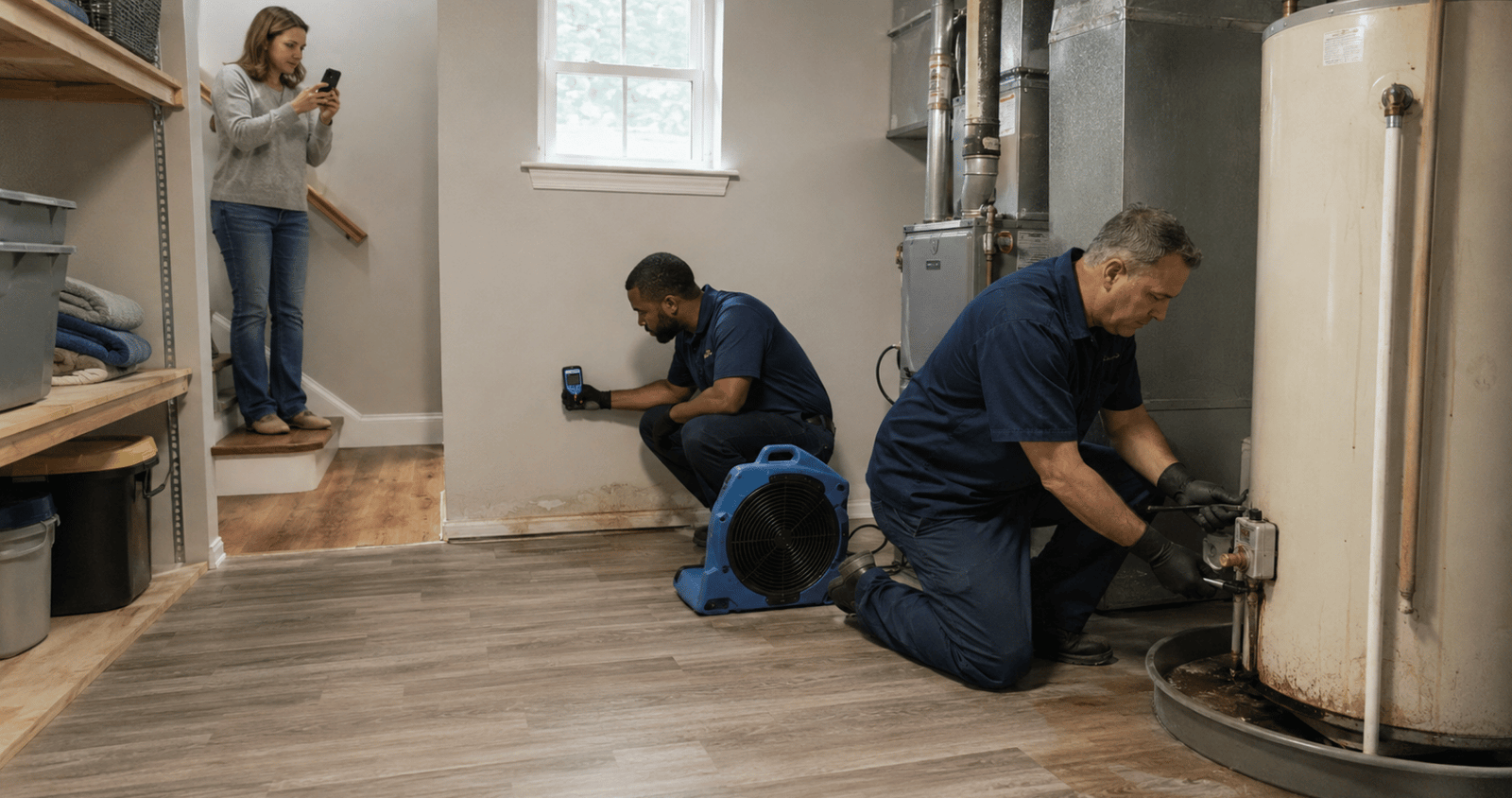
A water heater fails suddenly and floods a finished basement. The resulting water damage to the home is generally a homeowners claim as a sudden accidental event. Replacing the failed water heater itself is not, and that is where a warranty fits.
That third case is the most useful illustration, because a single failure splits across both products. Insurance covers the damage the failure caused. The warranty covers the equipment that failed.
Which is exactly why guidance frequently recommends carrying both rather than choosing.
Warranty Claims Do Not Affect Your Premium
A practical point that removes a common worry.
Home warranty claims do not affect homeowners insurance premiums, because they are completely separate products from different companies.
Which matters because insurance claims do affect premiums, frequently for three to five years, and homeowners are rightly cautious about filing small ones.
A warranty absorbs exactly the category of small recurring costs that would otherwise tempt someone into a marginal insurance claim.
That is arguably the strongest structural argument for a warranty on an older home. It keeps the insurance record clean by handling the things insurance was never meant to cover anyway.
What Insurance Never Covers
Worth restating, since it defines the gap a warranty fills.
Homeowners insurance does not cover damage resulting from routine wear and tear.
A furnace reaching the end of its life, a dishwasher failing from use, an aging water heater, or a worn out appliance are all outside the policy regardless of how much coverage you carry.
No endorsement fixes that, because it is not an exclusion in the ordinary sense. It is a definitional boundary. Insurance responds to events and wear is not an event.
Which is the honest reason home warranties exist as a separate industry rather than as an insurance add on.
Read The Exclusions Before Buying
Warranty contracts contain their own exclusions, and they matter as much as insurance exclusions do.
Categories that commonly appear.
Pre existing conditions, meaning anything already failing when the plan started.
Improper installation or prior repairs, which can void coverage on a specific item.
Lack of maintenance, the same principle insurance applies, requiring you to have serviced the equipment.
Cosmetic damage and items outside the listed system and appliance schedule.
Code upgrades, where bringing a replacement to current code costs more than the plan pays.
Request the full contract rather than a marketing summary, and read the exclusions and the caps together, since those two sections determine what the plan actually delivers.
How To Decide
A short framework.
Insurance is not optional. Lender requirements settle that, and the catastrophic exposure settles it for anyone without one.
For the warranty, count the age of your systems. Heating and cooling, water heater, electrical panel, and major appliances. If several are past seven years, the case strengthens considerably.
Compare the annual cost against your reserve. Roughly seven hundred fifty to one thousand fifty a year plus service fees, against your ability to absorb a four to seven thousand dollar replacement.
Check the caps before the price. A cheap plan with a low HVAC cap is worse than a costlier one that actually covers the system.
Buy while things work, given the thirty day waiting period and pre existing condition exclusions.
The Split In One Line
Insurance covers what happens to your home. A warranty covers what wears out inside it.
Buy the first because you must and because a fire is unrecoverable without it. Consider the second if your systems are aging and a five thousand dollar failure would be a genuine problem rather than an inconvenience.
Then read the caps rather than the price, because a warranty that pays two thousand dollars toward a six thousand dollar system has technically covered the claim and has not solved it.
This article is for general educational purposes and is not insurance or financial advice. Coverage terms, caps, exclusions, service fees, and pricing vary significantly by provider and by plan. Read the full contract before purchasing.
Some images in this article were generated using artificial intelligence and are for illustrative purposes only.