One Policy, Two Different Settlement Rules
Most homeowners believe their policy pays to replace what they lost. Many policies do, and many of them only do it for half of what they cover.
Here is the arrangement that catches people.
Most homeowners policies cover the dwelling itself at replacement cost, meaning the structure gets rebuilt with materials of similar quality regardless of age.
Personal property frequently defaults to actual cash value, meaning your belongings are paid at depreciated value unless you specifically added replacement cost coverage for them.
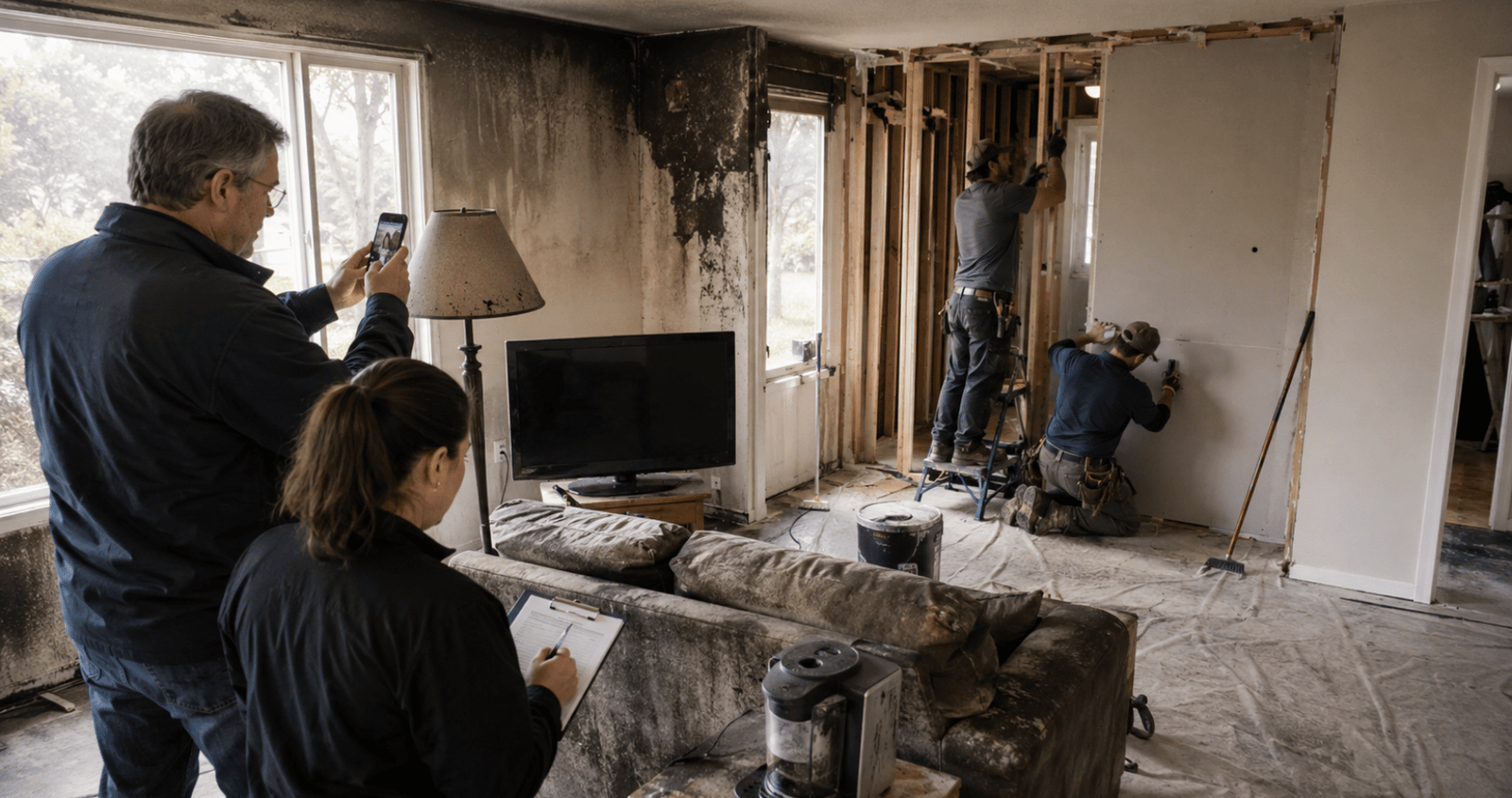
Which produces a strange result after a fire. The house gets rebuilt properly and the contents of it get settled at what a ten year old sofa was worth on the day it burned.
Two settlement rules, one policy, and the words distinguishing them sit on your declarations page next to lines most people never read.
What The Two Terms Actually Mean
Precise definitions, because everything else follows from them.
Replacement cost value pays what it costs to replace or repair the property today, without any deduction for depreciation.
Actual cash value pays replacement cost minus depreciation, meaning the loss in value over time from age and wear.
A worked example makes the gap visible. A television bought ten years ago is destroyed. Replacement cost pays what a comparable new television costs today. Actual cash value pays what a ten year old television was worth, which is a fraction of that.
Apply that same arithmetic across an entire household of furniture, appliances, electronics, and clothing, and the difference is measured in tens of thousands of dollars.
Where Depreciation Bites Hardest
Not evenly distributed, which is why the choice matters more for some households than others.
Electronics depreciate faster than almost anything else you own.
Roofs are the classic problem. A roof approaching the end of its useful life settles at a small fraction of replacement cost under actual cash value, and roof claims are among the most common homeowners claims there are.
Appliances, which lose value quickly and cost more to replace than people remember.
Furniture, where a decade of ordinary use produces substantial depreciation on paper.
Anything with a long useful life and slow depreciation, such as structural elements, suffers less. Anything technological or subject to wear suffers most.
Dwelling Limits Are Not Market Value
The most common and most expensive misunderstanding in home insurance.
Your dwelling limit should be based on the cost to rebuild your home, not on its market value or purchase price.
Those numbers diverge in both directions. In an expensive market, a house may sell for far more than it costs to rebuild, because the land carries much of the value. In a soft market or an area with high construction costs, rebuilding can cost more than the house would sell for.
The rebuild figure is calculated from square footage, construction type, materials, finishes, and local labor and material costs. One simplified method multiplies square footage by an average local cost per square foot, so a two thousand square foot home at one hundred fifty dollars per square foot produces a three hundred thousand dollar figure for the structure.
That is an estimate rather than an appraisal, and it is why insurers use more detailed replacement cost estimators.
If your dwelling limit was set when you bought the house and has only risen with automatic inflation adjustments, it may be well behind current construction costs.
Standard Replacement Cost Has A Ceiling
The limitation people discover at the worst possible time.
Standard replacement cost coverage pays up to one hundred percent of your dwelling limit and no further.
Which sounds sufficient until construction costs move.
Consider a home insured for three hundred thousand dollars under a standard replacement cost policy. It is destroyed, and rebuilding costs three hundred seventy five thousand because local building costs have risen sharply.
The insurer pays the policy limit of three hundred thousand. The remaining seventy five thousand is yours.
That scenario is not hypothetical in regions that have experienced widespread losses, because a single catastrophe drives up demand for materials and labor across an entire area at exactly the moment everyone needs to rebuild.
Two Endorsements That Raise The Ceiling
The fix, and there are two versions with different structures.
Extended replacement cost provides coverage above your dwelling limit, commonly ten to fifty percent more, with figures around twenty percent, one hundred twenty percent of limit, and one hundred twenty five to one hundred fifty percent appearing across different carriers.
Running that against the earlier example, a home insured for three hundred thousand with twenty percent extended replacement cost would receive an additional sixty thousand dollars, bringing the total to three hundred sixty thousand against a three hundred seventy five thousand rebuild.
Better, and still short. Which is why the second option exists.
Guaranteed replacement cost pays the full cost of rebuilding even where it exceeds policy limits, with no specific cap on the additional amount.
Two important caveats on that one. It is more expensive, and it is not available in every state or from every insurer. Some carriers describing coverage as guaranteed still cap it, in one case at twenty percent above insured value, so the label alone is not sufficient.
Ask for the specific terms in writing rather than relying on the name.
What The Extra Coverage Is For
A boundary worth understanding before assuming it solves every problem.
Increased replacement cost coverage is intended to cover increases in the price of construction rather than upgrades.
Which means it responds to a situation where a hurricane devastates your region and the demand for materials and labor rises sharply, driving rebuilding costs above your limit.
It does not fund a better kitchen than the one you had.
That distinction matters when setting expectations. The endorsement protects against cost inflation and post disaster demand surges, not against having underinsured a home you had already improved without telling your insurer.
If you have renovated, tell your carrier. Improvements you never reported are not covered by an endorsement designed for something else.
Older Homes Are A Special Case
A category where standard replacement cost may not be available.
Homes with features that cannot be replicated, or that would be prohibitively expensive to replicate, such as ornate crown molding, plaster detailing, or stained glass, present a problem for a policy promising materials of similar quality.
For these properties, insurers frequently offer modified replacement cost coverage, which pays to repair or rebuild using modern standard materials rather than matching the originals.
Which is honest rather than ideal. A hundred year old home rebuilt to modern standards is a different house.
If you own a historic or architecturally distinctive property, that conversation is worth having before a loss, and specialist carriers exist for exactly this situation.
Upgrade Your Contents Coverage
The single most actionable item in this article.
Personal property frequently defaults to actual cash value, and insurers generally allow policyholders to add replacement cost coverage for contents for an additional premium.
The premium difference is usually modest. The settlement difference is not.
Which makes this among the clearest value decisions available on a homeowners policy, and it applies equally to renters and condo policies where the same default frequently applies.
Check your declarations page for the personal property line. If it says actual cash value, ask what replacement cost would add.
How Contents Claims Actually Settle
Worth knowing so the process does not surprise you.
Even with replacement cost coverage on contents, many policies pay in two stages. An initial payment at actual cash value, followed by the remaining balance once you have actually replaced the items and submitted receipts.
That structure catches people twice. It means you need cash available to bridge the gap immediately after a loss, and it means forgetting to submit replacement receipts forfeits money you were entitled to.
Ask your adjuster how long you have to claim that balance, because there is generally a deadline.
An adjuster will also typically inspect damaged contents and evaluate them against standard replacement costs, which is why an inventory prepared in advance shortens the process considerably.
The Premium Difference Is Real But Small
Honest framing of the trade.
Replacement cost coverage produces a higher premium than actual cash value, because it produces a higher payout.
For most households the difference is modest against the exposure it removes, particularly on contents where depreciation is steepest.
The situations where actual cash value is a defensible choice are narrow. A household with substantial savings that could absorb a shortfall, or a property with contents of genuinely low replacement value.
For everyone else, the reason to carry actual cash value is usually that nobody explained the alternative, rather than a decision anyone made deliberately.
Review The Numbers Annually
The habit that keeps all of this working.
Three things drift over time and none of them announce themselves.
Construction costs, which have risen faster than general inflation in recent years and which determine your rebuild figure.
Your home itself, through renovations, additions, and improvements that raise the cost to rebuild.
Your contents, which accumulate faster than anyone estimates.
Automatic inflation adjustments on a policy help and frequently lag actual construction cost increases.
Once a year, at renewal, check the dwelling limit against a current rebuild estimate and confirm the settlement basis on both dwelling and contents. Ten minutes, and it is the review that determines whether a claim rebuilds your life or partly rebuilds it.
The Five Minute Check
Find the loss settlement terms on your declarations page, for both dwelling and personal property separately.
If contents say actual cash value, ask what replacement cost costs. That single question addresses the largest gap most policies contain.
Compare your dwelling limit against a current rebuild estimate, not against what the house would sell for.
Ask whether extended or guaranteed replacement cost is available, and get the specific percentage or terms in writing.
Tell your insurer about any renovations you have not previously reported.
The words on that page decide whether a total loss returns you to where you were or leaves you funding the difference. They cost a few minutes to read and considerably more to discover afterward.
This article is for general educational purposes and is not insurance advice. Settlement terms, endorsement availability, coverage percentages, and state restrictions vary significantly by insurer. Read your own policy and confirm details with your carrier.
Some images in this article were generated using artificial intelligence and are for illustrative purposes only.