The Salon's Insurance Does Not Cover You
If you rent a chair, this is the sentence worth reading twice. The salon owner's policy protects the salon owner's business. It does not protect yours.
That surprises a lot of stylists, because it feels like working inside someone else's building should come with someone else's coverage. It does not. As a booth renter you are an independent contractor running a small business, and every claim that comes from your work lands on you.
Who This Applies To
Anyone renting space inside a beauty business rather than working as an employee. Hair stylists, barbers, colorists, nail technicians, estheticians, makeup artists, massage therapists.
The test is simple. If you set your own prices, keep your own clients, and pay rent for your space, you are a booth renter. Salon owners have a different set of needs and a different policy.
The Two Coverages That Actually Matter
Almost every claim in this industry falls into one of two buckets, and they need two different policies.
General liability handles accidents around your space. A client trips over your cord. Someone slips on hair you had not swept yet. Hair color stains a client's jacket. These are premises and property claims, and they have nothing to do with your skill.
Professional liability handles your actual work. A chemical service causes a burn. A client has an allergic reaction to a product. A color correction goes badly wrong. This one is sometimes called malpractice or cosmetology liability.
Here is the part people get wrong. General liability does not cover professional claims. If a perm damages someone's scalp, that is a professional liability claim, and a general liability only policy pays nothing.
Both are usually sold together for booth renters, but confirm it rather than assuming.
Three Fine Print Traps
This is where most articles stop and where the real problems start.
Additional Insured Needs An Endorsement
Your salon will almost certainly ask to be named as an additional insured. Many stylists send over a certificate of insurance and consider it handled.
A certificate is not an endorsement. The certificate simply proves a policy exists. Additional insured status requires a specific endorsement added to the policy itself.
If your lease requires additional insured status and you only sent a certificate, you are technically out of compliance and your salon has no protection under your policy. Ask your insurer to add the endorsement and send that document too.
Shared Aggregate Limits
Some cheaper policies, particularly ones bundled with membership organizations, use a shared master aggregate. That means your coverage limit is pooled with every other member on the policy.
If a bad year drains the pool, your limit can be gone before your claim arrives.
Look for language confirming your aggregate is per individual, per year. If a policy is unusually cheap, this is often why.
Occurrence Form Versus Claims Made
An occurrence policy covers incidents that happen during your policy period, even if the client sues you two years later after you switched insurers.
A claims made policy only covers claims filed while the policy is active. Let it lapse or switch carriers and old incidents can become uncovered.
Beauty work produces delayed claims regularly. Chemical damage and allergic reactions do not always surface the same week. Occurrence coverage is generally the safer structure for this industry.
What It Costs
Booth renter policies are inexpensive relative to almost any other business coverage. Published rates commonly fall somewhere between about ten and forty five dollars a month, with many annual policies landing in the low hundreds.
Typical limits sit around one to two million per occurrence with a two to three million annual aggregate. Most salon leases require at least one million per occurrence.
The spread in pricing usually comes down to three things. Whether professional liability is genuinely included, whether the aggregate is shared, and whether tools and equipment coverage is bundled or sold separately.
What About Your Tools
Your shears, clippers, and kit are not covered by liability insurance. Liability pays other people. Your own property needs business personal property coverage, sometimes sold as a tools and equipment add on.
For a stylist carrying a few thousand dollars of shears, this is worth the small additional premium. Check whether your existing renters or homeowners policy excludes business property, because most of them do.
Before You Sign The Lease
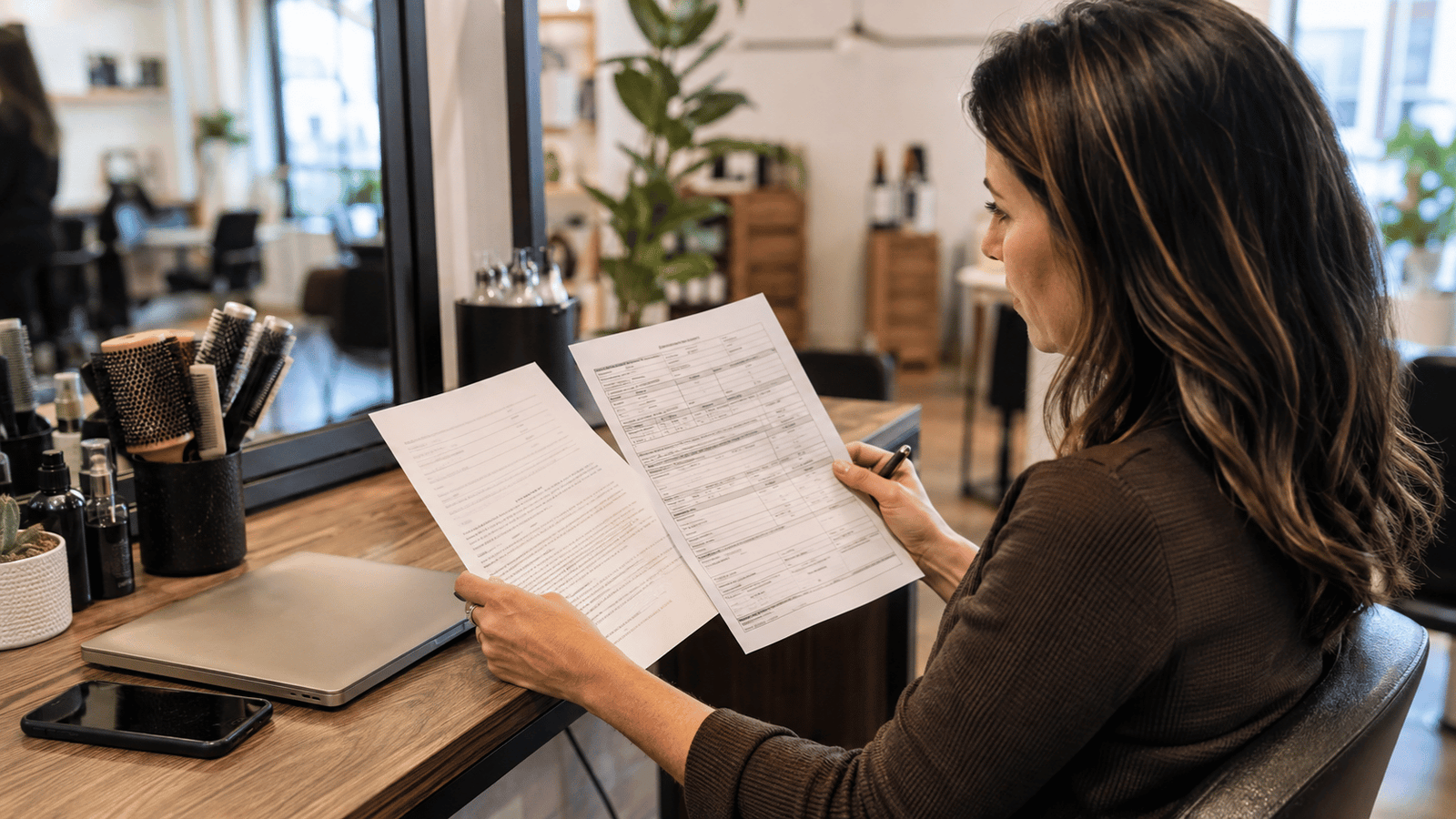
Read the insurance clause in your booth rental agreement first, then buy the policy that matches it. Not the other way around.
Check three things on any quote. Is professional liability actually included. Is the aggregate limit yours alone. Is it occurrence form. Those three answers separate a policy that works from one that only looks like it does.
This article is for general educational purposes and is not a substitute for reviewing your actual policy documents or your booth rental agreement. Coverage terms, limits, and requirements vary by insurer and by state.
Some images in this article were generated using artificial intelligence and are for illustrative purposes only.