Three Different Answers Depending On Who Owns The Laptop
Remote work moved millions of people into home offices without anyone reviewing their insurance.
The result is a gap most renters do not know they have, and the answer to whether your setup is covered depends entirely on one question. Who owns the equipment, and what are you using it for.
There are three cases and they produce three completely different outcomes.
Case One, Your Employer Owns It
If your employer issued the laptop, the monitor, and the docking station, your renters insurance will not cover them.
Renters policies protect your personal property. Equipment belonging to a business entity is not your personal property, which puts it outside the policy regardless of the fact that it sits in your apartment and you use it daily.
That equipment needs to be covered under your employer's commercial insurance.
What to actually do about it. Ask your employer directly whether their policy covers company equipment at employee residences, and what happens if it is stolen or damaged at your home. Get the answer in writing if you can.
Many employers do carry this. Some do not, and expect the employee to absorb the loss. Finding out before a break in is considerably better than after.
If your employer will not cover it, that is a conversation about a stipend or a written agreement rather than something your renters policy can solve.
Case Two, You Own It And You Are An Employee
If the laptop is yours and you use it for work as an employee, it is generally covered as personal property, subject to your policy's limits.
This is the most common situation and the most reassuring one. A personally owned laptop, monitor, and desk used by a salaried remote employee sit inside ordinary personal property coverage.
Two limits still apply.
Electronics sublimits, which vary by carrier and can be lower than people expect.
Your deductible, which on a single stolen laptop often eliminates the claim entirely.
The complication arrives when the line between employment and business blurs, which brings us to the third case.
Case Three, You Own It And It Is Your Business
If you are self employed, freelancing, contracting, or running any business from your rental, standard renters insurance generally does not cover business related losses, for property or liability.
This is the case that catches people, because the equipment looks identical. Same laptop, same desk, same apartment. What changed is the purpose, and insurers care about purpose.
The fix is a business property endorsement, sometimes called a home business rider.
One rough threshold worth knowing. If you earn more than a couple thousand dollars a year from work done at home, it is worth asking your insurer how they classify your situation rather than assuming employee status protects you.
The Default Limit Is Smaller Than Your Setup
Here is the number at the center of this.
Many renters and homeowners policies limit office equipment replacement to around two thousand five hundred dollars.
Now price a modern home office. A decent laptop, an external monitor or two, a docking station, a keyboard and mouse, a webcam, a microphone, a chair, and a standing desk. Twenty five hundred dollars goes quickly, and that is before anyone owns a camera or specialized tools.
There is a second reduction people rarely notice. Coverage for business equipment stolen or damaged while traveling can drop to as little as five hundred dollars.
If you take a work laptop to a coffee shop, an airport, or a client site, that is the figure that applies.
The Fix Costs About Twenty Five Dollars
This is the most actionable sentence in the article.
The Insurance Information Institute reports that for less than twenty five dollars in premiums, you could likely increase your business property coverage to five thousand dollars.
Some carriers allow business property limits up to ten thousand.
Twenty five dollars a year, to double the limit on the equipment you earn a living with. That ratio is better than almost anything else available on a renters policy.
Ask for it by name as a business property endorsement, and ask what the resulting limit would be both at home and away from home.
The Liability Gap Is Larger Than The Property Gap
Property is the part people think about. Liability is the part that can actually hurt.
Standard policies contain a business pursuits exclusion. If you regularly meet clients or customers at home and someone is injured during a business visit, that claim may fall outside your liability coverage entirely.
Picture a client tripping on a cable in your home office. In a personal context that is a straightforward liability claim. In a business context it may be excluded, and personal injury claims routinely reach five figures.
Two questions decide whether this applies to you.
Do clients, customers, students, or vendors come to your apartment? Photography clients, music students, therapy clients, tutoring, personal training, product pickups.
Do you have business related visitors of any kind? Including couriers arriving specifically for business purposes.
If the answer to either is yes, a business property endorsement does not solve it. That is a liability question, and it generally needs general liability coverage, which covers customer injuries on your property, damage to a customer's property, and advertising injuries.
Downtime Is Not Covered Either
A third gap, and the one self employed renters feel most.
If a fire or a burst pipe destroys your home office, your renters policy may replace the equipment. It does nothing about the income you lose while you cannot work.
Business income coverage handles that, and it sits in commercial territory rather than on a personal policy.
For someone whose entire income runs through a home office, that gap is worth pricing. For an employee who would simply work from a library for a week, it is not.
The Structure Trap
Worth naming because it catches people who did everything else right.
If you purchased equipment under an LLC or a business name, that equipment belongs to a business entity. It is business property on a personal policy regardless of how you use it, exactly like an employer owned laptop.
The same logic applies to anything expensed through a business for tax purposes.
If you formalized a side business and bought a camera or a computer through it, check how your insurer treats that specific equipment. The answer may not match what you assumed when you set the business up.
Four Questions For Your Insurer
Call and ask these directly. The answers take five minutes and they settle the whole subject.
How do you classify my situation? Employee working remotely, or home based business. Their answer, not your assumption, determines everything.
What is my business property limit, at home and away from home? Both figures, since the away from home number is often much lower.
Is employer owned equipment covered at all? Almost certainly not, but confirm so you know to raise it with your employer.
Am I covered if a business visitor is injured here? If you host anyone for work purposes, this is the question that matters most.
Write the answers down. If any of them surprise you, that is where the money should go.
Documenting A Home Office Properly
Business equipment claims get scrutinized more closely than ordinary personal property claims, which makes documentation matter more here than elsewhere.
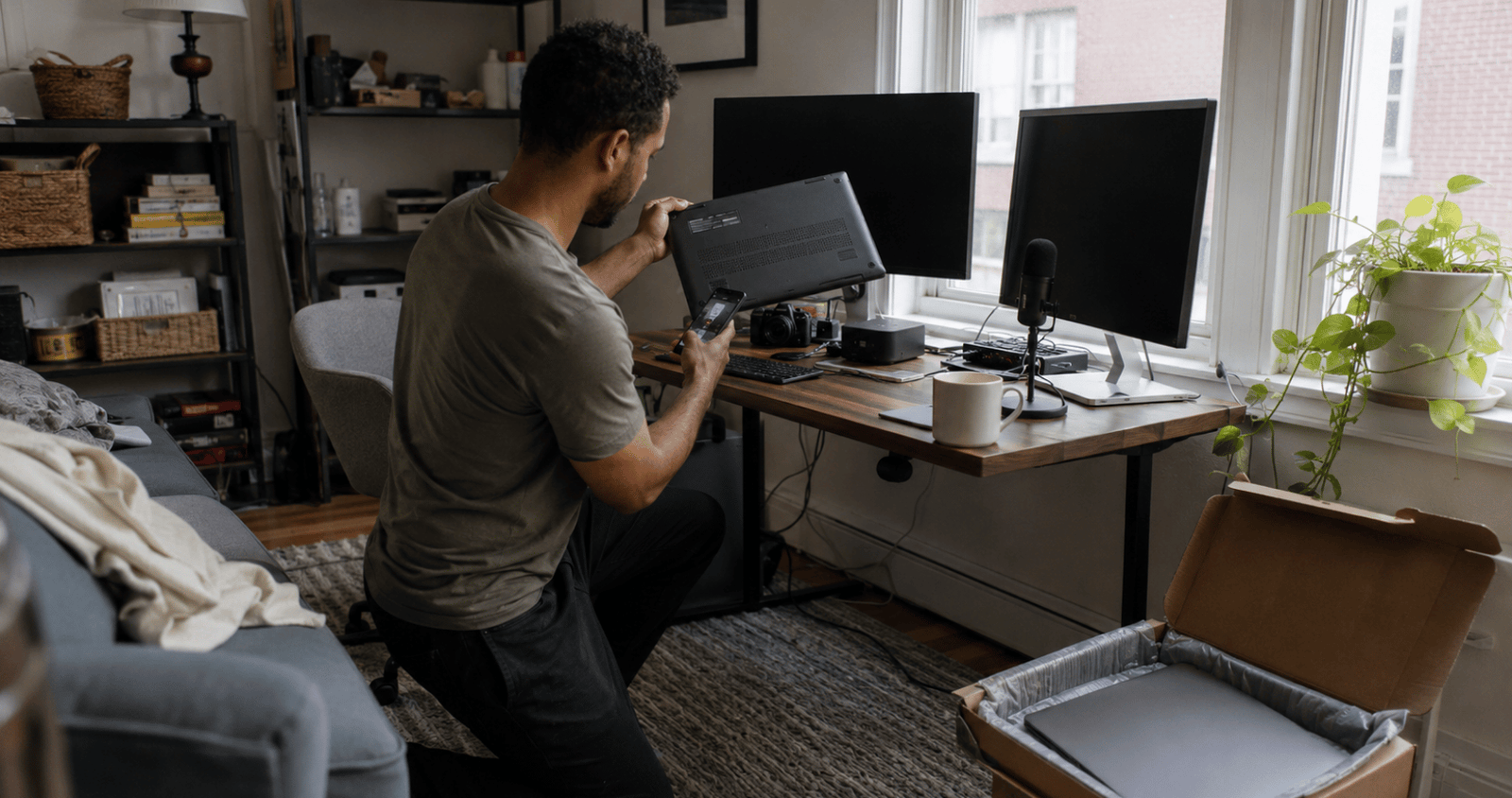
Photograph the setup as a whole and each item individually. A wide shot establishes the office exists. Close shots establish what is in it.
Capture serial numbers. On laptops these sit on the underside, on monitors on a rear panel label, and on docking stations and peripherals on a base label. Photograph the label rather than typing the number.
Keep purchase records separately from the equipment. If the receipts live only in an email account you access from the stolen laptop, you will spend a bad afternoon.
Record which items are personal and which are employer issued. This is the field nobody thinks to note and the first thing an adjuster will ask. A simple two column list resolves it.
Update it when the setup changes. Home offices accumulate quietly, and a monitor added last spring is easy to forget when reconstructing a loss.
Store all of it in cloud storage. The same advice applies here as everywhere else, with one added reason. If a claim turns on whether equipment was business or personal, contemporaneous records carry far more weight than a description offered after the fact.
Two Things Worth Doing Regardless
Choose replacement cost over actual cash value if you have not. Home office equipment depreciates quickly, and a three year old laptop settles for a fraction of what replacing it costs. The premium difference is usually small and this is the category where it bites hardest.
Consider a surge protector rather than a power strip. Much of a home office runs on the same circuit, which means a single electrical event can take out several items at once. Standard policies handle surges inconsistently, so prevention is worth more here than coverage arguments.
What Each Situation Actually Needs
A short sort.
Salaried employee, personally owned gear, no visitors. Your standard policy likely covers you. Check your electronics sublimit and consider replacement cost over actual cash value.
Salaried employee, employer owned gear. Talk to your employer, not your insurer.
Freelancer or contractor, no clients visiting. A business property endorsement handles the equipment gap for a modest premium.
Home business with clients or students visiting. You need liability coverage beyond a personal policy, and probably a proper in home business policy or business owner's policy.
Business with meaningful equipment and income dependency. A business owner's policy bundling property, liability, and business income is the appropriate product.
Most remote workers fall in the first category and are fine. The trouble comes from people in the third and fourth categories who assume they are in the first.
A Note On Taxes
Worth mentioning and then handing off.
If you use part of your rental exclusively as a home office and you qualify for the home office deduction, a portion of your renters insurance premium may be deductible. The simplified method carries its own cap.
What constitutes a qualifying home office is defined narrowly, and running a business from home does not automatically qualify you.
This is genuinely tax advice territory rather than insurance advice, so the useful move is to raise it with whoever prepares your return rather than acting on an article.
The Five Minute Version
Three questions decide everything.
Who owns the equipment. Are you an employee or running a business. Does anyone come to your apartment for work.
If you own your gear, work as an employee, and nobody visits, you are probably fine and should just check your electronics sublimit.
If any of those answers differ, one phone call sorts it. Ask about a business property endorsement, which is inexpensive, and about business visitor liability, which is the gap that actually threatens your finances.
The home office arrived faster than most people's insurance did. Catching up costs about the price of a decent keyboard.
This article is for general educational purposes and is not insurance, legal, or tax advice. Classification of business activity, sublimits, endorsement availability, and exclusions vary by insurer and by state. Confirm your specific situation with your carrier, and consult a tax professional regarding any deduction.
Some images in this article were generated using artificial intelligence and are for illustrative purposes only.