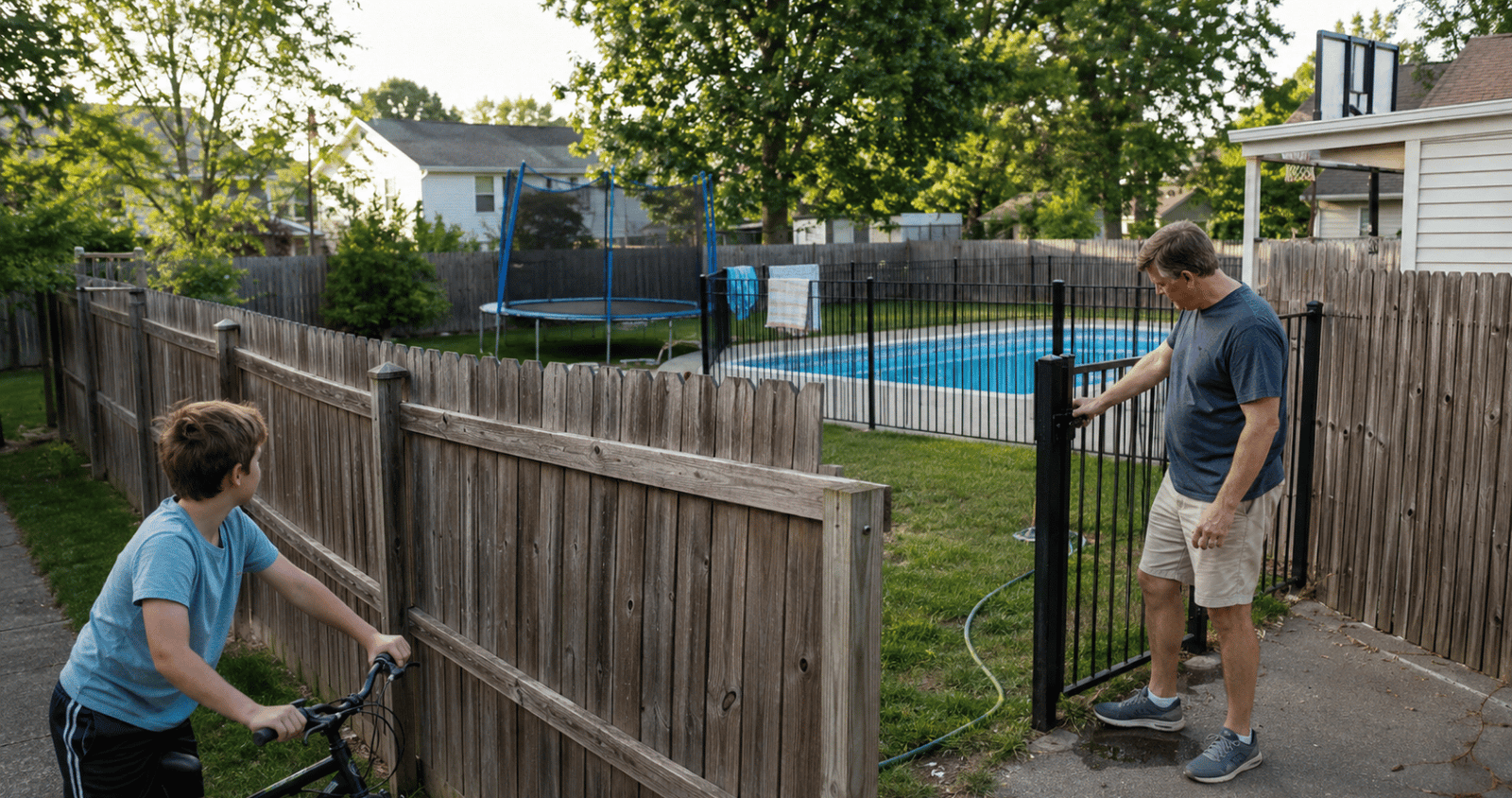
Permission Is Not The Test Here
Most liability thinking starts from a reasonable assumption. You are responsible for people you allowed onto your property.
Backyard features break that assumption, through a legal principle recognized across most US jurisdictions called attractive nuisance.
Under the doctrine, a property owner may be held liable for injuries to a trespassing child where a dangerous condition was one the child was unlikely to recognize as hazardous.
Which means a pool, a trampoline, a treehouse, or playground equipment can create liability for injuries to a child who entered without permission and without anyone knowing.
That is the mechanism, and it explains why three ordinary backyard items generate more underwriting attention than almost anything else on a home insurance application.
What Counts
Broader than most homeowners assume.
Commonly cited examples include swimming pools, trampolines, treehouses, playground equipment, abandoned vehicles, unsecured construction materials or equipment, and open wells or ponds.
The common thread is a man made feature or condition that may draw children in while posing a safety risk they cannot fully evaluate.
Two implications follow.
Temporary conditions count. A renovation project with materials and tools left accessible is an attractive nuisance while it lasts.
Above ground features count. A portable pool or a trampoline is not exempt because it can be moved.
Coverage Exists, With Conditions Attached
The reassuring part, followed by the important qualification.
Most standard homeowners policies include personal liability coverage that can respond when someone is injured on your property, including a child drawn in by an attractive nuisance.
The qualification is that insurers expect you to exercise a reasonable duty of care, meaning securing or eliminating known hazards, particularly those posing a risk to children.
Where a homeowner failed to take reasonable precautions, an insurer may reduce or deny coverage.
Which means the coverage is conditional on behavior rather than automatic. Fencing a pool, netting a trampoline, and securing tools are not merely good practice. They are what keeps the policy responsive.
Pools Draw The Most Scrutiny
The single most significant liability item most families add to a property.
Carriers respond to that risk in specific and predictable ways.
Fencing requirements. Most insurers want a fence with a self latching and self closing gate around any in ground or permanent above ground pool, and some require it as a condition of binding coverage.
Diving boards and slides raise flags, and some carriers will decline or surcharge a property with them.
Higher liability limits, frequently requested or required.
Premium increases, reflecting the added exposure.
None of that is unreasonable given that courts treat the doctrine seriously, holding owners responsible for keeping children safe whether or not permission was given.
Before installing a pool, call your insurer rather than after. The requirements are cheaper to meet at construction than to retrofit.
Trampolines Are Frequently Excluded Outright
A harder line than pools receive at many carriers.
Some insurers specifically exclude trampoline related incidents from their policies because of the risk profile.
Others cover them subject to conditions, commonly requiring safety netting, padding, and a fenced yard.
Which produces a critical question worth asking before buying one. Does my policy cover trampoline liability at all, and under what conditions.
Consider the arithmetic if it does not. A child from an adjacent property enters through an unlocked gate and suffers a fracture. Without a trampoline exclusion, personal liability applies subject to the per occurrence limit, commonly one hundred thousand or three hundred thousand dollars. Where a settlement or judgment exceeds that, the homeowner bears the excess personally.
Where a trampoline exclusion does exist, there is no coverage at all for that incident.
The Umbrella Trap
The most important paragraph in this article and the one homeowners most frequently overlook.
Umbrella policies follow the form of the underlying homeowners policy. Which means if the underlying policy excludes trampoline liability, the umbrella typically excludes it as well.
Read that carefully, because it reverses a common assumption.
An umbrella is not a patch over a hole in your primary policy. It is an additional layer sitting above coverage that already exists. Where the primary policy provides nothing for an incident, the umbrella generally provides nothing either.
The same logic applies to dog breeds. An umbrella sitting above a homeowners policy that excludes your dog's breed may not respond to a bite claim.
Which produces the correct sequence. Confirm the primary policy covers the exposure first, then add an umbrella above it. Buying the umbrella first solves nothing.
Dogs, And The Breed Lists
The third feature drawing underwriting attention, and treatment varies enormously between carriers.
Home insurance generally covers dog bites under the personal liability section of a homeowners, condo, or renters policy.
Restricted breed lists complicate that. Commonly listed breeds include pit bulls, rottweilers, German shepherds, Doberman pinschers, akitas, chow chows, wolf hybrids, Alaskan malamutes, Siberian huskies, and Great Danes, with each carrier maintaining its own list.
Three carrier approaches exist.
Exclude coverage entirely for bites from restricted breeds.
Cover with a surcharge.
Apply no breed restrictions at all, which some carriers do.
That third category is the reason a decline from one insurer means very little. An independent agent will know which carriers are comfortable with which breeds.
Your State Law Changes The Exposure
A legal detail that determines how much protection you actually need.
Some states follow a one bite rule, under which an owner is liable only where they knew the dog was dangerous.
Others impose strict liability, meaning the owner is liable for any bite regardless of the dog's history.
In a strict liability state, a dog with no history and no aggression can produce a claim from a single incident, and the owner's knowledge is irrelevant.
Look up which applies where you live, because it changes both your exposure and the case for higher limits.
Disclosure Is Not Optional
The mistake that converts a covered claim into no claim at all.
Hiding a pool, a trampoline, or a dog breed from your insurer is misrepresentation. Where it is discovered during a claim, the carrier can deny the claim entirely.
Which turns a bad afternoon into a catastrophe. The exposure was always there, and the concealment removed the coverage that would have addressed it.
Two practical points.
Tell your insurer when anything changes. A new dog, a new trampoline, a pool installed last summer.
Ask what conditions apply, because they frequently come with requirements you can meet easily if you know about them.
An insurer who declines to cover a trampoline has told you something useful. An insurer who does not know about it has told you nothing, and you have coverage that may not respond.
Raise Your Limits
The straightforward recommendation.
Three hundred thousand dollars is the standard minimum on a homeowners policy. Guidance for homes with any of these features suggests carrying at least five hundred thousand.
The reasoning is arithmetic. Injury claims involving children, permanent injury, or extended medical treatment pass three hundred thousand dollars without difficulty, and anything above your limit comes from your own assets.
Liability is among the cheapest coverage on a homeowners policy, and raising the limit typically costs far less than homeowners expect.
That is the first step, and it should come before the umbrella conversation rather than instead of it.
Then Add An Umbrella
The second layer, once the primary coverage is confirmed and adequate.
An umbrella sits above your home and auto liability and provides an additional layer, typically starting at one million dollars, that responds once the underlying limits are exhausted.
Cost figures commonly cited put a first million at roughly two hundred to four hundred dollars a year, with sources describing it as a few hundred dollars annually for most families.
Guidance identifies pools, trampolines, guns, and dogs as among the strongest reasons to carry one, alongside situations including hosting parties frequently, having an inexperienced driver in the household, coaching youth sports, serving on a nonprofit board, and being a landlord.
Two conditions to confirm before relying on it.
The underlying policy must cover the exposure, for the reasons above.
You must maintain the required underlying limits, since dropping them later can void umbrella claims.
What It Will Not Do
Boundaries worth knowing so expectations stay accurate.
It covers damage to other people's property, not your own. If a windstorm launches your trampoline into your own siding, that is a dwelling coverage question rather than a liability one.
It does not replace the primary policy, and it does not fill gaps the primary policy leaves.
It does not cover intentional acts, as no liability policy does.
Note also that damage to the feature itself sits under different coverages. A trampoline destroyed by a covered peril such as windstorm or vandalism may be paid under personal property coverage, and if it strikes a fence or shed, other structures coverage may respond.
The Safety Measures That Protect Coverage
Practical steps that reduce both risk and the chance of a denied claim.
Fence the pool with a self latching, self closing gate, and consider a pool alarm or cover.
Net and pad the trampoline, place it on level ground away from structures, and fence the yard.
Secure construction materials and tools during any project.
Cover or fence open wells and ponds.
Train the dog, secure the gate, and post a sign, and never let a dog greet unfamiliar visitors at an open door unsupervised.
Supervise, which sounds obvious and is the factor courts and insurers examine most closely.
Document what you have done. Photographs of fencing, gates, and netting support both an underwriting submission and a claim.
Shop With Someone Who Knows The Market
The practical route through all of this.
Carrier stances on pools, trampolines, and dogs vary enormously, and an independent agent knows which carriers are comfortable with which features.
Which means a homeowner told their trampoline is uninsurable has usually been told that by one carrier rather than by the market.
Two things to bring to that conversation. An honest list of every feature on the property, and photographs of the safety measures in place.
Four Things To Do Before Summer
Tell your insurer about every feature, including anything added since your last renewal.
Ask two specific questions. Is this covered, and what conditions apply.
Meet the conditions and photograph them, including fencing, gates, netting, and locks.
Raise your liability limit and price an umbrella, in that order, after confirming the primary policy responds.
A backyard that draws neighborhood children is a good thing. The insurance version of that is a set of features carriers price carefully and sometimes decline, and the homeowners who get caught are almost always the ones who never mentioned them.
This article is for general educational purposes and is not insurance or legal advice. Coverage terms, breed restrictions, trampoline treatment, safety requirements, and liability standards vary significantly by insurer and by state. Confirm your specific situation with your carrier or agent.
Some images in this article were generated using artificial intelligence and are for illustrative purposes only.