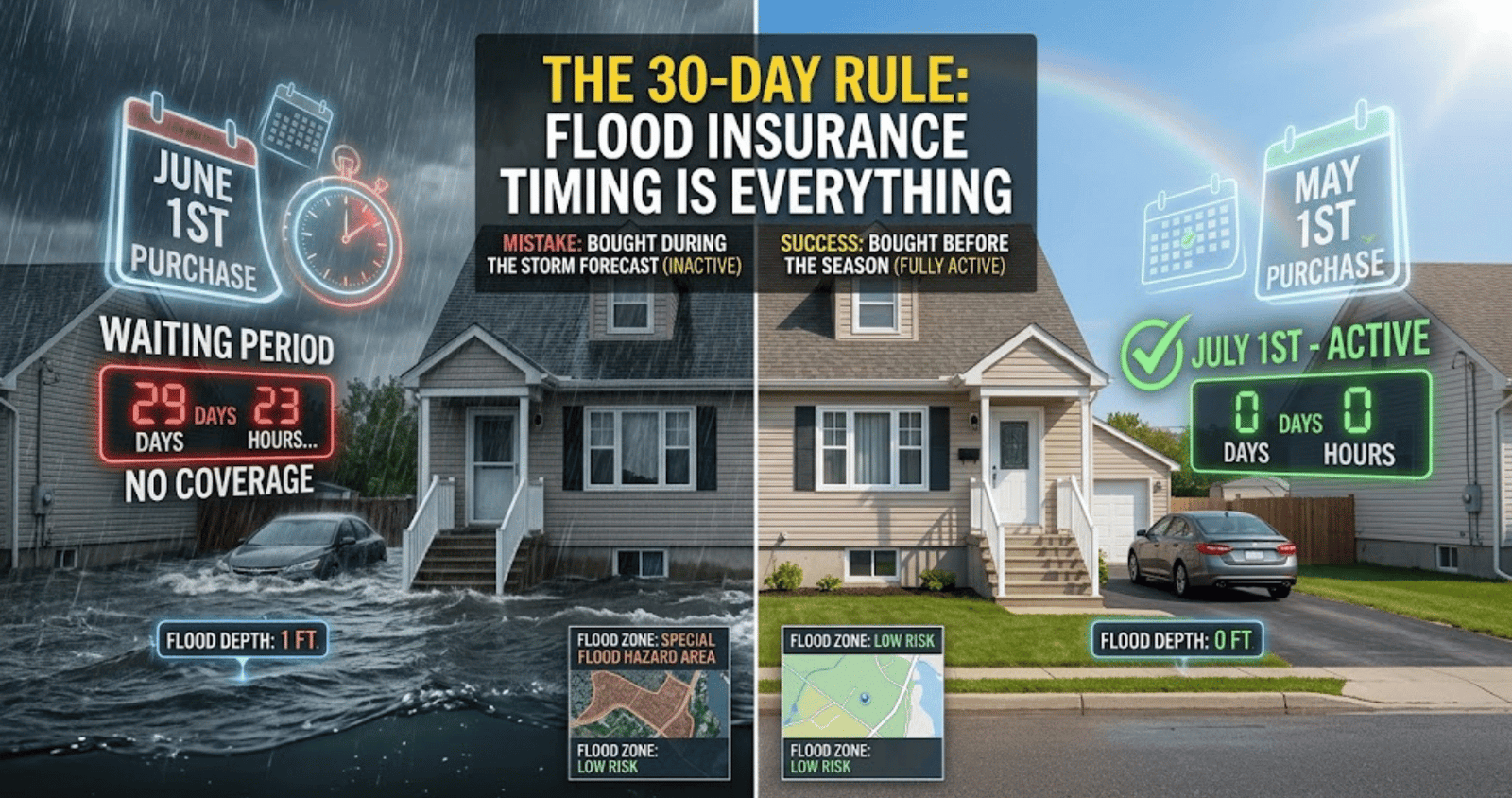
The Thirty Day Rule Is The Whole Problem
Most flood insurance mistakes come from one misunderstanding, and it is a matter of timing rather than coverage.
A new federal flood policy carries a standard thirty day waiting period before it takes effect.
Which means a policy bought when a storm appears in the forecast covers nothing for that storm. A policy purchased on June first begins coverage on July first.
That is the single most expensive misunderstanding in flood preparedness, and it converts flood insurance from a seasonal purchase into a year round obligation.
Narrow exceptions exist, most notably when coverage is purchased as part of a new mortgage closing, where the waiting period is waived.
Everything else in this article matters. That deadline is the part that decides whether any of it applies to you.
Flood Is Excluded Everywhere
The starting point, stated plainly.
Standard homeowners insurance excludes flood damage, and flood coverage is a separate policy rather than an endorsement in most cases.
The definition matters too. Insurance defines a flood narrowly as surface water covering normally dry land, generally affecting two or more properties or at least an acre.
Which is why water entering through a wind damaged roof is a homeowners claim and water rising from outside is a flood claim, and why the distinction between them is the most contested question after any storm.
Flood Zones Are A Weak Signal
The statistic that should end the most common objection.
Roughly one quarter of all flood claims come from outside high risk zones, and one analysis of federal claims across a recent decade found nearly one third originating outside current high risk areas.
Which means the low risk designation on a map is a description of historical modeling rather than a promise about the next storm.
Coverage is mandatory only where a property sits in a designated special flood hazard area and carries a federally backed mortgage. Everyone else can buy it, and a meaningful share of everyone else eventually needs it.
Check your own address on the federal flood map service, and treat a favorable zone as one input rather than an answer.
What The Federal Program Caps
The limits, which are lower than many homeowners assume.
Building coverage caps at two hundred fifty thousand dollars for residential property.
Contents coverage caps at one hundred thousand dollars.
Contents are paid at actual cash value, meaning depreciation reduces the settlement.
Three things are excluded outright.
Temporary living expenses, meaning no hotel or meal costs while your home is repaired.
Finished basement improvements, including walls and flooring.
Business interruption.
That contents valuation point deserves emphasis. A household of furniture, appliances, and electronics settled at depreciated value produces a very different number than replacing them, which is the same gap that appears elsewhere in property insurance and which private policies frequently close.
Basements Are Treated Harshly
The exclusion that catches people with below grade space.
Federal flood coverage strictly limits what it covers in basements to certain building items such as furnaces, water heaters, and electrical panels.
Finished basement improvements and the contents stored there are not covered.
Which means a finished basement flooded to a depth of a few inches produces a claim covering the furnace and not the flooring, the walls, or anything in the room.
Sewer backup receives similar treatment. Federal flood coverage responds to backup damage only where flooding directly caused it, which leaves ordinary drain and sump failures outside the policy entirely. That gap is closed by a water backup endorsement on your homeowners policy rather than by flood insurance.
Anyone with a finished basement should read the next section carefully, because this is where private coverage differs most.
How Federal Pricing Works Now
A change fully phased in and worth understanding.
Pricing is now set through a property specific methodology rather than by flood zone alone, using distance to water, elevation relative to flood levels, rebuild cost, and historical flood frequency in the area.
Two consequences.
Two neighboring homes can price very differently, because elevation and distance to water differ even across a short distance.
Some premiums fell and others rose when the methodology changed, and increases are capped at a maximum of eighteen percent annually until a property reaches its full risk based rate.
Which means a property still climbing toward its risk based rate will continue rising at renewal even with no claims and no changes.
Published figures put the full risk based average around one thousand eight hundred eight dollars a year, with state averages varying considerably.
One further point worth knowing. Every federal policy with identical property characteristics costs the same regardless of which agent or company sells it. There is no shopping the federal program on price.
Where Private Coverage Wins
Five genuine advantages, and they cluster around the federal limits.
Higher limits. Private carriers routinely write building limits of five hundred thousand dollars, one million, or considerably more for high value properties.
Replacement cost on contents, rather than depreciated value.
Additional living expenses, covering hotel and meal costs during repairs, which the federal program omits entirely.
Better basement treatment, including finished improvements and belongings stored below grade at many carriers.
Shorter waiting periods, commonly ten to fourteen days rather than thirty, with immediate coverage available in narrow circumstances such as a mortgage closing.
Private pricing can also be lower for properties with favorable characteristics such as higher elevation or greater distance from water, because private carriers use proprietary models rather than a standardized methodology.
Where The Federal Program Wins
The counterweight, and it is more significant than a price comparison suggests.
As a federal program, it cannot non renew you for being a bad risk or for filing claims.
Private carriers can, and in hardening markets some have pulled back.
Which means for a property you intend to hold through a long mortgage in a genuinely high risk location, guaranteed availability has real value that a lower premium does not replace.
Properties with higher flood exposure also frequently find the federal program more affordable, since private models price those risks aggressively or decline them.
The practical result is that the right answer depends heavily on your property. Favorable characteristics point toward private. High exposure points toward federal.
Reauthorization Is A Live Issue
Context worth knowing rather than worrying about.
The federal program operates under authorization that Congress extends periodically, and it has run on a long series of short term extensions with several lapses in recent years, including a stretch during a government shutdown when new policies could not be issued.
When the program lapses, new policies cannot be written, and home sales in high risk zones stall because lenders require coverage to close.
Two implications.
Do not leave a purchase to the last minute if a closing depends on it.
A homeowner relying entirely on the federal program carries exposure to that uncertainty in a way a private policyholder does not.
None of that argues against federal coverage, which continues to operate and to pay claims. It argues for not assuming the program's availability is unconditional when timing a purchase.
Many Homeowners Carry Both
A structure that is becoming more common and solves several problems at once.
The approach is to hold a federal policy for the base amount and add a private policy on top for coverage above the federal caps.
That combination captures the guaranteed availability of the federal program while addressing the limits, the contents valuation, and the living expenses gap.
It suits higher value homes particularly, where two hundred fifty thousand dollars of building coverage is well short of the rebuild cost.
Ask a broker who writes both about how the two layer together, since the coordination matters and the excess layer needs to be structured correctly to sit above the primary one.
Renters Need This Too
An option frequently overlooked, and it is inexpensive.
Renters can purchase flood coverage for contents only, without any building portion, which makes it considerably cheaper than a homeowner policy.
The same exclusions apply, including the treatment of basement contents and the depreciated valuation on the federal side.
Anyone renting a ground floor or below grade unit in an area with any flood exposure should price it, because a standard renters policy excludes flood exactly as a homeowners policy does.
Timing It Properly
The practical instruction that follows from the waiting period.
Work backward from your region's risk season rather than forward from today.
For hurricane exposed areas, a policy must be purchased by roughly the end of April to be active when the season opens on June first. For regions where spring snowmelt drives flooding, the equivalent deadline falls in winter.
Which means the sensible purchase window is the quietest part of the year, when nobody is thinking about it.
Two habits help. Set a calendar reminder aligned to your local season, and if you are currently uninsured, buy now rather than at the reminder, because the thirty days start when the policy does.
Comparing Policies Properly
Six questions that produce a genuine comparison.
What are the building and contents limits, and do they match your rebuild cost and contents value?
Is contents coverage replacement cost or actual cash value?
Are additional living expenses included?
How are basement improvements and below grade contents treated?
What is the waiting period?
Can the carrier non renew me, and under what circumstances?
Price is the seventh question rather than the first. Two policies at similar premiums can differ enormously on those six points, and the differences only surface at claim time.
Four Things To Do
Check your address on the federal flood map service, and treat the result as information rather than a verdict.
Get both a federal and a private quote, since the federal price is fixed across sellers and private pricing varies by property.
Compare the six coverage questions above before comparing premiums.
Buy well before your season, because thirty days is the number that decides whether any of this protects you.
Flood is the most commonly excluded peril in home insurance and the most commonly experienced disaster in the country. The gap between those two facts is filled by a policy that has to be bought while nothing is happening.
This article is for general educational purposes and is not insurance advice. Coverage limits, waiting periods, basement treatment, pricing methodology, and program authorization vary and change over time. Confirm current details with an agent and the federal flood program.
Some images in this article were generated using artificial intelligence and are for illustrative purposes only.