One Metro, Two Insurance Regulators
Kansas City is the only major market in this series where crossing a street changes which state regulates your policy.
State Line Road runs through the middle of the metro. Renters in Westport, Brookside, and the River Market sit under Missouri regulation. Renters in Overland Park, Prairie Village, and Mission sit under Kansas regulation.
Same weather, same commute, two different regulatory environments and two different sets of tenant rules.
For most day to day purposes the coverage looks identical. Where it matters is pricing pressure, and Missouri has a rule that Kansas does not.
The Missouri Pricing Rule
This is worth understanding if you rent on the Missouri side.
Missouri regulation requires carriers to price policies on in state claims history rather than national catastrophe averages. The Missouri Department of Commerce and Insurance has stated that the state does not allow insurers to base Missouri rates on losses in other states.
That cuts both ways. A quiet year in Missouri does not import rate increases from hurricane states. A bad Missouri storm year lands directly in the following year's renewals, statewide, regardless of which carrier wrote the policy.
And 2025 was a bad year. Missouri logged more than one hundred seventy three thousand homeowners insurance claims totaling roughly one point six billion dollars, the largest annual total the state had recorded in several years, with wind and hail driving most of it.
Renters have not felt that as sharply as property owners, since you are insuring contents rather than a roof. But it explains why quotes on the Missouri side have been moving.
Storm Season Is The Whole Story Here
The Kansas City metro sits in the heart of severe convective storm territory, and the numbers are substantial.
Missouri averages around thirty tornadoes a year. Kansas averages roughly ninety six.
In 2025, storm damage insurance claims in Kansas alone surpassed eight hundred million dollars, with the Kansas City metro accounting for one hundred twenty eight million of that.
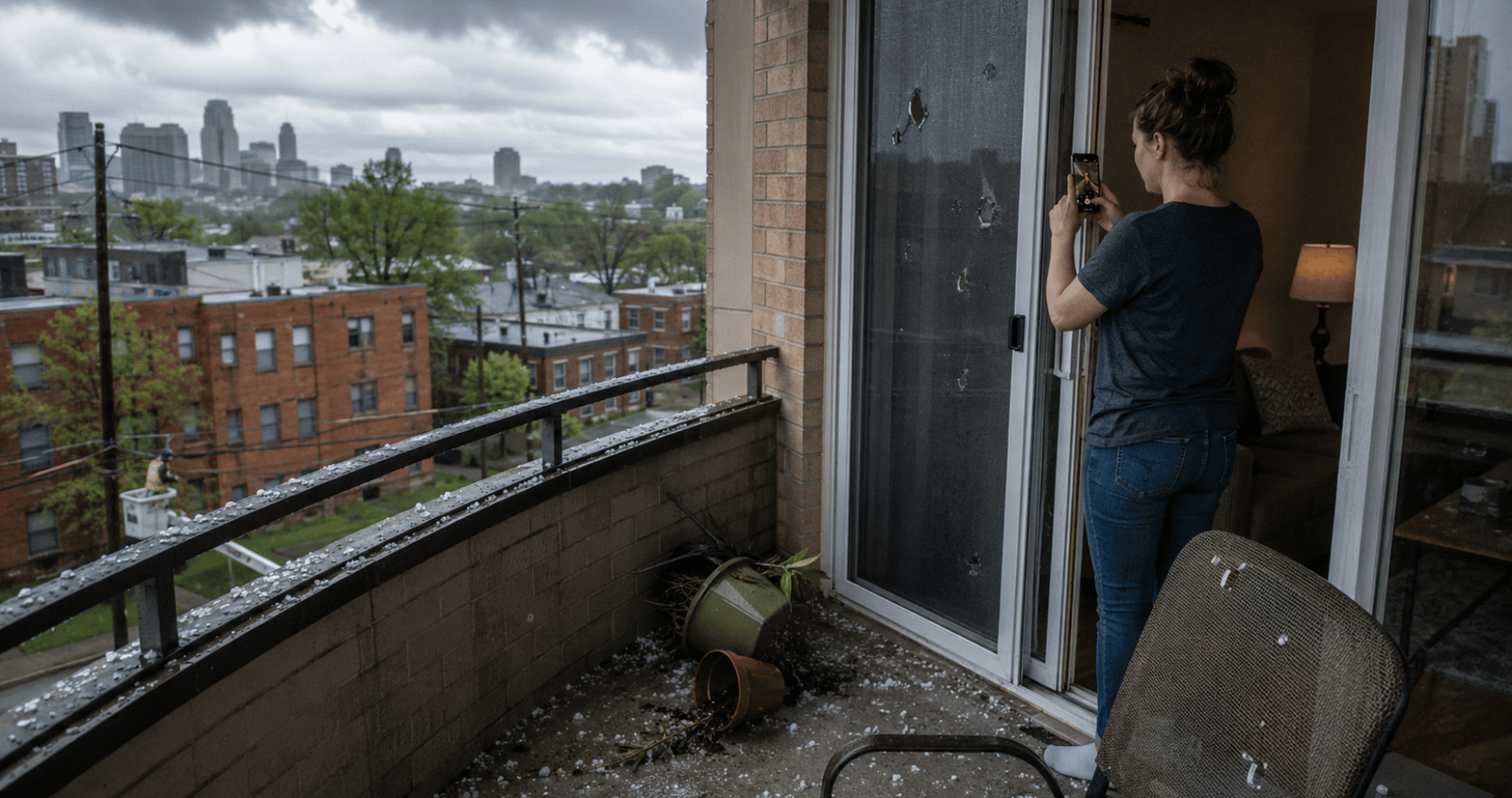
Hail is the frequent claim rather than the dramatic one. State Farm reported paying ten percent more in hail related claim dollars in Missouri in 2025 than in 2024, making Missouri the second highest state nationally for hail claim payouts. In March 2026, the National Weather Service recorded more than six hundred fifty hail events across nine states in a single day, including Kansas and Missouri.
What Your Policy Handles
The good news is that this is what renters insurance is built for.
Tornado, wind, and hail damage to your belongings is covered on standard policies in both states. So is fire, theft, vandalism, and sudden water damage from interior plumbing.
Liability covers you when you are responsible for someone else's injury or property damage. Loss of use pays for temporary housing when a covered event makes your unit unlivable.
Two things to check on your declarations page before spring.
Any separate wind and hail deductible. These are common in this market and are sometimes expressed as a percentage of your coverage rather than a flat amount. On thirty thousand dollars of personal property, a three percent figure is nine hundred dollars against perhaps five hundred for a kitchen fire.
Your loss of use limit. After a significant tornado or hail event, local housing and contractors both tighten quickly.
The Two Exclusions That Matter Here
Flooding. Excluded from every standard policy in both states. Properties near the Missouri and Kansas rivers carry real exposure, and renter flood policies through the National Flood Insurance Program cover contents only, which keeps them far cheaper than the homeowner version.
Sewer and drain backup. Also excluded, and this is the one most likely to actually reach you. Both Kansas City and the older parts of the metro on both sides have aging housing stock and aging drainage. A water backup endorsement closes it and is inexpensive.
Ask for it by name as the water backup and sump discharge or overflow endorsement. For ground floor and garden level units it is the most sensible addition available.
Winter Adds A Third Season
Ice storms can paralyze this region, and they produce a familiar chain.
Ice brings down limbs and lines. Outages follow. Pipes freeze in older buildings and burst when they thaw.
A pipe that freezes and bursts suddenly is covered for damage to your belongings. Gradual leaks are not.
If you leave for an extended stretch in winter, most policies expect heat to be maintained or the water shut off and drained. Skipping that can turn a covered claim into a denied one.
The weight of ice and snow is generally a covered peril for your property.
Hail Season Has A Rhythm
Kansas City hail is predictable enough to plan around, which is unusual among the risks in this series.
Peak season runs roughly March through June, with a secondary bump in late summer. That gives renters a clear window for the preparation that actually affects a claim.
Before March. Complete your inventory video, confirm your deductibles, and add any endorsement you have been putting off. Coverage changes made after a storm is forecast may not take effect in time, and flood policies carry a waiting period of around thirty days.
During the season. Park under cover when you can. Vehicle hail damage goes through comprehensive auto rather than renters, but a windshield taken out in an apartment lot is still a bad week.
After an event. File early. When a single hail day produces thousands of claims across a metro, adjuster availability tightens within days and early filers move through faster.
One detail specific to hail. Damage is often not obvious from inside. If a storm broke a window or damaged a screen, photograph it the same day, because a delay of a week invites questions about whether the damage came from that storm or an earlier one.
Older Housing On Both Sides
Much of the metro's rental stock predates modern electrical and plumbing standards, in Kansas City neighborhoods like Westport and Brookside as much as in older Johnson County communities.
Two habits protect a claim in those buildings.
Report electrical warning signs in writing immediately. Flickering lights, buzzing outlets, warm cover plates, breakers tripping on the same circuit. Safety first, and the written record protects your claim if that hazard later causes damage.
Report any leak the day you see it. In older buildings the line between a covered sudden loss and a denied gradual one is frequently just the date on an email.
Older construction also means shared walls and stairwells in much of the metro's multi family housing, which is the practical argument for carrying liability above the lease minimum. One kitchen fire rarely stays in one kitchen.
What Kansas City Renters Pay
Estimates land in a workable range.
Missouri renters insurance runs roughly seventeen to twenty eight dollars a month, or fifteen to thirty depending on the analysis. Kansas premiums run slightly above the national average, attributed to the state's position in Tornado Alley.
Kansas City specific figures suggest typical policies cost under twenty dollars a month.
Here is the number worth acting on. A comparison of five carriers offering renters coverage in the Kansas City area found annual premiums ranging from one hundred seven to three hundred fourteen dollars.
That is nearly triple, for coverage in the same metro. Twenty minutes of quoting is worth more here than most coverage decisions.
Also useful, the price difference between Missouri's most and least expensive cities is only about fourteen dollars a month, which means carrier choice matters considerably more than which neighborhood you pick.
Setting Your Numbers
The average renter owns twenty thousand to fifty thousand dollars worth of personal property, and most Missouri renters choose coverage in that range.
Walk your apartment room by room and total replacement costs rather than accepting a quoting default. People routinely underestimate.
Then check three lines on your declarations page.
Settlement basis. Actual cash value pays depreciated value. Replacement cost pays what a comparable new item costs today. After hail takes out a window and rain ruins a room at once, that difference decides whether you can rebuild.
Deductible. Five hundred and one thousand are the common options. Pick one you could genuinely cover in an emergency.
Liability. One hundred thousand is the usual default and the usual lease minimum. In multi family buildings where one kitchen fire reaches several units, three hundred thousand costs a few dollars a year more and is the better place to be.
Which State's Rules Apply
Neither Missouri nor Kansas requires renters insurance by law. Landlords in both states can require it as a lease condition, and the practice is standard across the metro.
Your lease governs, and which side of State Line Road you are on determines which state's landlord tenant law applies to disputes about deposits, notice, and habitability.
That distinction rarely affects an insurance claim. It matters considerably if you end up arguing with a landlord about a deposit or a repair, so know which state you actually rent in rather than assuming Kansas City means Missouri.
The Earthquake Footnote
Worth mentioning and then setting aside honestly.
Missouri sits atop the New Madrid Seismic Zone, and earthquake coverage is a separate endorsement excluded from every standard policy.
The exposure is concentrated in southeastern Missouri, several hundred miles from Kansas City. For most metro renters this is not the endorsement worth spending money on.
Water backup is.
Getting The Price Down
Shop across carriers, given a metro spread running from around one hundred seven to over three hundred dollars a year.
Bundle with auto, usually the largest single discount available.
Claim safety and security features. Smoke detectors, deadbolts, and monitored alarms factor in at most carriers.
Raise your deductible only if you could absorb the higher amount, and note it does nothing about a separate wind and hail deductible.
Check your credit based pricing, which moves premiums more than most renters expect.
Before Spring
Three things.
Video every room with closets and drawers open, capturing serial numbers, and store the file in cloud storage rather than on a laptop that could be destroyed.
Find every deductible on your declarations page, including any separate wind and hail figure, and convert percentages into actual dollars.
Ask about a water backup endorsement if you live at or below ground level. In a metro with this much aging drainage, it is the gap most likely to reach you.
The Short Version
Kansas City renters face a genuinely severe storm environment on both sides of the line, and standard policies handle wind, hail, and tornado damage well.
The gaps are water arriving from below or outside, and neither is expensive to close.
Three moves. Shop carriers, because the metro spread runs from about a hundred dollars a year to over three hundred. Add water backup if you are at ground level. And find your wind and hail deductible before March rather than after.
This article is for general educational purposes and is not insurance advice. Cost figures reflect published surveys and comparisons with differing assumptions and will not match your quote. Coverage terms, deductibles, and regulatory provisions vary by insurer and by state.
Some images in this article were generated using artificial intelligence and are for illustrative purposes only.