The Coverage That Pays The Gap, Not The Bill
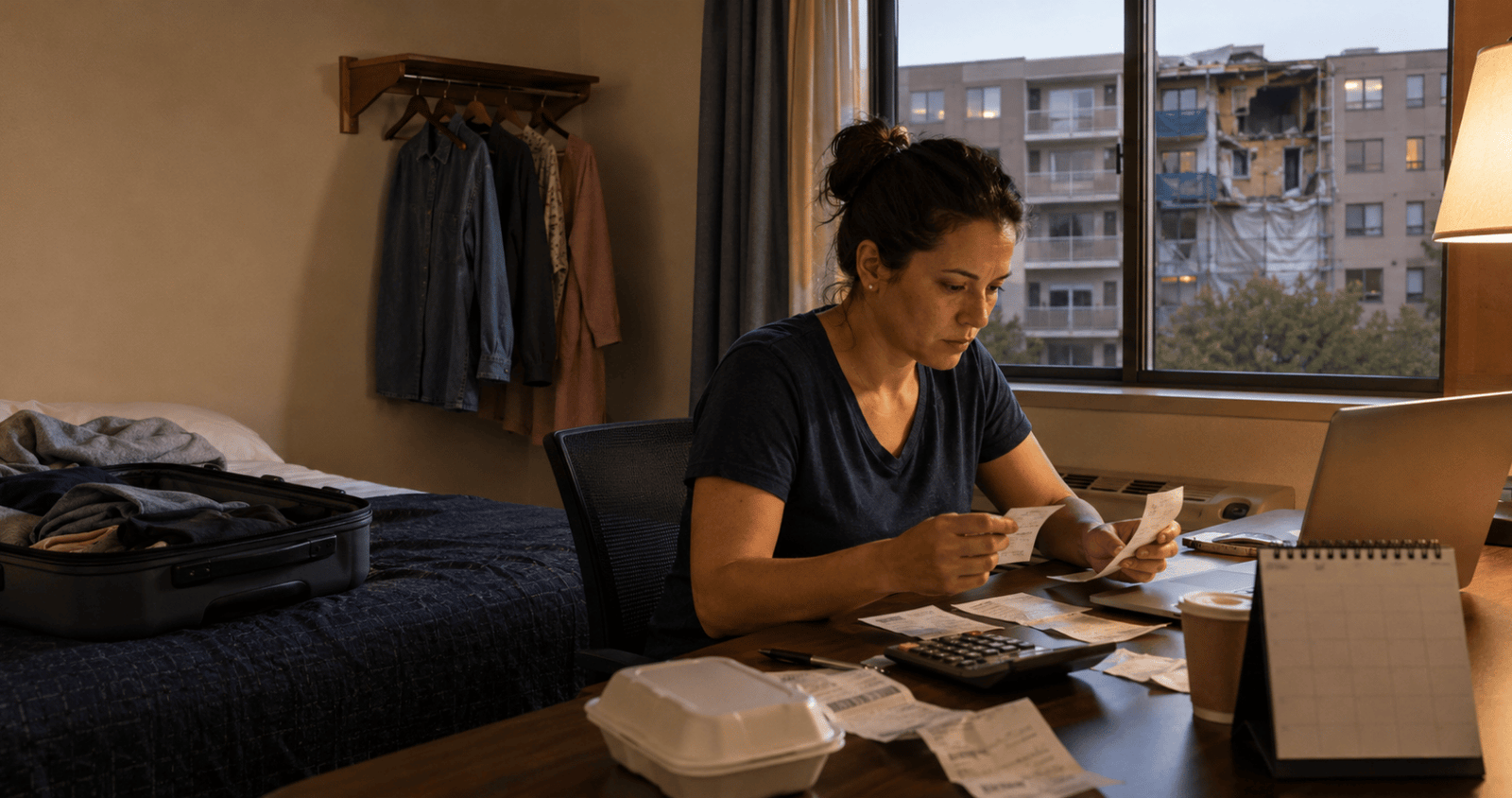
Your apartment burns. You check into a hotel for three weeks. You assume your insurer handles the hotel.
They handle part of it. And the part they skip catches almost everyone.
Loss of use, sometimes called additional living expenses or Coverage D, only reimburses what you spend above your normal costs. Your rent does not stop. Your insurer does not pay it. What they cover is the difference between your usual life and the more expensive temporary version.
That distinction changes the arithmetic completely.
Watch The Money Move
Say your rent is one thousand two hundred dollars a month and a two week hotel stay costs two thousand eight hundred.
You might expect twenty eight hundred back. What you actually get is roughly sixteen hundred, because half a month of rent, around six hundred, is what you would have spent anyway.
Food works the same way. If groceries normally run a thousand dollars a month and eating out without a kitchen pushes it to fifteen hundred, the covered amount is the five hundred difference.
Meanwhile you are still paying rent on an apartment you cannot enter.
Nobody explains this until the adjuster does.
What Counts As Additional
The list is broader than most renters realize once they understand the principle.
Hotel or short term rental costs above your rent. Restaurant meals above your grocery baseline. Laundromat trips if your building had laundry. Extra fuel or transit if your temporary place is farther from work. Pet boarding. Storage for belongings that survived.
Anything you were already paying for does not count. Anything the displacement forced on you generally does.
Keep every receipt from the first hour. Reimbursement runs on documentation and nobody is going to reconstruct your spending for you.
How Much You Actually Have
Two structures exist and yours will be one of them.
Some carriers set a flat amount, commonly three thousand to five thousand dollars.
Others tie it to your personal property coverage, typically twenty to thirty percent. Thirty thousand dollars of property coverage at twenty percent gives you six thousand.
Now check that against your city. In a market where hotels run three hundred dollars a night, a five thousand dollar limit covers roughly two and a half weeks of accommodation before you are paying out of pocket, and repairs after a serious fire routinely run longer.
Most insurers will raise this limit for a modest premium increase. Almost nobody asks.
There Is Also A Clock
Separate from the dollar limit, policies usually cap how long the coverage runs. Twelve months is common, with some carriers extending to twenty four.
Coverage ends whichever comes first, the repairs finishing, the dollar limit running out, or the clock expiring. For most renters the dollar limit hits long before the calendar does.
The Comparable Housing Rule
You get temporary housing similar to what you had. Not an upgrade.
A studio renter cannot claim a four bedroom house or a hotel suite. Insurers will fund something reasonably equivalent to your normal standard of living, and they will push back on anything beyond it.
Fair enough in principle. Worth knowing before you book somewhere nice and expect full reimbursement.
It Can Trigger Without Any Damage To Your Unit
Here is the part almost nobody knows.
Your apartment does not have to be damaged. If a covered peril makes it inaccessible, coverage can still apply.
A mandatory evacuation order during a wildfire. A civil authority barring access to your block after a nearby fire. Your building being closed for repairs after damage elsewhere in it.
Your belongings might be perfectly fine and you might still have a valid loss of use claim. If you are ever ordered out of your home, call your insurer before assuming there is nothing to claim.
When It Will Not Help
The trigger has to be a peril your policy covers. That constraint carries a lot of weight.
Displaced by flooding. Not covered without a flood policy, and neither is the hotel.
Displaced by an earthquake. Same problem in most states.
Displaced by a power outage with no actual damage. Generally not covered, since an outage alone rarely renders a unit legally uninhabitable.
Staying elsewhere by choice while minor repairs happen. Also not covered. The standard is uninhabitable, not inconvenient.
One Piece Of Good News
Loss of use claims frequently do not require you to pay your deductible first, though this varies by carrier.
That matters when you are displaced suddenly and short on cash. Worth confirming with your insurer now rather than discovering it in a hotel lobby.
Two Numbers To Look Up Tonight
Find your loss of use limit on your declarations page. It will be a flat figure or a percentage of your personal property coverage.
Then divide it by what a week of hotel and restaurant meals costs where you live. That tells you how long you could actually stay displaced before paying your own way.
If the answer is under a month, raising the limit is usually cheap. Everyone thinks about protecting their belongings. Almost nobody thinks about where they would sleep.
This article is for general educational purposes and is not a substitute for reviewing your actual policy documents or your lease. Limits, time caps, deductible rules, and covered perils vary by insurer and by state.
Some images in this article were generated using artificial intelligence and are for illustrative purposes only.