Fire Uses Every Part Of Your Policy At Once
Most claims touch one section of a renters policy. Fire touches all three, usually within the same hour.
Your personal property coverage replaces what burned. Your loss of use coverage pays for somewhere to sleep. And if the fire started in your kitchen, your liability coverage is the only thing standing between you and a bill for repairing the building.
That last one is where renters get hurt, and almost nobody sees it coming.
What Counts As Fire Damage
Broader than people expect.
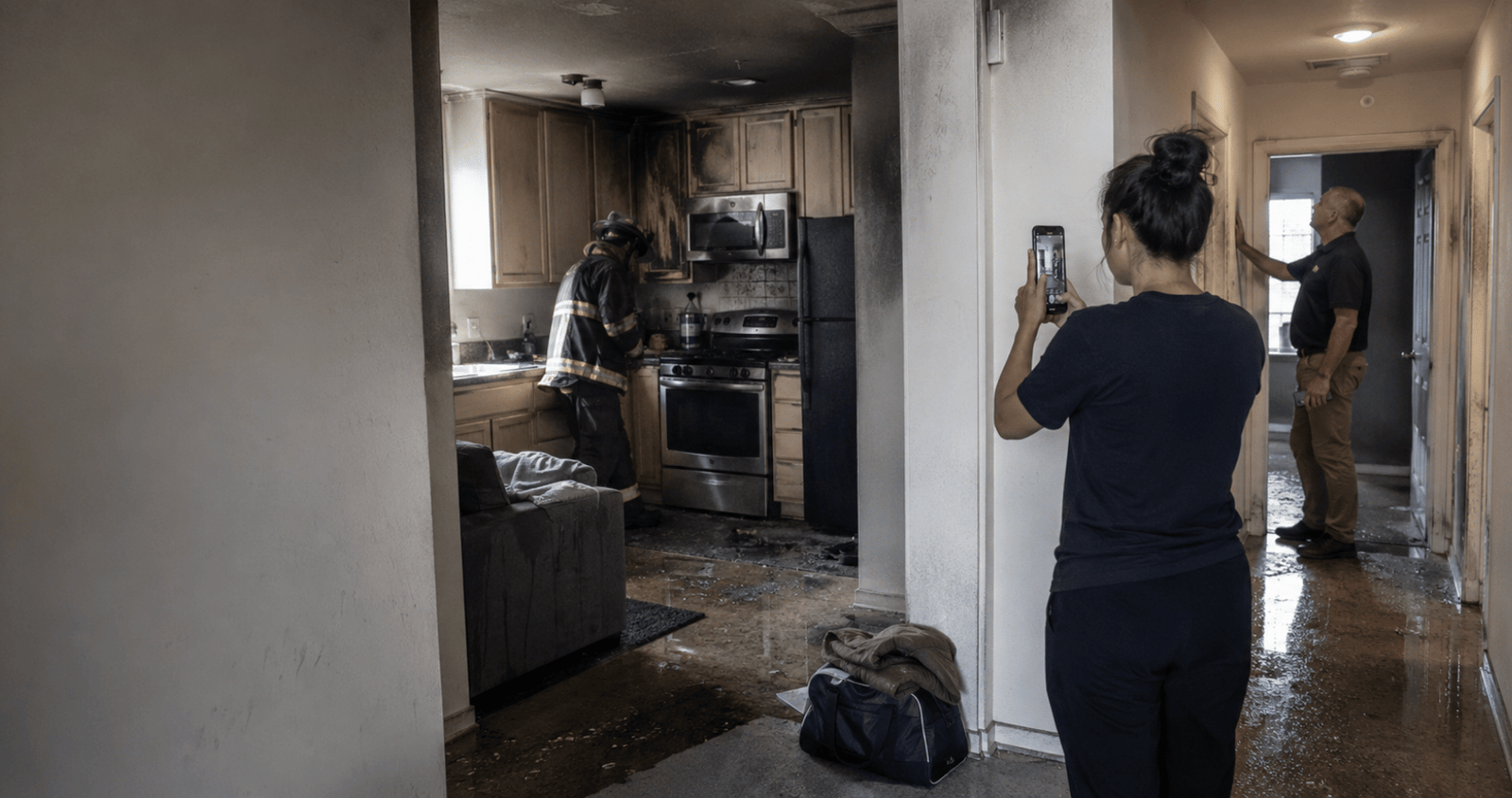
Flames are the obvious part. But a fire claim typically also covers smoke damage, soot residue, water damage from firefighting efforts, and damage from sprinklers that activated.
The water is worth flagging. Fire departments do not use a delicate amount, and in many apartment fires more belongings are ruined by water than by flame. That is still part of the same covered loss.
Charring, heat damage to electronics that never caught fire, warped furniture near the source. All of it counts.
Smoke Damage Is Covered Even If The Fire Was Not Yours
This surprises renters constantly and it matters in apartment buildings.
Smoke and soot damage to your belongings is covered even when the fire started in a neighboring unit or a common area and never reached your door.
Smoke travels through shared walls, vents, and hallways. It gets into clothing, upholstery, mattresses, books, and electronics. Clothing in particular absorbs odor in a way that professional cleaning sometimes cannot fix.
One practical warning. Smoke claims usually require more documentation than direct fire losses, because the damage is not always obvious to an adjuster on a walkthrough. A shirt that looks fine still smells. Photograph everything, note the odor specifically in your written list, and do not start cleaning before it is documented.
The Cause Almost Never Matters
Here is the reassuring part.
It does not matter what started the fire. A cooking accident, a faulty appliance, bad wiring, a space heater, a candle. Standard renters insurance covers your belongings regardless.
Two exceptions exist.
Intentional acts. Arson, or a fire you deliberately started, is never covered.
Gross negligence. This is a higher bar than ordinary carelessness. Leaving a pan unattended is negligence and is generally still covered. A pattern of reckless disregard for safety is a different matter, and insurers can and do deny on those grounds.
For nearly every real fire, your property claim will be honored.
The Scenario Nobody Prepares For
Now the part that actually threatens your finances.
You leave a pan on the burner. The fire damages your unit, the hallway, and two apartments beside you. Your landlord's insurance repairs the building.
Then their insurer comes after you.
This is called subrogation. The landlord's carrier pays for the damage, then pursues the person responsible to recover what it spent. Courts have upheld this against tenants and even against tenants' estates.
Without liability coverage, you are personally exposed. That means a lawsuit, a judgment, and potentially wage garnishment, for an accident that took four seconds.
Your renters liability coverage exists specifically for this. It pays the landlord's claim and it pays your legal defense, up to your limit.
Which raises the obvious question. What is your limit.
Most policies default to one hundred thousand dollars. A fire that spreads through a multi unit building can pass that easily once you count structural repairs across several apartments plus the displaced tenants' losses. Anything above your limit is yours to pay.
Raising liability from one hundred thousand to three hundred thousand typically costs a few dollars a year. In this specific scenario it is the most valuable few dollars on your entire policy.
When The Fire Started Somewhere Else
The process here is genuinely useful to know in advance.
If a neighbor's fire destroys your belongings, you file with your own insurer. Not theirs. Your policy pays for your property regardless of who was at fault, and it pays quickly, which matters when you are standing in a parking lot at two in the morning.
Your insurer then pursues the responsible party's liability coverage on its own. If that recovery succeeds, you can often get your deductible refunded.
Do not spend days trying to establish fault first. File with your own carrier and let them handle the rest.
The First Forty Eight Hours
Order matters more than people realize.
Safety and the fire department. Obvious, but the report they generate becomes evidence. Get the incident number before you leave the scene.
Tell your landlord as soon as it is safe. In writing if possible, even a text. Timing gets scrutinized later.
Call your insurer the same day. Most carriers have twenty four hour claim lines. Early filing goes smoother than late filing, and adjusters notice delays.
Ask about immediate funds. Many insurers advance money for a hotel and essentials rather than making you front three weeks of costs. Ask on the first call rather than assuming reimbursement is the only route.
Photograph everything before touching anything. Wide shots of each room, then close ups. Video walking through narrating what you see. Include the smoke residue on walls and in closets.
Do not throw anything away. This is the single most common mistake. Damaged belongings are your proof of loss. An adjuster may want to see them. Bag ruined items and set them aside, but keep them until the claim is settled or your insurer releases you.
Request the fire marshal report. It establishes cause and origin, which drives everything if fault is contested.
Building The Claim
Your insurer will ask for a proof of loss form. It describes the extent of the damage and lists what was destroyed along with each item's value.
You do not need a receipt for every object you own. You do need estimates that are reasonable and consistent.
Work room by room rather than trying to remember everything at once. Open your closets mentally. Kitchen drawers. The storage closet. People routinely underestimate their own losses by thousands because they forget entire categories.
Bank and card statements help reconstruct purchases. Photos on your phone from before the fire often show belongings in the background, which is surprisingly persuasive evidence.
Then remember the sublimits. Jewelry, firearms, cash, and collectibles carry category caps regardless of your total limit. Electronics may be capped too. A fire is exactly when those caps become visible.
Where You Sleep Next
Loss of use coverage handles temporary housing when a fire makes your unit uninhabitable.
One detail worth internalizing. It pays the difference between your normal costs and your displaced costs, not the whole hotel bill. Your rent obligation does not automatically stop, and your insurer does not pay it.
Keep every receipt from the first night. Hotel, meals above your grocery baseline, laundromat trips, extra commuting, pet boarding, storage for what survived. All of it is claimable and none of it gets reimbursed without documentation.
Your Lease After A Fire
Separate from insurance, and worth understanding.
In most states, if a unit is declared uninhabitable, a tenant can terminate the lease without penalty. The threshold varies and the mechanics vary more.
Get the uninhabitable declaration in writing. Give your landlord written notice. Before you stop paying rent or simply leave, check your state rules or talk to a local tenant organization, because doing this wrong can create a debt you did not need.
If You Had No Insurance
Harder, but not hopeless.
If someone else caused the fire, you can pursue them. You will need the fire marshal report establishing cause and origin, thorough documentation of your losses, and their insurance information. If they dispute liability, you may need an attorney. If they were uninsured too, you are looking at small claims or a civil suit, which is slow and uncertain.
If you caused it, your landlord's insurer can pursue you and you have no coverage to respond with.
The gap between those outcomes is roughly fifteen dollars a month.
Two Things To Do Before Anything Happens
Photograph your belongings room by room and store the file in cloud storage. After a fire, memory is the only inventory most people have, and it is a poor one.
Then check your liability limit. If it reads one hundred thousand, ask what three hundred thousand costs. A kitchen fire that reaches three apartments is the scenario that number exists for, and it is the cheapest meaningful upgrade on a renters policy.
Everything else about fire coverage works largely in your favor. Those two steps are what decide whether it works well.
This article is for general educational purposes and is not legal or insurance advice. Coverage terms, exclusions, sublimits, and tenant rights vary by insurer and by state. For lease termination questions, consult your state rules or a local tenant advocacy organization.
Some images in this article were generated using artificial intelligence and are for illustrative purposes only.