Two Policies, One Building, And A Line That Decides Everything
Every article about renters insurance says the same sentence. Your landlord's policy covers the building, not your stuff.
True, and not detailed enough to be useful. Because when something goes wrong, the question is not which policy covers the building. It is which policy covers this particular loss, and the answer depends on where the damage happened and who caused it.
Here is the actual boundary, and the situations where it moves.
What A Landlord Policy Contains
A landlord policy has four parts, and they mirror yours in structure while covering entirely different things.
Dwelling coverage. The physical structure. Walls, roof, foundation, built in systems and appliances.
Landlord owned personal property. Any furniture, appliances, or equipment the owner provides with the unit.
Loss of rent. Compensation for rental income lost while a covered event makes the property unlivable. Notice this protects their income, not your housing.
Liability protection. Claims against the owner for bodily injury or property damage, typically arising from common areas or structural failures.
Four parts, and none of them is your furniture.
What It Explicitly Excludes
Landlord policies name the exclusions plainly.
Your personal property. Furniture, electronics, clothing owned by the tenant. Not covered, not partially, not at a reduced limit. Not covered.
Your temporary housing. Their loss of rent coverage replaces their income. It does nothing for your hotel bill.
Damage you caused, in most circumstances, which is what your liability coverage exists to address.
That third one is the reason landlords require renters insurance, and it is worth understanding properly.
The Four And Four
The cleanest way to hold this in your head.
Their policy covers: the building, their own property in it, their rental income, and their liability for building conditions.
Your policy covers: your belongings, your temporary housing, your liability to other people, and small medical payments for guests.
Neither policy covers what the other is designed to protect. Two parties, two sets of risks, no overlap where it matters.
How Real Losses Actually Split
Abstractions are less useful than scenarios, so here are the common ones.
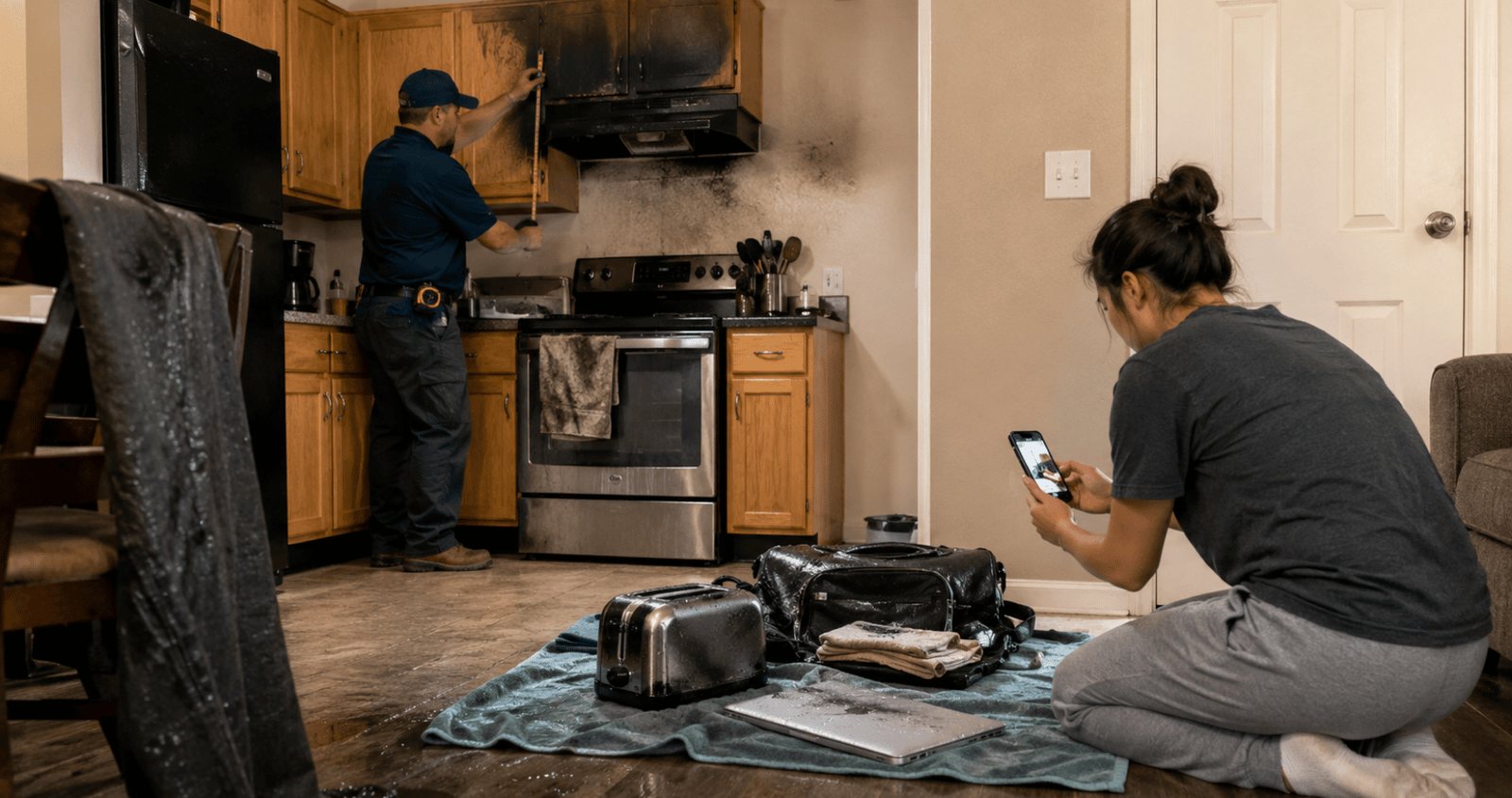
A kitchen fire you accidentally started. Landlord insurance typically covers the structural damage, including walls, cabinets, and built in appliances. Your renters policy covers your belongings damaged by fire and smoke. And because your negligence caused it, your liability coverage may respond to offset the landlord's claim against you.
A pipe bursts because it was old. Landlord insurance handles the building damage. Your policy covers your belongings. Nobody pursues anybody, because age is not negligence.
Water damage because you left a faucet running or never reported a leak. Your liability coverage is the one that applies, because the cause was your action or inaction. These cases hinge heavily on documentation and maintenance records.
A guest is injured. This one has its own rule.
Where And Why Decide Guest Injuries
When someone gets hurt, coverage turns on two questions.
Where did it happen? Common areas, stairwells, parking lots, and lobbies are under the landlord's control.
What caused it? A condition of the property, or something you did or failed to do.
Injuries tied to property conditions under the landlord's control generally fall under their liability coverage. A broken stair tread, inadequate lighting in a hallway, an unmarked wet floor in a lobby.
Injuries caused by your actions or by hazards inside your unit trigger your liability coverage instead. A cable across a doorway, a dog, a spill you did not clean.
The messy cases are the ones in between. A guest injured on an icy walkway outside your door, where responsibility for clearing it depends on your lease. Read that clause before winter rather than after a fall.
The Waiver At Lease Signing Is Not Insurance
Here is the part most renters have never had explained, and it matters more than anything else on this page.
A product called tenant legal liability coverage has spread widely through property management networks since the mid two thousands. It appears at lease signing, often as a small monthly charge, sometimes framed as a convenient alternative to buying your own policy.
It is not a renters insurance policy and it does not do what one does.
It covers damage you cause to the unit you occupy. That is its purpose, and it exists so the landlord has a recovery path without depending on tenants to buy and maintain their own coverage.
It generally does not extend to common areas, other units, or the broader complex. So the kitchen fire that reaches three apartments is exactly the scenario it may not fully address.
It does not cover your belongings at all. No personal property coverage. If the building burns, your furniture is gone and this product does nothing.
It does not pay for your temporary housing. No loss of use.
It does not cover your liability away from home, or a guest injury, or anything outside the specific damage it was written for.
If your property manager offers this at signing, it may satisfy a lease requirement. It does not protect you. A renters policy costs a similar amount and covers your belongings, your housing, and your liability everywhere.
Ask which one you are being sold, and read what it says rather than what the desk staffer describes.
When You Can Claim Against Your Landlord
The reverse direction, which renters ask about constantly.
Their liability coverage can respond when a loss traces to their failure rather than to bad luck.
Situations that come up repeatedly include a known defect they did not disclose, negligence in maintaining plumbing, roofing, or drainage, failure to act after receiving written notice of a problem, unsafe conditions in common areas, and a breach of a repair obligation in the lease.
Note the pattern. Almost all of it turns on whether they knew and whether they acted.
Which is why the single most useful habit for a tenant is putting everything in writing. A leak reported by email in October and a ceiling collapse in January tell a coherent story. The same leak mentioned in a hallway conversation tells no story at all.
Their Claim Can Be Denied Too
A detail that gives tenants more leverage than they realize.
Landlord policies contain their own conditions, and insurers can deny or reduce a claim when deferred maintenance, missed inspections, or undocumented repairs are found to be the root cause of a loss, particularly where response timelines and work history cannot be demonstrated.
Read that from a tenant's perspective. If a landlord ignored a maintenance issue you reported, their own insurer may push back on their claim for the same reason you would push back on their attempt to bill you.
That does not mean you should threaten anyone with it. It means your written record is valuable to more than one party, and preserving it protects your position regardless of how the dispute develops.
Your Policy Protects Them Too
Worth stating, because the lease requirement can feel adversarial and it is not.
When a tenant accidentally causes damage, their liability coverage is the first line of defense, which spares the landlord from filing on their own policy and absorbing a premium increase.
A tenant liability policy can also cover the landlord's deductible on a major claim the tenant caused.
So the requirement is genuinely mutual. It keeps their claims history clean and it keeps a bill you could not absorb off your shoulders. The alignment is unusual in landlord tenant matters and it is real here.
Why Landlords Started Requiring This
Understanding the history makes the lease clause feel less arbitrary.
For decades most renters carried no coverage. When a tenant caused a fire or a flood, the landlord filed on their own policy, absorbed the deductible, and watched their premium rise at renewal. Multiply that across a portfolio and it becomes a serious operating cost.
Two responses emerged.
Requiring tenants to carry their own policy, which shifts the first line of defense to the tenant's liability coverage and keeps the owner's claims history clean.
Offering a tenant liability product directly, which guarantees the landlord has a recovery path without depending on tenants to buy and maintain coverage themselves.
The first option protects both parties. The second protects primarily the landlord, which is exactly why it is worth knowing which one you are being offered.
Neither approach is unreasonable from an owner's perspective. The problem is when the second is presented to a tenant as though it were the first.
The Deposit Sits In The Middle
One more piece of the boundary, and it explains a lot of end of tenancy disputes.
Your security deposit exists to cover damage to the unit beyond normal wear and tear. That category overlaps almost exactly with what your renters liability coverage excludes, since liability does not cover property rented to or occupied by you.
Which means the alignment is deliberate. Damage to the apartment comes out of the deposit and then out of your pocket. Damage to other people and their property comes out of your liability coverage.
Two practical implications.
Photograph the unit at move in and move out. This is the single most effective protection against deposit disputes, and it costs ten minutes.
Know your state's deposit rules. Return deadlines and itemization requirements vary widely, and many states require an itemized list of deductions within a set number of days. A landlord who misses that requirement may forfeit the right to withhold.
Neither insurance policy helps here. The deposit is its own system and documentation is the only leverage available.
Common Areas Are Their Territory
Frequently misunderstood, so worth being clear.
Your belongings stolen from a shared storage room are covered by your policy, since they are your property.
Your injury in a poorly maintained stairwell is generally their responsibility, since they control the space.
A package taken from a lobby is covered by your policy as personal property.
Damage to the lobby itself is theirs.
The rule is ownership for property and control for injuries. Apply those two tests and most common area questions resolve.
What To Ask Before You Sign
Four questions, all reasonable to ask a landlord or property manager.
What insurance are you requiring, and what limits? Get the specific figure and whether they need to be listed on your policy.
Are you offering a tenant liability product, and is it a substitute or an addition? If it is being presented as a substitute for renters insurance, understand exactly what it excludes.
Who is responsible for clearing walkways and common areas? This determines who owns an ice injury.
Are there outstanding maintenance issues or code violations? Some states require disclosure. Asking directly is free regardless.
The Line In One Paragraph
They insure the building, their property in it, their income, and their liability for conditions they control. You insure your belongings, your housing, and your liability for what you do.
When something happens, ask two questions. Whose property was damaged, and whose conduct caused it. Those two answers allocate almost every loss correctly.
And if a property manager offers you a waiver at lease signing instead of a policy, read it. It may satisfy their requirement while leaving you with nothing at all.
This article is for general educational purposes and is not legal or insurance advice. Policy structures, product terms, disclosure obligations, and landlord responsibilities vary by insurer, by lease, and by state. Read your own documents and confirm details with your carrier or a tenant advocacy organization.
Some images in this article were generated using artificial intelligence and are for illustrative purposes only.