Two Questions Decide Every Appliance Claim
Your fridge dies. Before you call anyone, answer two things.
Who owns it. And what broke it.
Get both answers and the outcome is obvious. Skip either one and you will spend a week talking to people who cannot help you.
Question One, Who Owns It
Renters insurance covers appliances you own. Nothing else.
The rough test is whether it is built in or portable.
Built in usually means the landlord's. A dishwasher wired into the cabinetry. The oven and range. A refrigerator that came with the unit. Central air conditioning. The garbage disposal. Anything permanently installed is part of the property, and the property belongs to your landlord.
Portable usually means yours. A microwave you bought. A window air conditioner. A countertop dishwasher. A portable washer. Anything you could unplug and carry out at the end of the lease.
Then there is the gray area. Appliances left behind by a previous tenant sit in genuine limbo. Nobody bought them for you and the landlord may not consider them part of the unit. If a departing tenant left you a mini fridge, ask your landlord in writing who owns it before something happens to it.
That written answer costs nothing and settles an argument you might otherwise have during a claim.
Question Two, What Broke It
This one trips up more people than ownership does.
Renters insurance responds to external events. Fire. Theft. Vandalism. Water from a burst pipe. Lightning. A tree through the window.
It does not respond to the appliance simply failing.
A washing machine whose motor burns out after five years is not a covered loss. It is a machine reaching the end of its life. Rust, corrosion, gradual deterioration, cosmetic scratches, none of it is covered either.
The distinction is not about how expensive the repair is. It is about whether something happened to the appliance, or whether the appliance just stopped.
The Grid That Answers Everything
Put the two questions together and every scenario sorts itself.
| Situation | Who Handles It |
|---|---|
| Your microwave destroyed in a fire | Your renters policy |
| Your window AC stolen | Your renters policy |
| Your portable washer ruined by a burst pipe | Your renters policy |
| Your blender simply stops working | Nobody, unless you added equipment breakdown |
| Landlord's fridge stops cooling | Your landlord |
| Landlord's dishwasher damaged in a fire | Landlord's insurance |
| You broke the landlord's oven | Your liability coverage may respond |
| Landlord's fridge leaks and ruins your rug | Your renters policy covers the rug |
That last row matters more than people expect, so it gets its own section below.
Power Surges Are Their Own Problem
Worth separating out because appliance damage from surges is common.
Many policies cover a surge that results from a lightning strike, since lightning is a named peril. Surges from routine grid fluctuations, utility switching, or old building wiring are commonly excluded or limited.
So two people can lose identical televisions in the same week and get opposite answers, depending entirely on what caused the spike.
If your building has aging electrical infrastructure, this gap is worth closing.
The Endorsement Built For This Exact Gap
Equipment breakdown coverage, sometimes called boiler and machinery coverage, is an optional add on that covers the thing your standard policy will not. Mechanical failure. Electrical failure. Surges that did not come from lightning.
Published pricing puts it around ten to fifty dollars a year depending on the carrier and what is included. Some versions also cover food spoilage when a refrigerator fails, which pairs neatly with the gap most renters discover after a bad week.
Whether it is worth buying depends entirely on what you own.
If your personal appliances amount to a microwave and a toaster, skip it. Replacing them costs less than several years of the endorsement.
If you own a high end espresso machine, a portable washer and dryer, multiple window air conditioners, or a serious kitchen setup, the arithmetic changes. A few dozen dollars a year against a thousand dollar replacement is reasonable.
One important distinction. This is insurance, not a home warranty. It covers sudden mechanical and electrical breakdown, and it generally still excludes ordinary wear and tear. Home warranty products handle wear and tear and work differently, with service fees and caps.
When The Landlord's Appliance Damages Your Things
Here is the scenario that catches renters off guard.
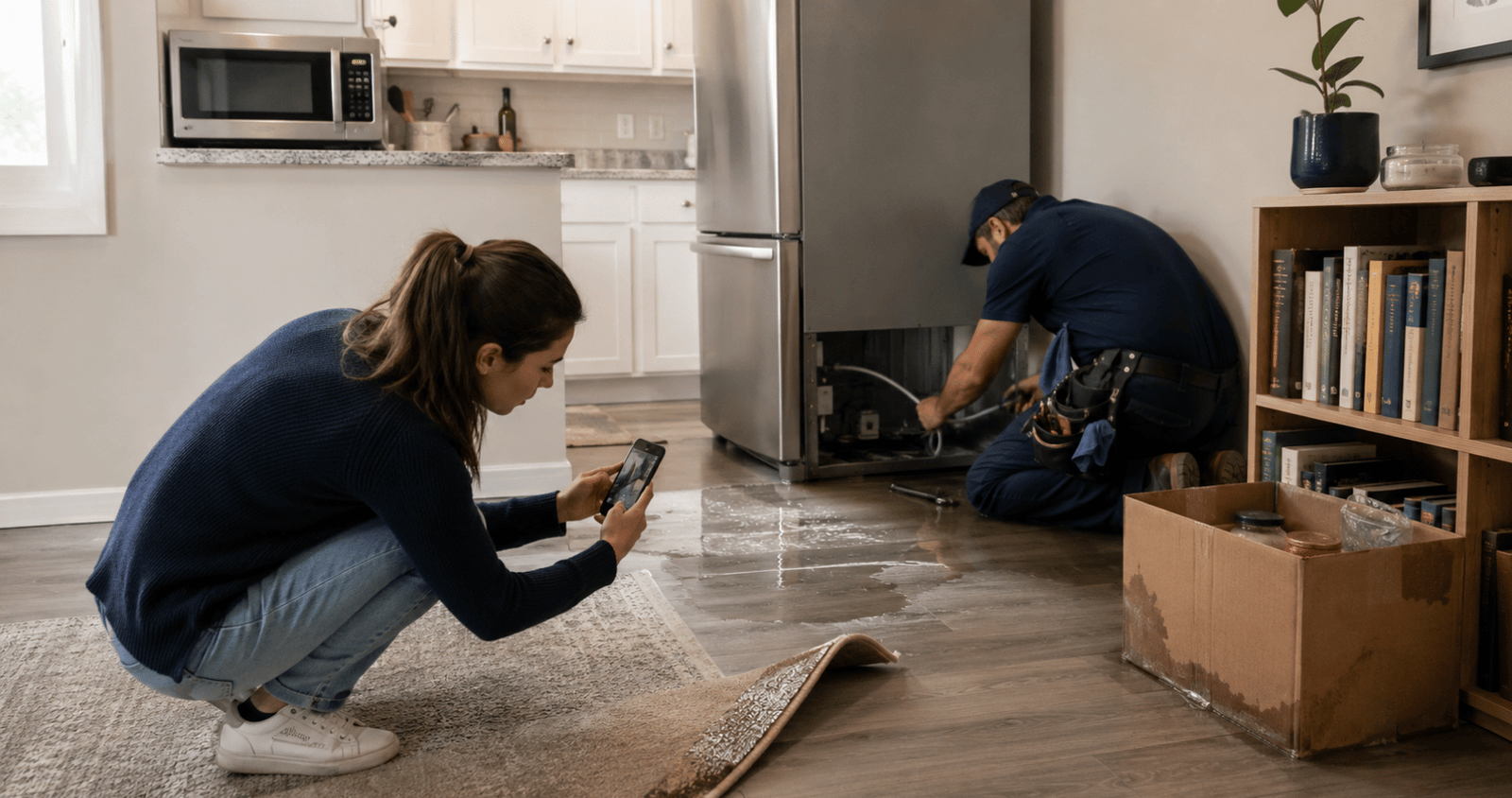
The landlord's refrigerator fails and leaks across the kitchen floor, ruining a rug, some boxes in the pantry, and the bottom of a bookshelf.
The fridge is not your problem. That is the landlord's appliance and their repair.
Your belongings are your problem, and your renters policy is what covers them. Do not assume the landlord's insurance will replace your rug, because it will not. Their policy protects their property and their interests.
If their failure to maintain the appliance caused the damage, you may also have a claim against them directly. That is a separate track worth pursuing alongside your insurance claim, not instead of it.
When You Damage The Landlord's Appliance
The reverse also happens.
You drop something into the garbage disposal and destroy it. You overload the built in dishwasher and crack a component. You warp the oven racks.
Your property coverage does nothing here, since the appliance is not yours. Your liability coverage may respond, because it covers damage you cause to someone else's property.
Whether it applies depends on the circumstances, and ordinary wear during normal use is not usually treated as damage you caused. But if a landlord is billing you for a broken appliance, mentioning it to your insurer is worth doing before you simply pay.
The Informal Split Some Landlords Use
You may hear about a fifty fifty convention. The idea is that if an appliance breaks more than halfway through its expected lifespan, the landlord and tenant split the replacement cost.
This is worth knowing about and worth treating carefully. It is not a legal requirement anywhere. It is an informal practice that only applies if your lease says so or your landlord chooses to offer it.
If a landlord proposes it, check your lease first. In most cases, maintaining and replacing their own appliances is entirely their obligation.
What To Do In Your First Week Somewhere
Two habits prevent nearly every dispute in this article.
Document what came with the unit. Photograph every appliance during your move in walkthrough, before you unpack. Note anything already damaged. This protects your deposit and establishes ownership at the same time.
Keep receipts for anything you bring. Store them digitally. An insurance claim on a personal appliance needs proof of purchase and value, and a photo of a receipt in cloud storage is worth more than a memory of what you paid.
If your lease does not spell out which appliances belong to whom, ask for that in writing before you move in. Landlords generally have no problem answering, and the answer becomes useful exactly once, at the worst possible moment.
The Short Version
Own it and something happened to it, your policy responds. Own it and it just quit, you are on your own unless you added equipment breakdown. Landlord owns it, it is their problem, except for whatever of yours got damaged in the process.
Photograph the appliances in your unit this week and file your receipts somewhere permanent. Those two steps decide how quickly any of the above actually gets resolved.
This article is for general educational purposes and is not a substitute for reviewing your actual policy documents or your lease. Coverage terms, endorsement availability, and landlord obligations vary by insurer, by lease, and by state.
Some images in this article were generated using artificial intelligence and are for illustrative purposes only.