Whether You Get Paid Depends On Why The Lights Went Out
Two renters lose the same four hundred dollars of groceries on the same night. One gets reimbursed. The other gets denied.
The difference is not their policy. It is what knocked the power out. Insurance treats a lightning strike and a grid overload as completely different events, even though your fridge cannot tell them apart.
The Fork That Decides Everything
Ask one question. Did something break, or did the utility just fail?
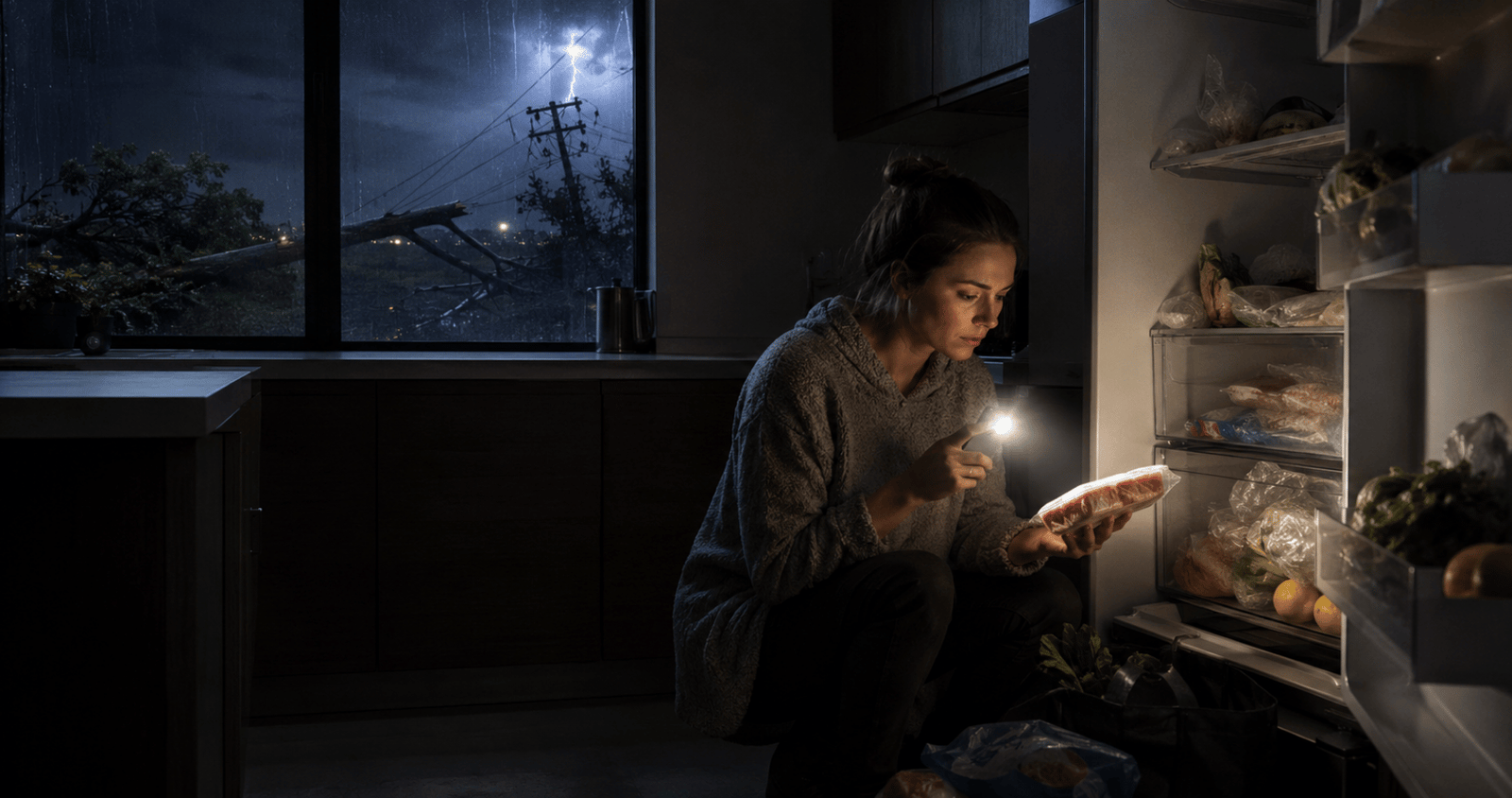
Storm damage, a lightning strike, a falling tree taking down a line, a fire. These are named perils. When one of them causes the outage, the resulting food loss is usually treated as a valid personal property claim.
A transformer blowing, a substation fault, a grid overload during a heat wave, planned rolling blackouts. Nothing was damaged in a way your policy recognizes. These outages commonly fall outside coverage.
That distinction feels arbitrary from the kitchen floor. It makes more sense once you see the logic. Renters insurance pays for damage from listed events. A utility failing to deliver electricity is a service interruption, not a peril.
Some policies do extend coverage to off premises power interruption, which is why this is worth checking rather than assuming. Carriers differ here more than on most questions.
What Never Gets Covered
A few causes are excluded almost everywhere.
Your fridge dying of old age is mechanical breakdown, not a covered peril. If it belongs to your landlord, that conversation goes to them instead.
Leaving the freezer door open is your own negligence. Nobody pays for that.
Power shut off for an unpaid bill will get a claim denied immediately.
Rodents chewing through wiring is pest damage, excluded like every other infestation.
Flood or earthquake related outages fall under separate policies entirely.
The Sublimit Is Smaller Than You Think
Even on a covered claim, refrigerated property usually has its own cap. Common limits run around two hundred fifty to five hundred dollars.
Look for wording about refrigerated property on your declarations page rather than assuming your full personal property limit applies. It generally does not.
Your deductible may also apply, though not always. Some carriers waive it on food spoilage specifically. That is worth asking about directly, because a five hundred dollar deductible against a four hundred dollar loss ends the conversation before it starts.
The Route Most Renters Never Try
Here is the useful part.
Your utility company may have its own spoilage reimbursement process, entirely separate from insurance. Many run a residential claims program for extended outages, particularly ones caused by their own equipment failures.
The amounts are modest and the rules vary by utility and by state. But this route often covers exactly the scenario insurance excludes, the grid or equipment failure with nobody else to blame.
Check your utility's website for spoilage or damage claims before you call your insurer. It costs nothing to file and does not touch your insurance record.
Two Endorsements Worth Asking About
Food spoilage coverage extends or raises the limit on refrigerated goods, and often covers spoilage regardless of what caused the outage. Pricing is low. Published rate manuals show limits in the two hundred fifty to one thousand dollar range for roughly fifteen to fifty dollars a year.
Equipment breakdown coverage handles appliance and electronics damage from mechanical or electrical failure, including power surges that did not come from lightning. This is the one that covers your gaming setup when old building wiring fries it, which a standard policy will not.
Neither is expensive. Both fill gaps that catch people every storm season.
What To Do In The First Four Hours
This part matters more than the insurance question, because preventing the loss beats claiming it.
Keep the doors shut. A closed refrigerator holds safe temperature for roughly four hours. A full freezer holds for about forty eight hours, half that if it is only partly full.
Move perishables into a cooler with ice if the outage looks long. Meat, dairy, eggs, and leftovers are the first things at risk.
Watch the temperature, not the clock alone. Federal food safety guidance says perishable food held above forty degrees Fahrenheit for more than two hours should be discarded.
Photograph everything before you throw it out. Wide shots of the full fridge, then close ups. Keep grocery receipts if you have them.
When in doubt, throw it out. No claim is worth food poisoning.
Filing The Claim
Document first, call second.
Note the exact time the power went out and came back. Utilities publish outage records, and matching your timeline to theirs strengthens the claim.
Itemize what spoiled with estimated values. A list of thirty items reads better than a total.
Then run the arithmetic. If your sublimit is two fifty and your deductible is five hundred, there is no claim to file. That is worth knowing before you spend an hour on the phone.
The Short Version
Find out what caused the outage before you do anything else, because that answer decides everything. Check your refrigerated property sublimit while you are in the policy anyway. And try your utility company, since the outages insurance will not cover are often exactly the ones the utility will.
This article is for general educational purposes and is not a substitute for reviewing your actual policy documents. Coverage terms, sublimits, and deductible rules vary by insurer and by state. For food safety guidance during an outage, follow official public health recommendations.
Some images in this article were generated using artificial intelligence and are for illustrative purposes only.