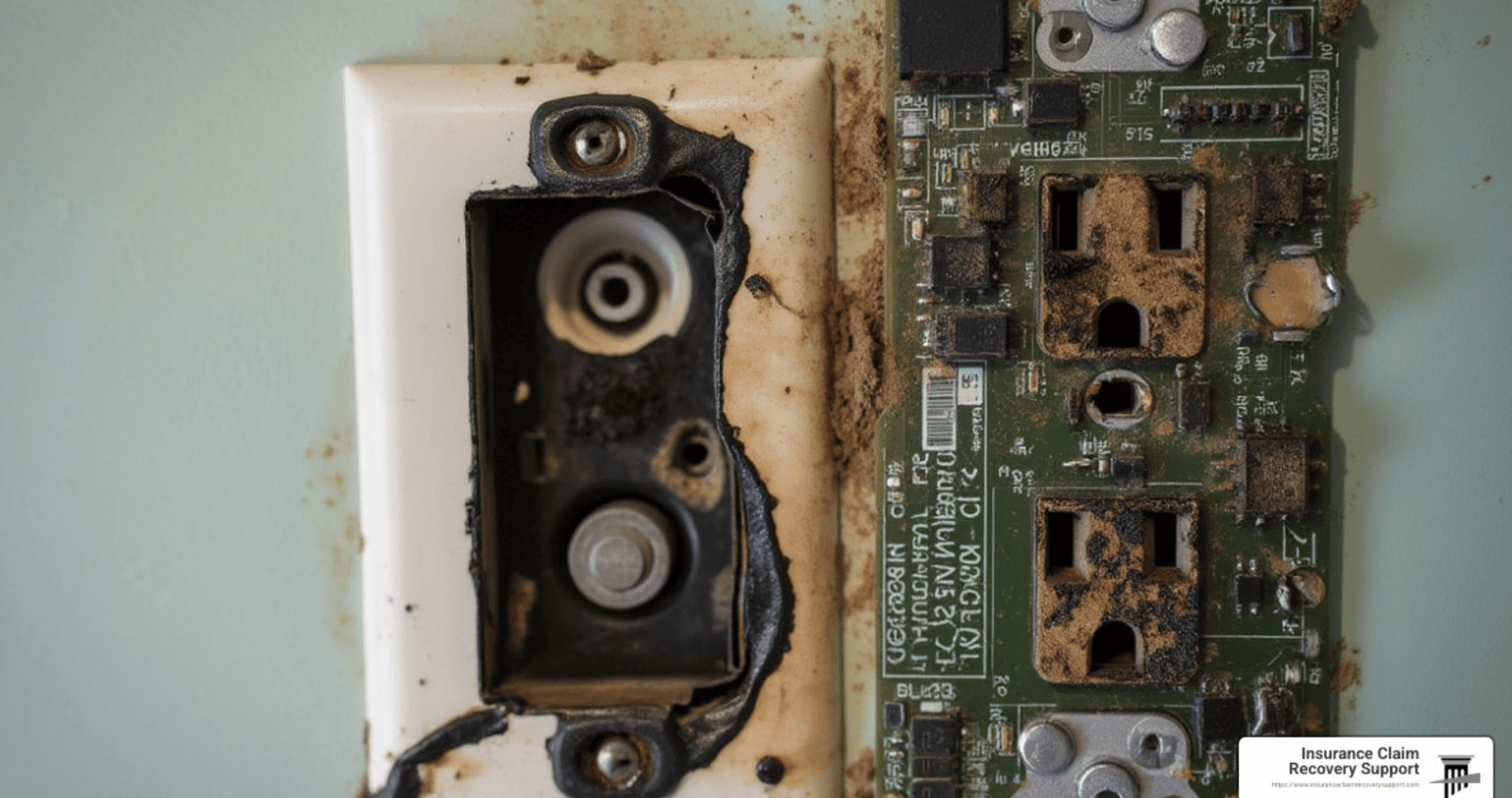
The Peril Is On Your Policy And A Carve Out Removes It
Search this question and you will get contradictory answers from sources that all sound authoritative.
One says power surges are covered. Another says they are not. A third says it depends on whether the electric company caused it.
They are all describing the same policy language and each one is capturing a different piece of it. Here is what is actually going on, because understanding it tells you exactly what to ask your insurer.
The Clause And The Carve Out
Many renters policies list a named peril along the lines of sudden and accidental damage from artificially generated electrical current.
That sounds like surge coverage, and in part it is. A transformer blowing down the street and sending a spike through your apartment can fall inside that peril.
Then comes the qualification. Insurers commonly exclude damage to tubes, transistors, and similar electronic components when an artificially generated current caused the surge.
Read that carefully. The peril is listed. The exclusion removes damage to the exact internal parts that a surge actually destroys in a television or a computer.
So the honest answer is that the coverage exists on paper and often stops precisely where your electronics begin. That is why every source you read disagrees with the others.
Lightning Is The Clean Case
One scenario avoids all of that ambiguity.
Lightning is a named peril on essentially every renters policy. If lightning strikes your building or a nearby utility pole and sends a surge through the outlets, the electronics it destroys are covered under personal property, subject to your deductible.
No artificially generated current clause, no component carve out. Lightning caused it, lightning is covered, the damage is covered.
This is why the question you will be asked first is what caused the surge.
Fire From A Surge Is Also Clean
A second scenario that works reliably.
If a surge overloads wiring and starts a fire, the fire damage to your belongings is covered under the fire peril, regardless of what caused the original spike.
The surge itself may sit in the ambiguous zone. The fire does not.
Short circuit damage from an appliance can also be covered depending on your policy's wording around internal electrical failures.
The Grid Surge Is The Messy Middle
This is the common case and the frustrating one.
Utility switching, maintenance work, a transformer failure, rolling blackouts, or the moment power returns after an outage. All of these can spike voltage without any lightning involved.
Whether your policy pays depends on how your specific form handles artificially generated current and how aggressively the component exclusion is written. Carriers differ genuinely here.
Then there is the version nobody expects. A neighbor's failing air conditioner overloads the building's electrical system and fries your setup. No lightning, no fire, just old wiring and someone else's appliance. Standard coverage frequently does nothing.
Older buildings make this scenario more likely, which means renters in exactly the housing most likely to produce a surge are often the least protected against one.
Equipment Breakdown Closes The Gap
There is a clean fix, and it is inexpensive.
Equipment breakdown coverage is an optional endorsement that covers appliances and electronics damaged by mechanical or electrical failure, including surges not caused by a covered peril.
That last phrase is the whole point. It covers the grid surge, the building wiring surge, and the neighbor's air conditioner. Precisely the cases the base policy handles badly.
Some versions also cover refrigerator spoilage when an appliance fails, which pairs neatly with the outage that caused the surge in the first place.
If you own a serious computer setup, a large television, a home studio, or anything you could not casually replace, this endorsement is the specific product built for your situation.
Ask for it by name and ask whether the electronics component exclusion applies under it.
What Is Never Covered
Two things sit outside all of this regardless of endorsements.
Gradual failure. A television that simply stops working after six years is wear and tear. No surge, no covered peril, no claim.
Neglected electrical problems. If a known hazard went unreported, an insurer can treat the resulting damage as preventable rather than sudden. This matters for renters because you may not control the wiring, which is why the reporting step below is not optional.
Proving What Caused It
Causation is the entire claim, so document accordingly.
Note the time and what happened. A storm overhead, a visible flash, the power cutting out and returning, a bang from outside. Write it down immediately.
Check whether neighbors were affected. A building wide or block wide event supports your account and points to an external cause. Their experience is corroboration.
Contact the utility. They keep outage and fault records, and matching your timeline to theirs strengthens the claim considerably.
Photograph the damaged devices, including any scorching around plugs or outlets.
Keep the damaged items. Do not throw a dead television away before an adjuster has seen it or released you. It is your evidence.
Get a repair assessment if you can. A technician stating that the failure is consistent with a voltage event is more persuasive than your description of the noise you heard.
Two Settings That Decide Your Payout
Even on a covered surge claim, two things on your declarations page control what arrives.
Replacement cost versus actual cash value. Electronics depreciate faster than almost anything else you own. Actual cash value on a three year old television pays a fraction of what replacing it costs. If your policy says actual cash value and you own recent electronics, changing it usually costs little and matters more than any other line.
Electronics limits. Some policies apply a category cap to electronics, and some apply a lower limit for items used for business. If you work from home on equipment you own, ask specifically how your policy treats it, since business property is restricted on most personal policies.
The Deductible Question Comes First
Before any of the coverage detail matters, run the arithmetic.
Most renters deductibles sit between five hundred and one thousand dollars. A surge that kills one television or one monitor frequently produces a loss below that line, which means there is no claim to make regardless of how the policy reads.
A surge that takes out a whole setup at once is different. Computer, monitors, television, console, router, and a couple of chargers can pass a deductible easily, and that is the scenario where the coverage question becomes real.
So the sequence is total the loss first, subtract the deductible, then decide whether the answer is worth a claim on your record. A small payout that raises your renewal premium for several years is a poor trade.
This is also an argument for equipment breakdown coverage specifically, since some versions carry a lower deductible than the main policy. Ask about that when you price it.
Why This Is Getting More Common
Two things are increasing the frequency of surge events, which is why this question comes up more than it used to.
Outages are more frequent. Recent federal data put the average American at more than eleven hours of power interruption a year. Every restoration after an outage is a moment when voltage can spike.
Households run more sensitive equipment. A home that once had a television and a microwave now has multiple computers, a router, a mesh network, smart devices, and a work setup. More plugged in means more exposure per event, and modern electronics tolerate voltage irregularity poorly.
Neither trend argues for panic. Both argue for the twenty dollar surge protector and the five minute phone call about equipment breakdown coverage.
Surge Protection That Actually Works
Insurance is the backstop. Prevention is cheaper and faster.
Buy real surge protectors, not power strips. Many strips sold as protection are just outlets. Look for a Joules rating and aim for two thousand or higher for expensive equipment. A manufacturer equipment warranty is a reasonable signal of quality.
Replace them periodically. Surge protectors degrade as they absorb spikes, and an old one can offer little protection while still powering your devices normally. Many have an indicator light for exactly this reason.
Unplug during severe storms. Physical disconnection is the only genuinely complete protection against a direct lightning event. If a storm is overhead, unplug the computer, the television, and any external drives.
Ask about whole building protection. Some buildings have surge protection at the panel level. Your landlord will know, and the answer tells you something about your exposure.
Report These Warning Signs
A short list worth acting on, because these often precede a damaging event.
Flickering lights that are not tied to a bulb. Buzzing from outlets or the panel. Warm or discolored outlet covers. Scorch marks around a plug. Breakers tripping repeatedly on the same circuit.
Any of those go to your landlord in writing the same day, and to a licensed electrician if the landlord does not act.
Two reasons. The obvious one is safety. The insurance one is that a written report establishes you flagged a known hazard, which protects your claim if that hazard later causes damage.
The Utility Route
Worth trying, because it sits outside insurance entirely.
If a utility's equipment caused the surge, some providers have a damage claim process. Amounts are modest and outcomes vary, but filing costs nothing and does not touch your insurance record.
Some utilities also sell surge protection as a monthly line item on your bill, offering equipment level protection and sometimes a limited warranty on connected devices. Whether it is worth it depends on the price and what your building already has.
Call and ask before assuming your only option is a claim.
Two Calls Worth Making
Ask your insurer two specific questions. Whether your policy includes the artificially generated electrical current peril, and whether the electronics component exclusion applies to it. Those two answers tell you exactly where you stand, and no article can tell you because carriers write it differently.
Then ask what equipment breakdown coverage costs. If you own electronics worth more than a few hundred dollars and live in an older building, it is the endorsement built for the exact gap this article describes.
While you are at it, count your surge protectors. If any are more than a few years old and have no indicator light, replace them. That is a cheaper fix than any claim.
This article is for general educational purposes and is not insurance advice. Named perils, exclusions, endorsement availability, and component carve outs vary significantly by insurer and by policy form. Read your own policy and confirm details with your carrier or a licensed agent.
Some images in this article were generated using artificial intelligence and are for illustrative purposes only.