Renters Judge Earthquake Coverage On The Wrong Number
Ask a renter why they skipped earthquake insurance and you will hear the same answer.
The deductible is enormous. Twenty percent of my coverage means nothing gets paid unless everything I own is destroyed. Why would I buy that.
The math is right. The conclusion is wrong, and the reason is a piece of the coverage almost nobody looks at.
Every Standard Policy Excludes It
Start with the baseline, because a surprising number of renters do not know this.
Every standard renters policy in California excludes earthquake damage. So does every homeowners policy and every condo policy. This is not a fine print quirk. It is a categorical exclusion, the same way flood is.
The exclusion applies nationwide, not just in California. A renter in Seattle, Portland, Salt Lake City, or Memphis has the same gap.
If you want earthquake protection, you buy it separately or by endorsement. There is no version of a standard policy that includes it.
What Renters Actually Buy Is Small
Here is the first thing that changes the calculation.
A homeowner buying earthquake coverage is insuring a building. That is expensive, because rebuilding a house after a quake is expensive.
A renter has no building to insure. Renters earthquake coverage is contents plus loss of use, full stop. No dwelling. No structure. No foundation.
Which is why the premium is so much lower than people assume. Renters earthquake coverage frequently runs under ten dollars a month depending on your limits and location.
That number surprises people who have only ever heard about the homeowner version.
The Percentage Deductible, Honestly
Now the part everyone fixates on, and they are not wrong to.
Earthquake deductibles are expressed as a percentage of your coverage limit rather than a flat dollar amount. For renters, that percentage commonly falls somewhere in the range of ten to twenty five percent. California's public program offers deductible options at five, ten, fifteen, twenty, and twenty five percent.
Run it on real numbers. Thirty thousand dollars of contents coverage with a fifteen percent deductible means the first four thousand five hundred dollars of earthquake damage is yours.
A quake that knocks over a bookshelf and breaks a television produces no payment at all. Neither does one that cracks some dishes and damages a laptop.
One clarification worth knowing. You do not write a check for the deductible. It is subtracted from your covered losses, so it is a reduction in payment rather than an upfront cost.
Still, the practical effect is real. Earthquake coverage is bad at small claims by design.
The Part That Pays From Dollar One
Here is what the deductible objection misses entirely.
California's earthquake program applies no deductible to loss of use coverage for renters. None.
Read that again against everything above. Your contents claim may never clear the deductible. Your temporary housing claim starts paying immediately.
And loss of use here is broader than people expect. It covers the additional cost of living somewhere else, and it extends to food, moving costs, and storage expenses. It also applies when a civil authority prevents entry to your neighborhood, not only when your specific unit is destroyed.
That last point is the one that matters most for renters, and it deserves its own section.
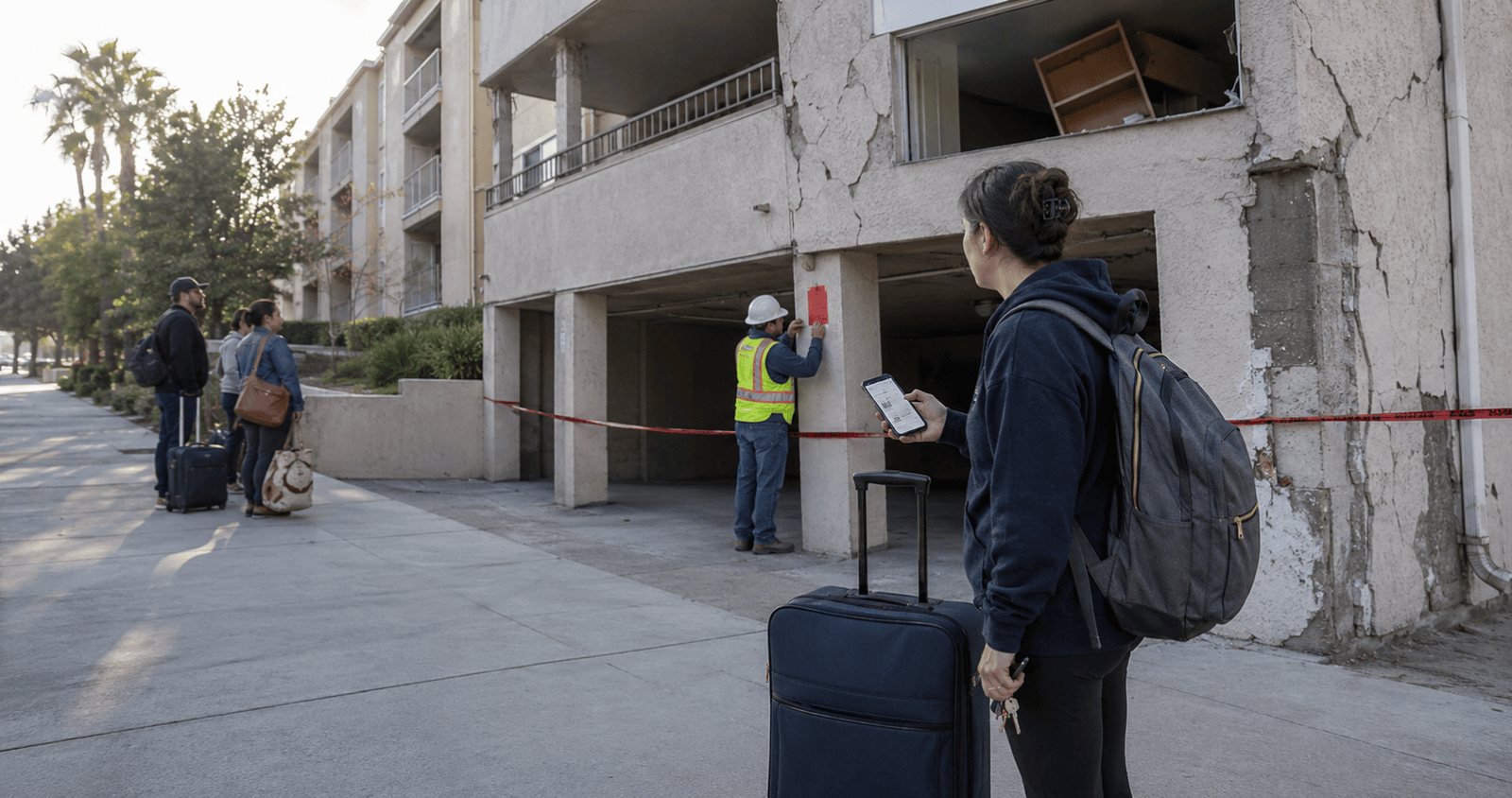
Red Tagged Buildings Are The Real Renter Scenario
Picture what actually happens to a renter in a significant earthquake.
Your belongings may be fine. Some broken glass, a fallen shelf, nothing catastrophic. The building, however, gets inspected and red tagged as unsafe to occupy.
You cannot go home. Not for a weekend. Potentially for months while structural assessment and repairs happen, if they happen at all.
Meanwhile you need somewhere to live, in a rental market where thousands of other displaced people are looking for the same thing at the same time, which is exactly when prices spike.
Your standard renters policy will not help, because loss of use only triggers for covered perils, and earthquake is excluded from it. Your landlord is not obligated to house you.
That is the scenario earthquake coverage is genuinely built for. Not the broken television. The three months of displacement with no deductible standing in the way.
How You Buy It
You do not buy directly from California's earthquake authority. You buy through the carrier that already writes your renters policy, if they participate.
The program is a publicly managed, privately funded pool created in 1996 after the Northridge earthquake, and it is the largest residential earthquake insurer in the country. Participating insurers sell the product to their own policyholders.
So the call is to your existing insurer, not to a new company. Ask whether they participate and what a renters contents and loss of use policy would cost at your address.
Outside California the mechanics differ. In Oregon and Washington, renters earthquake coverage is more often placed through the standard market, sometimes as an endorsement added directly to an existing policy rather than as a separate contract. Availability shifts by carrier and by address, so confirm current options for your state rather than assuming.
The Law Behind The Paperwork You Keep Ignoring
If you rent in California, you have probably seen an earthquake insurance offer arrive with your renewal and thrown it out.
There is a reason it keeps appearing. California law requires residential property insurers to offer earthquake coverage, and to re offer it every other year if you decline.
That mailing is not marketing. It is a statutory obligation, and it exists specifically because so few Californians carry the coverage. Roughly nine in ten California homeowners go without it.
Next time it arrives, read the number before deciding. For a renter the figure is usually far smaller than expected.
One More Feature Worth Knowing
California's program also includes emergency repair coverage, with the first fifteen hundred dollars carrying no deductible.
That covers things like boarding up broken windows or clearing shattered glass out of furniture, and damage that follows from the quake itself, such as rain getting in through a break.
Confirm what applies to your specific policy form, since coverages differ between the renter and homeowner versions. But it is another piece that pays before any percentage deductible enters the picture.
What This Coverage Will Not Do
Worth being clear about the limits before you buy, because earthquake policies are narrower than people assume.
It does not repair the building. That is your landlord's problem and their insurance. You are insuring your belongings and your displacement, nothing structural.
It does not cover flood or tsunami. Water damage following a quake, including tsunami inundation along the coast, generally falls under flood exclusions and needs a separate flood policy. Two different catastrophes, two different products.
It does not cover land movement generally. Landslides, mudflow, and sinkholes are usually excluded even when a quake triggered them. Policy language matters here and varies by carrier.
It does not cover a vehicle. Your car crushed in a collapsed carport goes through comprehensive auto coverage, not your renters earthquake policy.
It rarely covers pre existing damage. Insurers scrutinize whether cracks and structural issues predated the event. Photographing your unit at move in helps you here more than almost anything else.
None of that undermines the case for coverage. It just means you should know which gaps remain open after you buy.
Before A Quake, Do These Three Things
Preparation affects your claim more than most renters realize.
Photograph everything now. Room by room, including inside closets and cabinets. Store the file in cloud storage rather than on a device that could be buried in a red tagged building. After a major event, memory is a poor inventory and adjusters value conservatively without documentation.
Secure heavy furniture. Bookcases, wall units, and tall dressers cause a large share of quake related property damage and injuries. Straps and anchors cost very little. Many landlords permit them, and some will install them if asked in writing.
Know your building. Soft story construction, meaning residential floors over open parking or storefronts, performed badly in past California earthquakes and is the type most likely to be red tagged. Many cities have retrofit ordinances and public records of which buildings have complied. Knowing where your building stands tells you how likely the displacement scenario really is.
Who Should Carry It And Who Can Reasonably Skip
An honest framework rather than a sales pitch.
Strong case for carrying it. You live in a seismically active area, particularly in an older building or a soft story structure with parking underneath. You would struggle to fund three months of emergency housing out of savings. You own enough that replacing it would genuinely hurt. You have no family nearby to stay with.
Weaker case. You own very little, you have savings or family you could fall back on for months, and your building is newer construction built to modern seismic code.
Notice that most of the strong case is about displacement rather than belongings. That is the correct way to think about this coverage.
The question to actually ask. Not whether your contents claim would clear the deductible. Ask where you would sleep for three months if your building were red tagged tomorrow, and what that would cost you.
Running Your Own Numbers
Three figures settle it.
Find what a renters earthquake policy costs at your address and your contents limit. Your existing insurer can quote it, or you can use a premium estimator to get in the range.
Calculate your deductible in dollars, not percent. Multiply your contents limit by the percentage you would choose. That is the real number.
Then estimate three months of local temporary housing at post disaster prices. In most metropolitan areas that figure is large, and it is the figure the coverage protects against without a deductible.
Compare the annual premium to that third number. For most renters in seismic zones, the arithmetic looks better than the deductible objection suggests.
The One Sentence Version
Judge this coverage on displacement, not on broken belongings.
The percentage deductible makes it useless for small losses and that is by design. What it actually buys a renter is somewhere to live when the building is condemned, with no deductible standing between you and that money.
Call your current insurer this week and ask two things. What a renters earthquake policy costs at your address, and whether loss of use carries a deductible on their form. Those two answers tell you almost everything.
This article is for general educational purposes and is not insurance advice. Coverage terms, deductible options, availability, and program features vary by insurer, by state, and over time. Read your full policy form and declarations page, and confirm current details with a licensed agent or with the California Earthquake Authority directly.
Some images in this article were generated using artificial intelligence and are for illustrative purposes only.