The Question Is Not Whether You Are Covered, It Is What Caused It
Search whether renters insurance covers a move and you will find flatly contradictory answers. Some sources say yes, some say no, some say rarely.
They are all describing the same policy from different angles, and the resolution is simple once you see it.
The Insurance Information Institute puts it precisely. Renters policies cover your belongings at your residence, in transit, and in storage facilities, but will not pay for damage done to your property while it is being handled by the movers.
So your coverage travels. What it does not do is follow your possessions into someone's hands.
Perils travel with you. Handling does not.
What Travels With Your Belongings
The named perils on your policy apply during a move.
Theft. Boxes taken from a truck, a driveway, or a loading dock.
Fire. A truck fire, or fire at a storage facility.
A vehicle accident. If the moving truck is in a collision and your belongings are destroyed, that is a covered loss.
Vandalism and weather related damage. The same as anywhere else.
These are the same perils that would apply in your apartment, and they continue applying while your things are on the road.
What Stays Behind
The exclusions during a move are consistent across carriers and they cover most of what actually goes wrong.
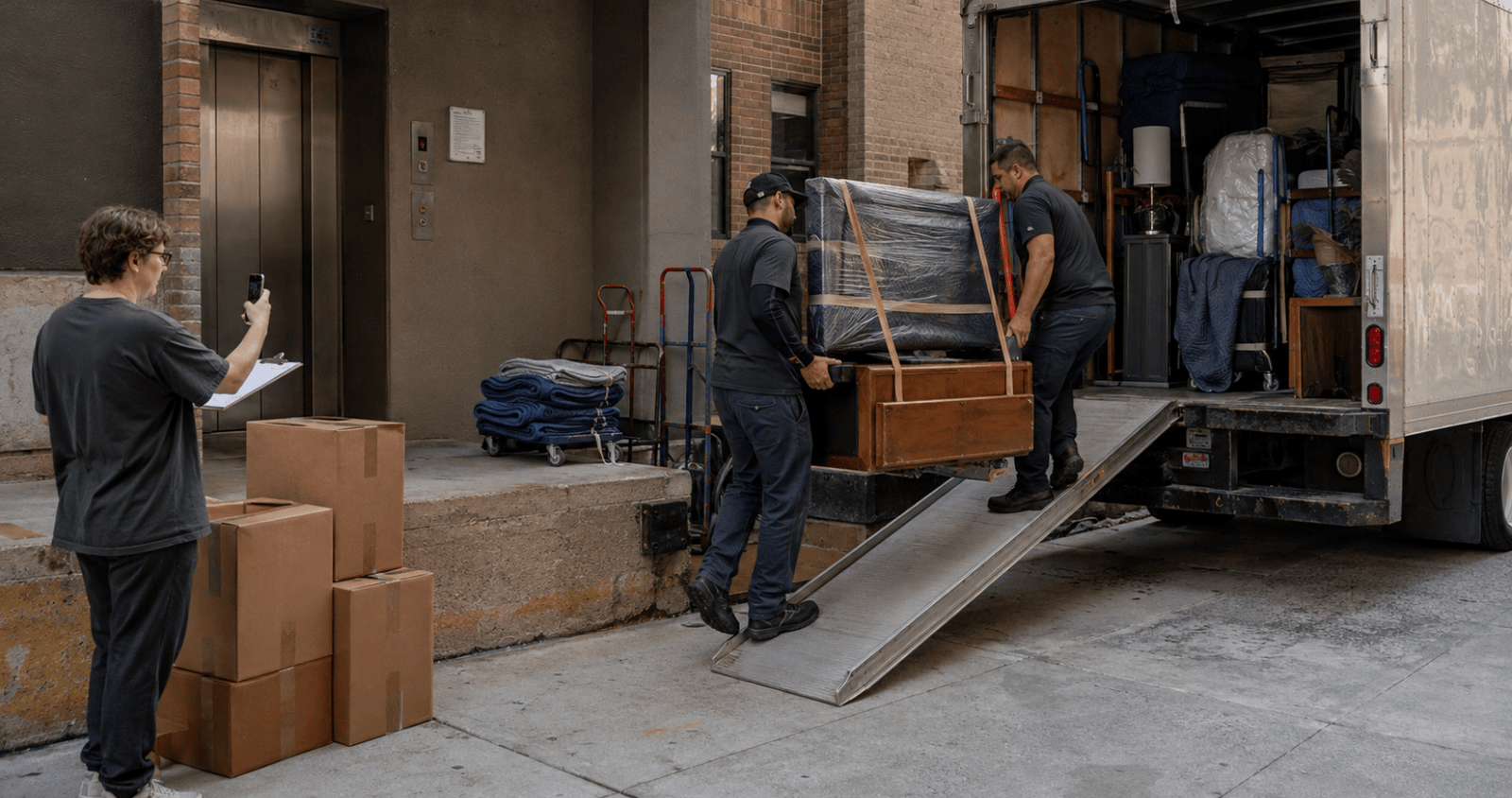
Movers dropping or damaging something. Whether packing, carrying, or transporting. This is the largest category of moving day damage and your policy does not touch it.
You dropping something. Accidental damage caused by the policyholder is not a covered peril. The television you carry down a stairwell yourself is your own problem.
Poor packing. Glassware that breaks because it was not wrapped properly is a packing failure rather than a covered event.
A friend dropping something. The helpful friend who breaks your flat screen is not a covered loss either, though depending on circumstances their own liability coverage might respond.
The rental truck itself. Damage to the truck is not covered by your renters policy. That requires coverage from the rental company.
Notice the pattern. Sudden external events are covered. Human handling is not.
The Limit That Applies In Transit
Even for covered perils, the amount available is smaller than your full policy limit.
Off premises coverage is commonly capped at around ten percent of your total personal property limit.
So thirty thousand dollars of coverage gives you roughly three thousand dollars of protection while your belongings are away from a residence.
Read that against a truck holding an entire apartment. If the truck is stolen or burns, three thousand dollars does not replace what was inside it.
This is the single most important number to check before a move, and almost nobody does.
The Sixty Cent Rule
Now the moving company side, which is where most people assume they are protected.
Under federal law, interstate movers must offer two liability options.
Released value protection is free and it is the default. It compensates by weight at sixty cents per pound.
Sixty cents. Per pound.
Progressive gives the arithmetic plainly. A twenty pound dining chair worth fifty dollars produces a payment of twelve dollars.
Now apply that to a television. Light, expensive, and fragile. A fifty five inch flat screen might weigh forty pounds, which is twenty four dollars against a replacement cost in the hundreds.
Released value protection is not insurance in any meaningful sense. It is a minimum liability floor, and it was never designed to make anyone whole.
Full Value Protection
The paid alternative from your mover.
Under full value protection, the mover is liable for the replacement value of items in your shipment. They must repair, replace, or compensate you for what they lose or break.
Cost typically runs around one percent of the total declared value of your belongings.
That is meaningfully better than sixty cents a pound, and for anyone moving a furnished apartment it is usually worth taking. Ask the mover to provide the specific terms in writing rather than accepting a verbal description, since coverage limits and exclusions vary.
A Legal Point Worth Knowing
Here is a detail almost nobody explains and it matters.
The liability coverage a moving company offers for damage or breakage is not technically insurance, and it is therefore not governed by state insurance laws.
Read that again. If a mover disputes your claim, you do not have the state insurance department complaint route you would have with a carrier. You are in a contractual dispute with a transportation company.
Federal moving regulations provide their own consumer protections for interstate moves, and those are worth understanding before you sign. But the regulatory backstop is different, and thinner, than the one behind an actual insurance policy.
That is the strongest argument for the third option.
Third Party Moving Coverage
Separate policies exist and they fill the gap between your renters coverage and your mover's liability.
Trip transit insurance covers your personal property against theft, disappearance, and fire while in transit or storage. It can be written for the full value of your property, or as excess coverage sitting above what the mover provides.
Third party moving insurance from outside providers typically costs between one and five percent of your possessions' value.
For a move involving genuinely valuable belongings, a long distance haul, or a shipment sitting in storage for a period, this is the product that actually protects you. It is regulated as insurance, which is the point.
Storage Between Leases
The gap between apartments is its own exposure and it catches people every year.
Standard policies generally cover belongings in a storage unit, though at off premises limits rather than your full limit.
Some policies cover items in temporary storage during a move for a defined window, often around thirty days. Beyond that window, treatment varies.
Two things to ask your insurer before you put anything in storage.
What limit applies to a storage unit specifically, since it may be lower than your general off premises limit.
Is there a time limit, and what happens if the gap between leases runs longer than expected.
If you are storing an apartment's worth of belongings for two months between leases, that is a conversation worth having in advance rather than discovering the answer afterward.
Do Not Create A Coverage Gap
The timing mistake, and it is easy to make.
Your old policy should remain in force until your lease ends. Your new policy should start when your new lease begins. Ideally they overlap by a day or two rather than meeting exactly.
Call your insurer before the move and give them both dates. Most carriers simply update the address on an existing policy, which is the cleanest outcome.
Do not cancel the old policy the day you hand back the keys and start the new one when you unpack. That gap is precisely when your belongings are most exposed.
Moving To Another State
An extra step people miss.
If your move crosses state lines, you may need a new policy rather than an address change, since insurance is regulated at the state level and your carrier may not write in your destination.
In most cases this is a phone call. But confirm before the move rather than after, because discovering your carrier does not operate in your new state on arrival day is a bad time to find out.
A move is also the natural moment to reassess the coverage amount itself, since you are handling everything you own and can see plainly whether the limit still fits.
The Certificate Your Building May Require
A practical detail that delays moves.
Many buildings require a certificate of insurance from the moving company before permitting access to elevators or loading docks. In some cities this is effectively mandatory.
Ask both buildings, the one you are leaving and the one you are entering, whether they require a certificate and what limits they need. Then pass that to your mover early.
Booking a mover who cannot produce the required certificate is a common reason moves get rescheduled at the last minute.
What To Do Before Moving Day
Six things, in rough order.
Inventory everything as you pack. Photograph items and note what goes in each box. This is the easiest moment you will ever have to build a complete record, and it doubles as your claim evidence.
Check your off premises limit. Ten percent of your personal property coverage is the usual figure, and it is what applies in transit.
Decide on mover liability. Released value is free and nearly worthless. Full value protection costs about one percent of declared value.
Consider third party coverage if the shipment is valuable or a long haul, since it is regulated as insurance and the mover's liability is not.
Confirm storage terms if anything sits between leases.
Sync your policy dates so there is no gap, and update your address.
Move irreplaceable things yourself. Documents, jewelry, hard drives, medications. No coverage of any kind makes an irreplaceable item replaceable.
Choosing A Mover Is A Coverage Decision
Because the mover carries most of the risk your policy will not, vetting them is part of protecting your belongings.
Check their federal registration. Interstate movers are required to register with federal regulators, and you can verify a company's registration and complaint history before booking.
Get the estimate in writing and understand whether it is binding or non binding. Disputes over final charges are among the most common moving complaints.
Ask for their liability options in writing, including what full value protection covers and what deductible applies to it.
Be cautious with unusually low quotes. Rock bottom pricing combined with a large deposit demand is a recognized pattern in moving fraud, and belongings held hostage over disputed charges is a genuine phenomenon rather than an urban legend.
Confirm they carry their own cargo and liability coverage, separate from the protection they sell you.
A reputable mover with full value protection removes more risk from a move than any adjustment to your renters policy can.
After The Move
Two things worth doing in the first week.
Inspect and report damage promptly. Moving companies impose claim deadlines, and they are often shorter than people expect. Unpack the valuable and fragile items first specifically so you can identify damage while a claim is still open to you.
Confirm your policy shows the new address. A policy listing the wrong address is a genuine problem at claim time, and address changes occasionally do not process correctly. Pull up your declarations page and read it rather than assuming the phone call worked.
While you are there, check whether the coverage amount still fits. Moves are when people buy furniture, and a limit set three apartments ago is often well behind what you now own.
The Short Version
Your renters policy follows your belongings onto the truck and into storage, but only against the perils it already covers, and only up to roughly ten percent of your limit.
It does nothing about the most likely form of moving damage, which is someone dropping something.
So three decisions. Take full value protection rather than the free sixty cents a pound. Add third party coverage if the shipment is worth protecting properly. And sync your policy dates so there is no day where nothing applies.
Then photograph everything as you pack, because you will never have a better opportunity to build the inventory you should have had all along.
This article is for general educational purposes and is not insurance advice. Off premises limits, storage time limits, transit treatment, and mover liability options vary by insurer and by carrier. Confirm details with your insurer and get mover liability terms in writing.
Some images in this article were generated using artificial intelligence and are for illustrative purposes only.