The Furniture Is Not Yours And You Are Still Responsible For It
Furnished rentals invert the usual insurance calculation.
In an unfurnished apartment, most of what surrounds you is yours. Your sofa, your bed, your table, your appliances in some cases. Your personal property limit needs to be large because it is covering a whole household.
In a furnished rental, most of what surrounds you belongs to someone else. Which means you need considerably less personal property coverage.
It also means you are living among several thousand dollars of property you did not buy and could be asked to pay for.
Less coverage needed, more exposure to someone else's things. That is the trade, and it changes which parts of a policy matter.
What The Landlord Already Insures
Landlord policies include a component covering property the owner leaves on the premises.
That typically extends to furniture, sofas, beds, dining tables, chairs, and wardrobes, plus appliances including refrigerators, ovens, microwaves, washers, and dryers.
So the furniture is insured, against fire, theft, vandalism, and other covered perils.
What that coverage does not do is protect you. It protects the owner's investment, and when they use it, their insurer can look at who caused the loss.
Where Your Exposure Actually Sits
Here is the part that requires an honest answer rather than a confident one, because sources genuinely differ.
The argument that your liability responds. Property management and insurance guidance frequently states that when a tenant damages furniture the landlord provided, the landlord can submit a claim against the tenant's renters insurance liability coverage, and that payouts can fund repair or replacement.
The argument that it does not. Standard renters liability contains an exclusion for property rented to or occupied by the insured, or property in your care, custody, and control. Furniture inside the unit you rent arguably sits squarely inside that exclusion, which is the same reason your liability will not pay for scratched floors or a damaged countertop.
Both positions appear in reputable places. The practical resolution is that treatment varies by policy form and by circumstance, and the honest advice is to ask your insurer the specific question rather than assuming either answer.
Ask it this way. If I accidentally damage furniture my landlord provided in the unit I rent, does my liability coverage respond, or is that excluded as property in my care and custody.
Get the answer in writing. It is a five minute question with a several thousand dollar consequence.
The Deposit Is The Likely Mechanism
Regardless of how your insurer answers, one path is certain.
Damage to a landlord's furnishings comes out of your security deposit first, exactly as damage to the unit does.
That alignment is not accidental. The deposit exists to cover damage beyond normal wear and tear, and furnished rentals expand what falls into that category considerably.
A stained sofa, a scratched dining table, a cracked television mount, a burned countertop. In an unfurnished apartment none of those exist as line items. In a furnished one they are all deposit deductions waiting to happen.
Which makes the next section the most valuable thing on this page.
Move In Documentation Matters Far More Here
In an unfurnished apartment you photograph walls, floors, and fixtures.
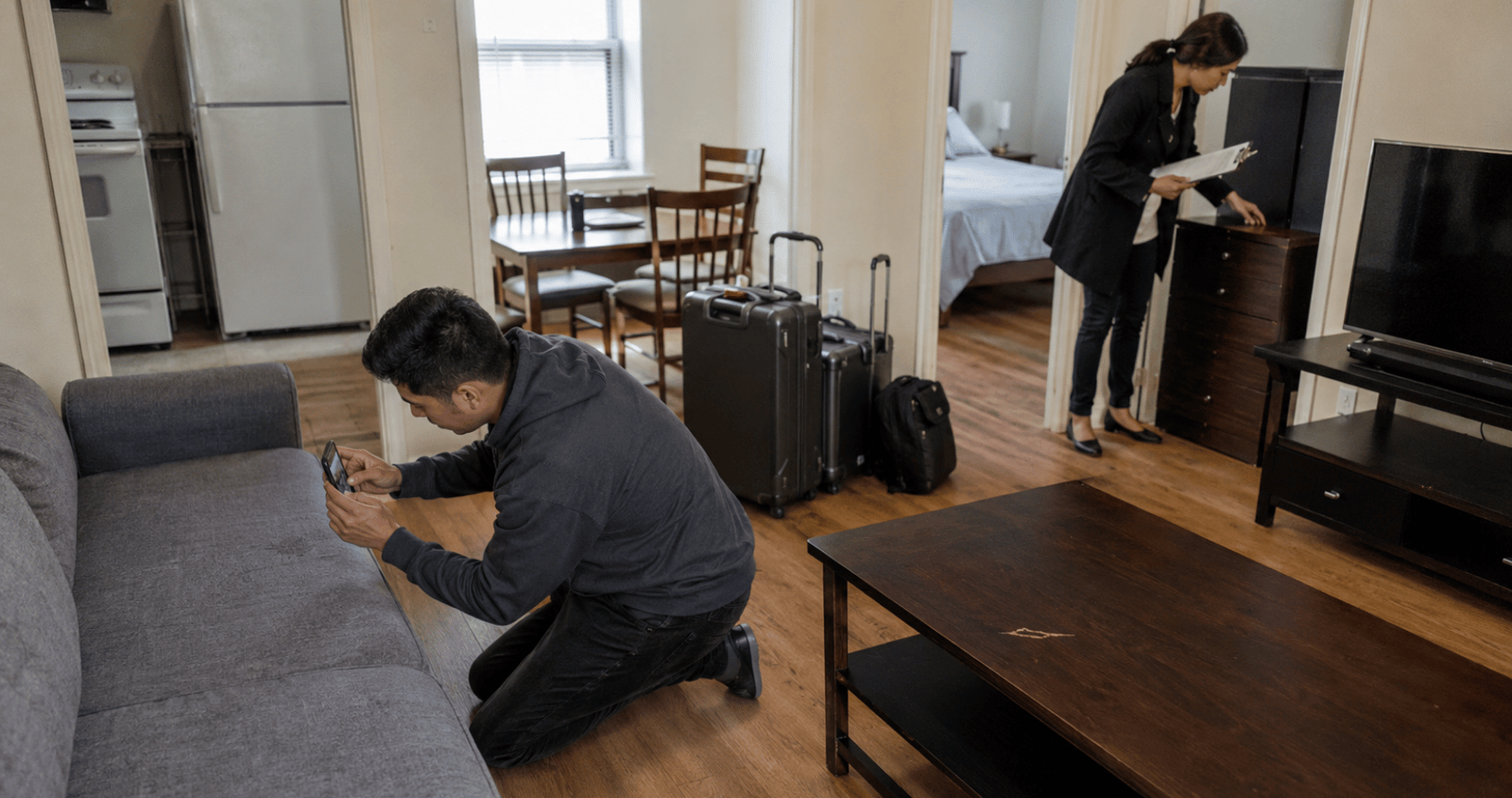
In a furnished rental you photograph all of that plus every piece of furniture, every appliance, and every item on the inventory list.
Photograph each piece individually, including existing marks. Scratches on the table, a stain on the sofa arm, a chip on a countertop, a scuff on a dresser.
Photograph the underside and back of furniture where damage often already exists and where nobody looks until move out.
Test and photograph every appliance, including running the dishwasher and checking that the oven heats.
Get a written inventory list from the landlord and walk it item by item, noting condition on the document itself.
Send your photographs to the landlord by email the day you move in, and keep the sent message.
This is a longer process than an unfurnished walkthrough, and it is the single most effective protection against a disputed deposit at move out. Furnished rentals produce more deposit disputes than unfurnished ones for the obvious reason that there is simply more to argue about.
How Much Personal Property You Actually Need
Lower than an unfurnished rental, and higher than people assume.
Do the honest count of what you brought with you.
Clothing, which is usually the largest category and is consistently underestimated. Electronics, including a laptop, a phone, a tablet, and any monitor or peripherals. Kitchen items you added. Bedding and towels if you brought your own. Books. Tools. Sporting equipment. A bike. Anything sentimental or valuable that came with you.
Someone arriving with two suitcases needs far less than someone relocating a household into furnished housing for a year.
There is no rule of thumb worth applying here. Count what you brought, add a margin, and set the limit accordingly.
One thing to watch. If you brought anything genuinely valuable, a camera kit, an instrument, jewelry, category sublimits still apply and scheduling still works the same way.
Everything Else Works Normally
Worth stating clearly, because the furniture question dominates and the rest of the policy is unchanged.
Liability toward other people works exactly as it does anywhere. A guest injured in your unit, damage to a neighbor's property, an incident away from home.
Loss of use still applies. If a covered event makes the unit uninhabitable, your policy pays the difference between your normal costs and your displaced costs. Being in a furnished rental does not change that.
Theft of your belongings is covered, at home and away.
The exclusions are identical. Flood, earthquake, pests, sewer backup without an endorsement.
So a furnished rental is not a different product. It is the same policy with a smaller property number and a bigger deposit conversation.
Your Landlord Cannot Pick Your Insurer
A point worth knowing because furnished and corporate housing arrangements sometimes blur it.
A landlord can require you to carry renters insurance as a lease condition. That is standard and enforceable.
What they cannot do is purchase a policy on your behalf or choose your provider. A renters policy is a personal contract between you and the insurance company, and selecting the carrier is yours.
If a furnished housing provider presents a specific product at signing, you can decline it and buy your own, provided your policy meets whatever the lease requires. Compare before accepting the one at the desk.
Corporate Housing And Short Stays
Furnished rentals cluster around specific situations, and each has a wrinkle.
Corporate relocations. Check whether your employer's relocation package includes coverage or reimbursement for it. Many do and few employees ask.
Travel healthcare and contract work. Frequent moves across state lines mean address changes and occasionally new policies, since insurance is regulated by state. Confirm your carrier writes in your next assignment's state before you go.
Short leases. Most renters policies are written for twelve month terms and auto renew. If your stay is shorter, ask about cancellation terms. Many carriers refund unused premium on cancellation, and some app based insurers offer genuinely flexible month to month arrangements suited to short stays.
Between homes. People selling one house and buying another frequently land in furnished rentals. If you own belongings in storage during that period, remember that storage typically falls under off premises limits and may carry a time cap.
The Question Nobody Asks At Signing
Two things worth clarifying before you take keys, both of which prevent expensive confusion later.
What happens if a landlord provided appliance fails? Repair or replacement of the owner's appliance is theirs. Any damage to your belongings from that failure runs through your policy. Knowing who to call saves days.
Is the inventory list part of the lease? If a furniture inventory is attached to your lease, it becomes a contractual document, and the condition notes on it carry weight at move out. Treat it as seriously as the lease itself.
Setting Your Numbers
Four decisions.
Personal property. Count what you actually brought. This will be far lower than an unfurnished rental and should not be zero.
Liability. Three hundred thousand rather than the hundred thousand default, for the same reasons that apply anywhere. Furnished or not, a kitchen fire reaches neighbors.
Settlement basis. Replacement cost, particularly since electronics are a disproportionate share of what people bring into furnished housing.
Deductible. One you could genuinely cover, noting that with a smaller property limit a high deductible eliminates more of your potential claims.
Then photograph everything, both what you brought and what was already there.
Move Out Is Where This Gets Decided
Everything documented at move in exists for one afternoon, and it is worth planning that afternoon properly.
Walk the inventory list again, item by item, in the same order you did at move in.
Photograph everything a second time, matching your original shots where you can. Two images of the same sofa arm, taken twelve months apart, settle an argument in seconds.
Clean thoroughly rather than adequately. Furnished units are frequently held to a higher standard because the next tenant moves directly in, and cleaning charges are the most common deduction after damage.
Be present for the inspection if the landlord permits it. Disagreements resolved in person, while both parties are looking at the same sofa, rarely become disputes.
Get the condition assessment in writing before you hand back keys.
Know your state's deposit timeline. Most states require return within a defined number of days along with an itemized list of deductions, and landlords who miss that requirement can forfeit the right to withhold.
When Normal Wear And Tear Becomes The Argument
The distinction that governs most furnished rental disputes.
Normal wear and tear is deterioration from ordinary use. Fading upholstery, a mattress softening, carpet flattening in a walkway, minor scuffs on a table.
Damage is something beyond that. A tear, a burn, a stain, a break.
Landlords cannot charge for wear and tear, and the line between the two is where furnished rentals generate friction, because furniture ages visibly and a twelve month tenancy leaves marks on anything upholstered.
Two things help your position.
Your move in photographs, which establish the starting condition.
The age of the item, since a five year old sofa is expected to look like one. If a landlord charges full replacement for an item that was already well used, that is worth questioning politely and in writing.
None of this requires an adversarial posture. Most disputes are the product of two people remembering the same sofa differently, and photographs simply remove the remembering.
The Practical Version
You need less personal property coverage and the same everything else.
What changes is the documentation. In a furnished rental you are living among someone else's belongings, and every existing scratch you fail to photograph on day one becomes a scratch you might pay for on the last day.
Spend an hour on move in day photographing furniture rather than fifteen minutes photographing walls. Email the results to your landlord and keep the sent message.
Then ask your insurer one question about whether your liability responds to damage to landlord furnishings, and write down the answer.
That is the whole difference between insuring a furnished rental and insuring any other one.
This article is for general educational purposes and is not insurance or legal advice. Liability treatment of landlord owned furnishings varies by policy form and by state, as do deposit rules and lease terms. Confirm details in writing with your carrier and read your lease.
Some images in this article were generated using artificial intelligence and are for illustrative purposes only.