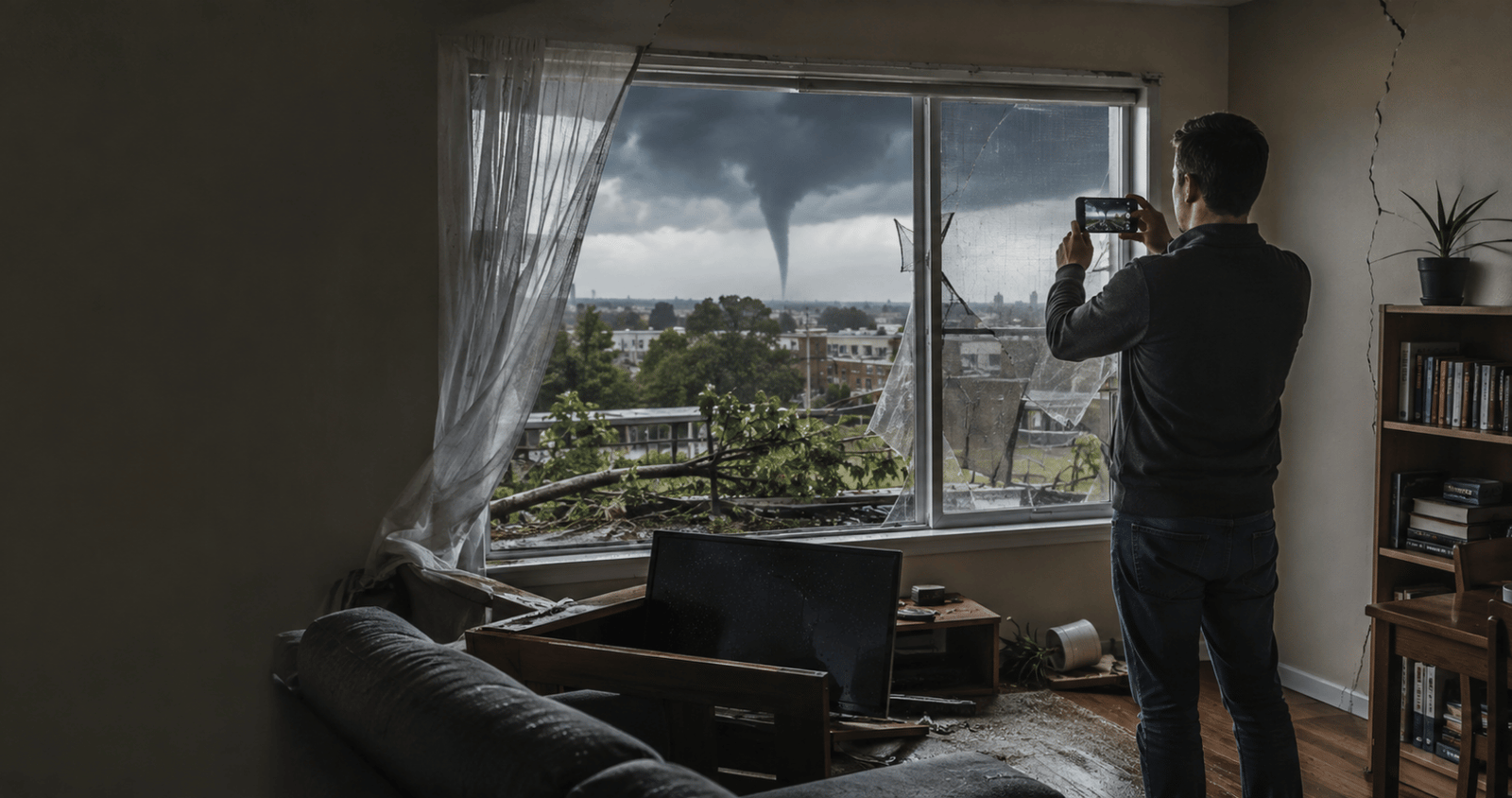
The Risk You Watch For Is Covered, The One You Ignore Is Not
Missouri renters watch the sky. Spring arrives, sirens sound, everyone knows what a wall cloud looks like.
That risk is covered. Tornado damage to your belongings falls squarely inside a standard renters policy.
The risk almost nobody in Missouri thinks about is an earthquake, and that one is excluded completely. Southeast Missouri sits on a fault system the USGS estimates has a twenty five to forty percent probability of producing a magnitude six or greater event within the next fifty years.
Those two facts together explain most of what a Missouri renter needs to understand.
Tornado Damage Sits Inside Your Policy
Missouri averages around thirty tornadoes a year, with confirmed EF-2 and EF-3 touchdowns across the Kansas City and St. Louis corridors most years. The 2011 Joplin tornado remains the reference point for how severe this gets.
Your policy handles it. Tornado damage is wind damage, and windstorm is a named peril on every standard renters form. If a tornado destroys your furniture, electronics, and clothing, that is a straightforward personal property claim.
The building itself is your landlord's problem through their policy. Yours covers what was inside.
Two things to check on your declarations page before spring.
A separate wind and hail deductible. These have become common in Missouri, sometimes expressed as a percentage of your coverage rather than a flat dollar figure. That produces a much larger number than the deductible applying to a kitchen fire.
Your loss of use limit. After a significant tornado, local housing fills fast and prices rise. Divide your limit by what a week of local accommodation would cost under those conditions.
The New Madrid Gap
Now the exclusion.
The New Madrid Seismic Zone runs through southeastern Missouri, from around Cape Girardeau down through the Bootheel counties. It has not produced a major event since 1812, which is precisely why nobody prepares for it.
Standard renters insurance excludes earthquake damage entirely. Every carrier, no exceptions, and the same is true of homeowners and landlord policies.
Coverage is available separately or as an endorsement, and Missouri has an unusual pricing profile worth understanding.
Premiums are relatively low compared to coverage on Pacific fault lines, because the event frequency is lower.
Deductibles run high, commonly ten to twenty percent expressed as a percentage of your coverage rather than a flat amount.
That combination means the coverage is inexpensive to carry and poor at small claims. It is built for the catastrophic scenario, not for a fallen bookshelf.
For a renter the relevant question is not whether your belongings would clear a fifteen percent deductible. It is where you would live for months if your building were declared unsafe, and whether the policy includes loss of use for that period.
Ask your insurer two things. What renters earthquake coverage costs at your address, and whether loss of use carries a deductible on their form.
Old Sewers In Both Big Cities
This is the risk most likely to actually affect a Missouri renter, and it is excluded from every standard policy.
St. Louis and Kansas City both operate aging sewer infrastructure, and backup is a frequent cause of renter property losses across both metros. Heavy rain overwhelms the system, water pushes backward through drains, and it enters ground floor and basement units first.
Standard renters insurance excludes sewer and drain backup completely. Not reduced. Excluded.
A water backup endorsement closes it, and it is inexpensive. Ask for it by name as the water backup and sump discharge or overflow endorsement.
For anyone renting at or below ground level in either metro, this is the single most sensible addition available.
River Flooding Is Its Own Exclusion
Missouri sits between two major river systems, and flooding along the Missouri and Mississippi affects communities statewide.
Flood is excluded from every standard renters policy, and it needs a separate policy through the National Flood Insurance Program or a private carrier. Renter flood policies cover contents only, which makes them considerably cheaper than the homeowner version.
Note that this is a different exclusion from the sewer backup above. Buying flood coverage does nothing about a backup, and a backup endorsement does nothing about a river. Renters in low lying areas near either river may reasonably need both.
Check your address on the FEMA map rather than assuming your neighborhood is unaffected.
Ice Storms Do Quiet Damage
Missouri winters produce ice storms capable of paralyzing the state, and they cause damage in ways renters underestimate.
Ice brings down limbs and power lines. Extended outages follow. Pipes freeze in older buildings, and a pipe that bursts suddenly is a covered event for your belongings.
Food spoilage from a long outage is a separate question. Coverage depends on what caused the outage, and refrigerated property usually carries a small sublimit if it is covered at all. Ask about a food spoilage endorsement if extended winter outages are common where you live.
The weight of ice and snow is generally a covered peril for damage to your property.
After A Tornado, Order Matters
Missouri produces enough of these that the process is worth knowing in advance.
Document before you clean or discard anything. Photos and video of every affected item and every entry point. Note specifically where water came from if there is water, since wind driven rain through a breach is covered while ground water is not.
Make temporary repairs to prevent further damage if it is safe, and keep the receipts. Policies generally require you to mitigate further loss.
Do not throw damaged belongings away until an adjuster has seen them or released you. They are your proof.
File promptly. After a significant tornado, claim volume across the region is enormous and adjuster availability tightens within days. Early filers move through faster.
Keep a running expense log from the moment you are displaced. Hotel, meals above your normal grocery spending, extra fuel, pet boarding, storage. All of it is claimable under loss of use and none of it gets paid without receipts.
One nuance specific to wind events. If a tornado breaches the building and rain then enters through that opening, the resulting damage is typically treated as a covered wind claim, because the rain got in because of wind damage. Water rising from the ground during the same storm is flood and is not covered. Note which happened.
What Missouri Renters Pay
Estimates cluster in a workable range.
Several analyses put Missouri renters insurance around seventeen to twenty eight dollars a month. One property management figure puts the state average near two hundred seventy six dollars a year. Carrier advertised rates run lower for minimal coverage.
The more useful finding is how little location matters here. The price difference between Missouri's most and least expensive cities is roughly fourteen dollars a month.
That is a narrow spread compared to states like Michigan or Texas, and it means shopping between carriers will do more for your premium than moving neighborhoods.
Get three quotes at matched limits and ignore the averages, including these.
What The Law Actually Requires
Missouri has no statute requiring renters insurance. Landlord tenant relationships are governed by state statute, and insurance is left to the lease.
Landlords can absolutely require it, and the practice has become standard across the Kansas City and St. Louis metros. The requirement must be clearly stated in the lease with the minimum coverage amounts specified.
Most Kansas City property managers require at least one hundred thousand dollars in liability coverage and ask to be named as an interested party so they are notified if the policy lapses.
That interested party listing is free and informational. It does not grant the landlord coverage under your policy, which is the appropriate arrangement.
Read the insurance clause before you shop, then buy to match it.
Why Landlords Push This
Worth understanding, because the requirement makes more sense once you see the mechanism.
When a tenant causes accidental damage, a grease fire or an overflowing tub, the landlord's policy covers the building but not the tenant's negligence. Without renters insurance the tenant cannot pay, so the landlord files on their own policy and their premiums rise.
Requiring your coverage keeps their claims history clean. It also protects you from a bill you could not absorb, which is why the requirement is not really adversarial.
Setting Your Limits
Walk your apartment and total replacement costs at current prices. Furniture, mattress, electronics, kitchen equipment, all your clothing, tools, sporting gear.
Most renters guess low and land between fifteen and twenty five thousand dollars once they actually count.
Then check the settlement basis. Actual cash value pays depreciated value, replacement cost pays what a comparable new item costs today. On electronics that gap is enormous, and the words appear on your declarations page next to the personal property line.
Finally, liability. Most policies default to one hundred thousand dollars, which is also what most Missouri landlords require. Meeting the minimum and stopping there is the common mistake.
A tornado does not create liability, but a kitchen fire that spreads through a multi unit building does. Raising liability to three hundred thousand typically costs only a few dollars a year and it is the best value change available.
Getting The Price Down
Bundling with auto is usually the largest single discount.
Raising your deductible lowers the premium, though it also raises the bar for filing smaller claims and does nothing about a separate wind and hail deductible.
Security systems, smoke detectors, and claim free history all factor in at most carriers.
Credit affects pricing more than many renters expect, which is why two people in the same building can receive very different quotes for identical coverage.
Before Storm Season
Three things, and none of them takes long.
Video every room with closets and drawers open, narrating what things are and capturing serial numbers. Store the file in cloud storage rather than on the laptop that could be destroyed.
Find three numbers on your declarations page. Your standard deductible, any separate wind and hail deductible, and your loss of use limit.
Know your shelter plan. This is not insurance advice, but a renter in a building without a basement should know where they are going when the sirens start. Coverage replaces belongings. It does not do anything else.
Three Calls Worth Making
Ask about a water backup endorsement. With aging sewers in both major metros, this is the gap most likely to actually affect you and the cheapest to close.
Ask what renters earthquake coverage costs. If you rent in southeastern Missouri, this is the largest uncovered risk you carry, and the premium here is lower than in Pacific fault states.
Check your wind and hail deductible. Find the number before spring rather than during a claim.
Missouri gets the unusual distinction of having its most visible risk fully covered and its least visible risk fully excluded. Knowing which is which is most of the work.
This article is for general educational purposes and is not legal or insurance advice. Coverage terms, deductibles, endorsements, and pricing vary by insurer and can change. Confirm details with your carrier, your lease, or the Missouri Department of Commerce and Insurance.
Some images in this article were generated using artificial intelligence and are for illustrative purposes only.