Homeowner Liability With Apartment Level Limits
Here is the mismatch at the center of renting a house.
Homeowners policies start liability at three hundred thousand dollars by default. Standard renters policies start at one hundred thousand.
That gap exists for a reason. Owning a property with outdoor and exterior spaces creates far greater exposure to third party injury claims than renting an apartment unit does.
Now rent a house. You have the driveway, the walkway, the yard, the porch, and the sidewalk. All the exposure a homeowner has.
And you almost certainly have the hundred thousand dollar default, because that is what renters policies come with and what most leases require.
That is the single most important thing to fix when you move from an apartment into a house.
What The Yard Actually Adds
The scenarios are concrete rather than theoretical.
A guest slips on an icy sidewalk. Someone trips over a sprinkler head. A delivery driver is bitten by your dog near the porch. A visitor falls in the driveway.
All of those fall under your renters insurance rather than your landlord's policy, because they arise from areas you occupy and control.
In an apartment, most of that space belongs to the landlord. A fall in a hallway or a parking lot is a premises liability question for the property owner. In a rented house, the same fall is yours.
One insurance professional puts it plainly. Those claims get expensive fast, and basic liability coverage may not be adequate anymore.
The Lease Decides Who Owns The Hazard
Since responsibility drives liability, the lease is the document that matters.
Read it specifically for who handles the following.
Snow and ice removal from walkways, steps, and the driveway.
Lawn and landscaping, including tree limbs and overgrowth.
Minor repairs, and where the line sits between tenant and landlord.
Exterior lighting, since inadequate lighting is a common factor in fall claims.
Gutters and drainage, which affect both water damage and ice formation.
In an apartment, nearly all of this is the landlord's. In a house rental, leases frequently push some or all of it to the tenant, sometimes in a single sentence that is easy to skim past.
Wherever the lease puts the duty, that is generally where the liability follows. Know which side you are on before winter rather than after someone falls.
Your Belongings In The Garage Are Covered
Now the property side, which has its own wrinkle.
The bike in the detached garage, the patio furniture, the tools in the shed. All of it is your personal property and it is covered against named perils like theft and fire, whether it sits inside the house or in a detached structure.
Bicycle theft alone accounts for a meaningful share of renters claims, which makes the garage a genuine exposure rather than a footnote.
The wrinkle is limits. Off premises limits may apply to belongings in detached structures depending on how your carrier reads the policy, and those limits are typically around ten percent of your total personal property coverage.
So thirty thousand dollars of coverage might mean roughly three thousand for everything in a detached garage.
Ask your insurer specifically how they treat a detached garage or shed on a rented property. This is a genuine gray area and the answer varies.
The Structures Themselves Are Not Yours
A clean distinction that resolves a lot of confusion.
Homeowners policies include coverage for detached structures, garages, sheds, fences. Renters policies have no equivalent, because you do not own them.
If a tree falls on the shed, the shed is your landlord's problem. What was inside the shed is yours.
The same logic applies to the fence, the driveway surface, the deck, and the house itself. Structure is theirs. Contents are yours.
More Footprint Means More Belongings
A practical adjustment people skip.
Moving from a one bedroom apartment into a three bedroom house usually means acquiring furniture, tools, outdoor equipment, and appliances that the apartment never had room for.
A lawnmower, a grill, patio furniture, a workbench, garden tools, seasonal storage. None of that existed in the old place.
The coverage amount that fit an apartment does not fit a house, and the phrase one insurance professional uses is apt. Raise your limits to match the footprint.
Redo the inventory after you move. Room by room, including the garage, the shed, and any outdoor space. Most house renters are underinsured for the first year simply because nobody recalculated.
Water Behaves Differently In A House
Three exposures that apartments rarely have.
Basements. Ground level and below ground storage is where people keep exactly the belongings they would miss. It is also where sewer backup and groundwater arrive first. Standard policies exclude backup entirely, and a water backup endorsement is inexpensive.
Sump pumps. Failure during a storm, often because the same storm caused a power outage, is a classic loss. Sump discharge failure is typically bundled into the same water backup endorsement.
Septic and well systems, where they exist. These are landlord infrastructure, but a failure can damage your belongings, and the same rules apply as anywhere. Sudden failure is generally a covered event for your property, gradual seepage is not.
Ask two questions before signing a house lease. Whether the property has a sump pump, and whether the basement has ever taken water. Sellers must disclose flooding history in many states, and landlords in some, but asking directly costs nothing.
Maintenance Duties Change Your Claim Position
An underappreciated consequence of house rentals.
In an apartment, plumbing problems, heating and cooling repairs, pest control, and appliance failures are typically the landlord's responsibility. Structural repairs and common areas are theirs too.
In a house, leases often shift some of that. And wherever a duty sits with you, a failure to perform it can turn a covered sudden loss into a denied maintenance claim.
Two habits protect you.
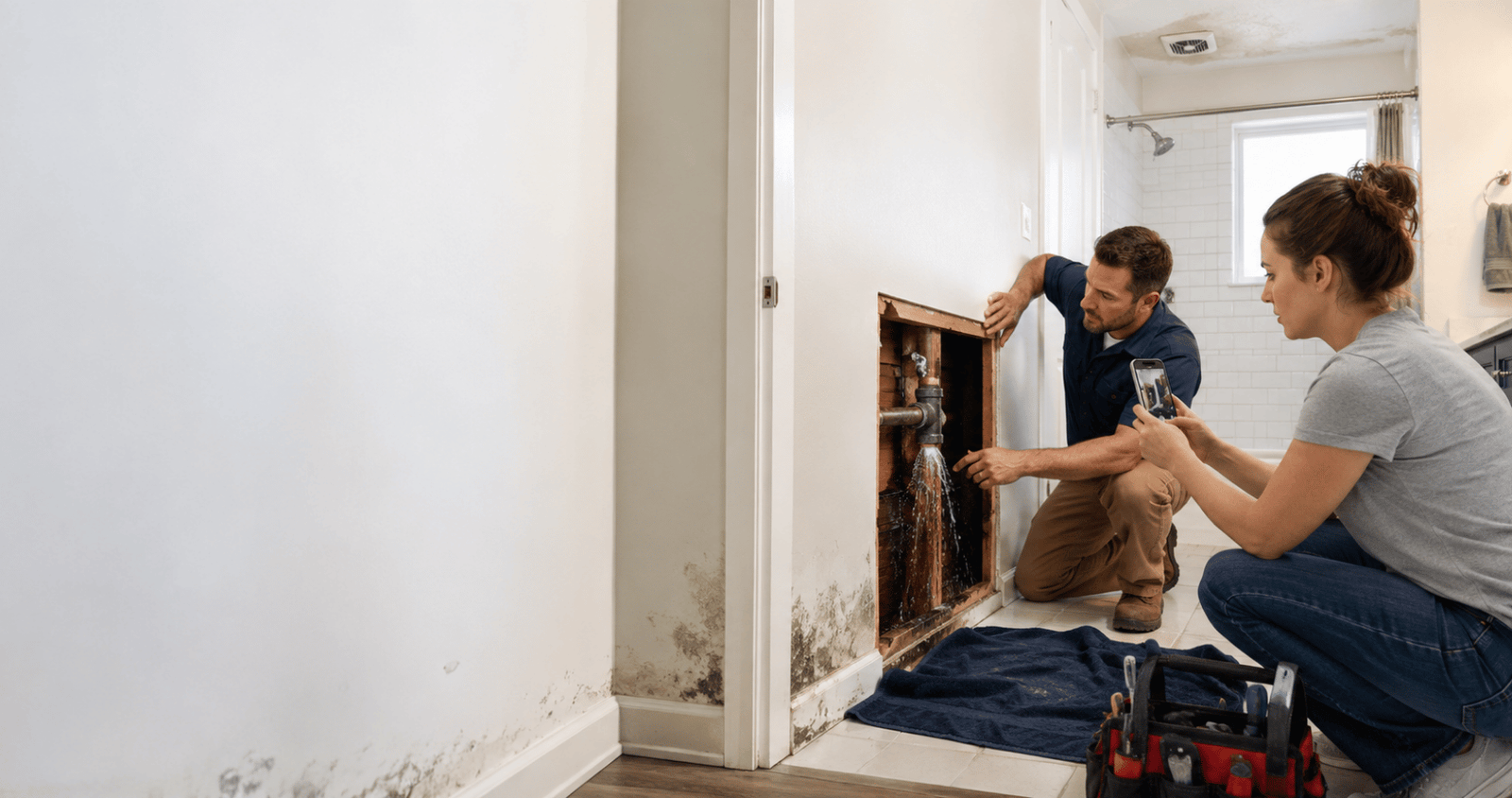
Report anything you are not responsible for, in writing, immediately. A leak, a failing water heater, a roof issue. That timestamp is what separates a sudden event from a gradual one.
Do what the lease assigns you. If you are responsible for changing furnace filters or clearing gutters, do it, because a claim traced to a duty you skipped is a difficult claim.
Liability Beyond The Property Line
Two situations specific to houses that catch people.
The sidewalk. In many municipalities, responsibility for clearing a public sidewalk falls on the occupant of the adjacent property rather than the city. Your lease may or may not address it. Your local ordinance probably does.
Trees. A limb from a tree on the property that damages a neighbor's car or fence can become a liability question, particularly if the tree was visibly diseased and nobody acted. Report visibly dead or damaged trees to your landlord in writing.
Neither is a reason to avoid renting a house. Both are reasons to carry more than the default liability limit.
Duplexes And Shared Houses Sit In Between
A common arrangement worth its own note, since it borrows problems from both sides.
You have a yard and often a driveway, which means the liability exposure of a house rather than an apartment.
You share walls and sometimes systems, which means a fire or a water incident travels between units exactly as it would in an apartment building.
Responsibility for shared outdoor space is frequently undefined. Who clears the shared walkway, who mows the common strip, who handles the shared driveway in winter. Leases in converted houses are often silent on this, and silence is where disputes start.
Ask specifically about shared areas before signing, and get the answer in the lease rather than in an email from a leasing agent who may not be there next year.
The liability recommendation is the same and slightly stronger. Shared construction means one incident reaches more people, and a yard means more ways for an incident to begin.
Home Businesses Are More Common In Houses
Renting a house often means finally having room for a workshop, a studio, or a proper office. That changes the insurance picture in two ways.
Business property is restricted on personal policies. Equipment used to earn income can be limited or excluded, and standard business property limits are commonly around twenty five hundred dollars. A business property endorsement typically raises that for a small premium.
Business visitors create a liability gap. Business pursuits exclusions can remove liability coverage entirely for someone injured during a business visit. Clients, students, or customers coming to a home studio or workshop fall into this category.
That second point matters more in a house than an apartment, simply because houses make client visits practical in a way apartments often do not.
If you plan to work from the property in any income generating way, raise it with your insurer before you start rather than after.
Setting Your Numbers
Four figures, in order of how much they matter for a house rental.
Liability. Move from one hundred thousand to three hundred thousand at minimum. Homeowners policies start there for exactly the reasons in this article, and the upgrade typically costs a few dollars a year. If you have assets, consider an umbrella policy above it.
Personal property. Recount after the move, including the garage, shed, basement, and yard. The apartment number is almost certainly low.
Settlement basis. Replacement cost rather than actual cash value, particularly for tools, outdoor equipment, and electronics.
Water backup. An endorsement, not a limit, and the most relevant addition for anything with a basement or a sump pump.
Before You Sign A House Lease
Four questions, all reasonable and all free to ask.
Who clears snow and ice, and who maintains the yard? This single answer determines a large share of your liability exposure.
Has the basement ever taken water, and is there a sump pump?
Which repairs are mine and which are yours? Get the line drawn explicitly rather than by implication.
Are there any trees or exterior conditions you are aware of that need attention?
Then raise your liability limit and recount your belongings.
Renting a house is a genuine upgrade in space and privacy. The insurance version of that upgrade is a larger liability exposure and more property spread across more places, and both are cheap to address if you do it at move in rather than after a claim.
This article is for general educational purposes and is not insurance or legal advice. Coverage terms, treatment of detached structures, off premises limits, and lease and municipal responsibilities vary by insurer and by location. Confirm details with your carrier and read your lease.
Some images in this article were generated using artificial intelligence and are for illustrative purposes only.