The Most Common Disaster Here Is The One Nobody Insures
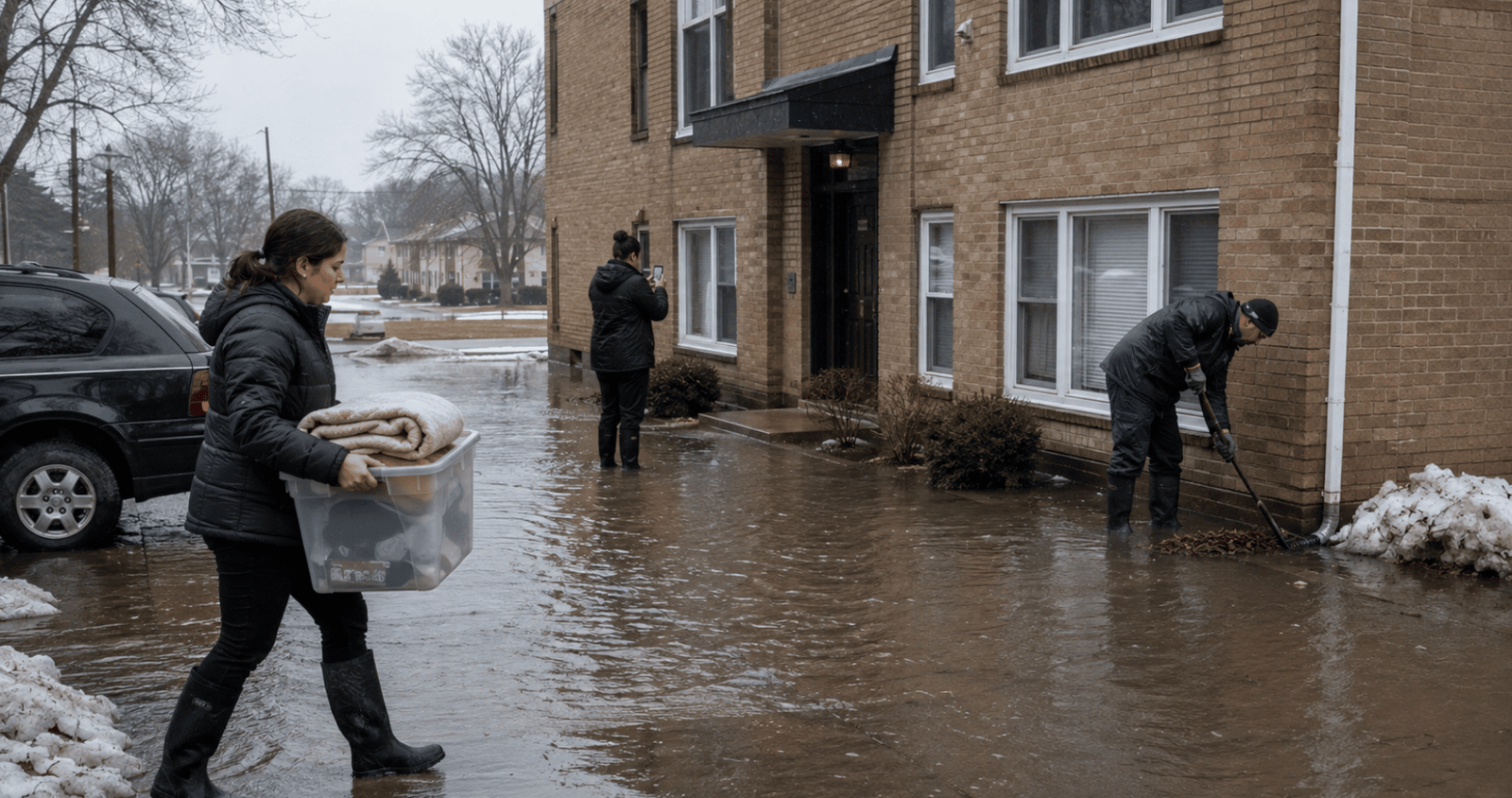
Flooding is the most common and costly disaster in Wisconsin. That is the state's own emergency management assessment, not an insurance company talking point.
It is also excluded from every standard renters policy in the state.
The gap between those two facts has a number attached. Wisconsin experienced record flooding in 2018 and again in 2022, and each event produced more than three hundred million dollars in uninsured flood losses.
Six hundred million dollars, across two events, absorbed by people who thought they were covered.
Renters were a meaningful share of that. Here is how the coverage actually works in this state and what closing the gap costs.
Wisconsin Flooding Works Differently
This is not coastal surge or hurricane rain. The mechanism here is seasonal and specific.
Spring thaw releases snowpack across a landscape where the ground is still frozen or already saturated. Rain falls on top of that and has nowhere to go. Rivers rise, low ground fills, and it happens on a schedule most years.
Flash flooding and overflowing rivers do the rest.
The affected areas are not where people expect. Flood event counts between 1996 and 2019 put Dane County at one hundred three, Rock County at ninety seven, Jefferson at eighty two, and Sauk and Milwaukee at seventy eight each.
Those are inland counties. Madison and Milwaukee both sit high on that list. If your mental model of flood risk involves a coastline, Wisconsin does not fit it.
Renter Flood Coverage Is Cheap
The fix is straightforward and less expensive than most renters assume.
A flood policy for a renter covers contents only. There is no building to insure, which is the entire reason it costs a fraction of the homeowner version.
Coverage runs through the National Flood Insurance Program or private carriers.
Two things to do before dismissing it. Check your address on the flood map, and note that a favorable zone designation describes historical mapping rather than a promise. Wisconsin's 2018 and 2022 events reached households well outside high risk zones.
The Waiting Period Is The Reason To Act Early
One timing detail that turns this from a someday task into a now task.
Flood policies typically carry a waiting period before coverage takes effect, commonly around thirty days. You cannot buy a policy in March when the forecast turns and expect it to respond in April.
Wisconsin's flood season is predictable in a way that coastal storm seasons are not. Snowpack accumulates through winter, the thaw comes, and rain lands on frozen or saturated ground. Anyone paying attention knows roughly when the risk peaks.
Which means the sensible window to buy is autumn or early winter, well before anything is melting. A policy purchased in January is in force by the time it matters. A policy purchased in late March may not be.
The same logic applies to the water backup endorsement, though that one usually takes effect faster. Ask your insurer when coverage begins rather than assuming it starts the moment you pay.
The Second Water Exclusion
Wisconsin renters need to understand two water gaps, not one.
Milwaukee's older housing stock was largely built before modern drainage standards, with aging basements and sump systems, which makes it vulnerable to both groundwater intrusion and sewer backup during heavy rain.
Standard renters insurance excludes sewer and drain backup completely. Separately from flood, and requiring a separate fix.
A water backup endorsement closes it and is inexpensive. Ask for it by name as the water backup and sump discharge or overflow endorsement.
For anyone renting a basement or garden level unit in Milwaukee, Madison, or any older Wisconsin city, this is the most sensible addition available.
Buying flood coverage does nothing about a backup. Buying backup coverage does nothing about a flood. Plenty of ground floor renters here need both.
Winter Is Where Your Policy Actually Works
The good news, and it is substantial.
Wisconsin averages more than forty five inches of snowfall annually in the northern tier, with significant ice storm frequency across the south. That produces three claim types and your policy handles all of them.
Burst pipes. A pipe that freezes and bursts suddenly is covered for damage to your belongings. This is one of the most common Wisconsin claims.
Ice dam water intrusion. If ice dam water infiltrates your rental and damages your belongings, renters insurance typically covers the property damage.
Wind, hail, and snow load. All covered perils for your personal property. Structural roof stress is your landlord's problem.
One condition runs through all three. Gradual leaks and unreported problems can be denied. Report anything dripping in writing the day you see it.
How An Ice Dam Ruins A Top Floor Apartment
Worth explaining because most renters do not know the mechanism until it happens to them.
Heat escapes through a poorly insulated roof and melts the snow sitting on it. The meltwater runs toward the colder eaves and refreezes there, building a ridge of ice.
That ridge blocks the next round of meltwater, which backs up under the shingles and finds a way inside.
The result is water coming through a ceiling during a snowstorm. Your belongings are covered. The roof and ceiling belong to your landlord.
If you see icicles forming along the eaves, that is the warning sign. Report it in writing immediately, because the timing of that report affects whether a later loss reads as sudden or gradual.
What Wisconsin Renters Pay
This is one of the more affordable states, and the figures reflect that.
Federal rate data puts Wisconsin as low as twelve dollars a month, or one hundred forty a year, for around thirty thousand dollars of coverage, below the national average near one hundred eighty five.
Other analyses put the state average around sixteen dollars a month, or one hundred ninety two annually. A third range comes in at fifteen to twenty two dollars monthly for thirty thousand in property and one hundred thousand in liability.
City level data at a higher coverage tier, fifty thousand in property with one hundred thousand liability and a one thousand dollar deductible, shows the spread clearly.
| City | Approximate Annual Cost |
|---|---|
| Green Bay | 120 |
| Madison | 125 |
| Milwaukee | 158 |
That is a narrow spread, roughly thirty eight dollars a year between the cheapest and most expensive major markets. Carrier choice will move your premium more than your address will.
Note also what that table shows about coverage tiers. Fifty thousand dollars of protection in Green Bay costs one hundred twenty a year, which is less than the state average often quoted for thirty thousand. Shopping matters more than the headline number.
The State Has A Lot Of Renters
Wisconsin has over eight hundred thousand renters, close to a third of households in the state.
Nationally, only around fifty five percent of renters carry coverage at all. Applied here, that leaves hundreds of thousands of Wisconsin households whose belongings, liability, and temporary housing costs are not covered by anyone.
At twelve to twenty two dollars a month against a winter that reliably produces burst pipes and ice dams, that is a difficult position to defend.
Student Housing Around Madison
University of Wisconsin Madison supports a large off campus rental population, and two rules apply specifically.
A roommate's belongings are not covered by your policy unless they are named on it. Each person needs their own, and most insurers will not add unrelated roommates anyway.
And a dependent full time student may be covered under a parent's homeowners policy while living away at school, typically at around ten percent of that policy's personal property limit, with conditions around age and residency. Off campus apartments on a student's own lease frequently fall outside that extension, so confirm rather than assume.
Liability In Older Multi Family Buildings
Much of Wisconsin's rental stock is older multi family construction, duplexes, and converted homes.
A kitchen fire in one unit reaches the units around it, and the landlord's insurer can pursue you for repairing all of it. Your liability coverage is what stands between you and that bill.
Most policies default to one hundred thousand dollars. Raising it to three hundred thousand typically costs a few dollars a year and is the best value change on the policy.
Winter adds another exposure. Slip and fall incidents on icy walkways are common claims here, and where responsibility for clearing a walkway falls depends on your lease.
Setting Your Numbers
Walk your apartment and total replacement costs at current prices. Furniture, mattress, electronics, kitchen equipment, all your clothing, and winter gear, which in this state is a real category with real cost.
Then check the settlement basis on your declarations page. Actual cash value pays depreciated value. Replacement cost pays what a comparable new item costs today. On electronics that gap is large.
Finally, look at loss of use. After a building wide winter event, multiple households get displaced at once into a limited local market. Divide your limit by what a week of local hotel and meals would cost under those conditions.
Getting The Price Down
Bundle with auto. Usually the largest single discount.
Shop the tier you need. The city data above shows fifty thousand dollars of coverage pricing lower than commonly quoted averages for thirty thousand, which means carrier differences outweigh coverage differences at this price point.
Raise your deductible if you can absorb it.
Claim safety features. Smoke detectors, deadbolts, and monitored alarms factor in at most carriers.
Check your credit based pricing, which moves premiums more than most renters expect.
Three Things To Do Before Spring
Price a renter flood policy if you are anywhere near a river, a low lying area, or downstream of snowpack drainage. This is the gap that cost Wisconsin households hundreds of millions twice in five years.
Ask about a water backup endorsement if you live at or below ground level. Separate problem, separate fix, and in Milwaukee's older buildings it is the more likely of the two to happen.
Watch your eaves in January. Icicles forming along the roofline mean an ice dam is building. Report it in writing that day, and your later claim will read as a sudden loss rather than a slow one.
Wisconsin prices renters insurance affordably and covers winter perils well. The gap is water arriving from below or outside, and it is the most common disaster the state faces.
This article is for general educational purposes and is not insurance advice. Cost figures reflect published surveys with differing coverage assumptions and will not match your quote. Coverage terms, endorsements, and exclusions vary by insurer.
Some images in this article were generated using artificial intelligence and are for illustrative purposes only.