When The Law Leans Landlord, Your Policy Is The Backstop
Tennessee is a straightforward rental market from a legal standpoint. There is no rent control, landlord tenant law generally favors property owners, and the eviction process moves faster than in most states.
That is not a complaint, it is context. And it changes how a renter here should think about insurance.
In Chicago or Portland, a tenant who loses belongings to a landlord's neglect has meaningful ordinance based remedies to pursue alongside an insurance claim. In Tennessee that second track is thinner.
Which means your own policy carries more of the weight. It is not a supplement to strong tenant protections here. It is the primary protection.
What Weak Tenant Protections Mean In Practice
Worth being concrete about the opening point rather than leaving it abstract, because it changes three specific behaviors.
Document faster. In states with strong tenant ordinances, a renter has more room to pursue a landlord who ignored a leak for a month. Here, your written record matters mainly for your insurance claim, which is a shorter and stricter timeline. Report problems in writing the day you see them, not the week you get frustrated.
Read the lease closely before signing. With fewer statutory backstops, the lease itself is doing most of the work. The insurance clause, the maintenance responsibilities, and the entry and repair terms are where your obligations actually live.
Do not let coverage lapse. A gap between policies is riskier when the fallback options are thinner. Set the renewal to auto pay if that helps, and confirm the effective date lines up with your lease start rather than beginning a week later.
None of this means Tennessee is a bad place to rent. It means the protection you carry yourself does more of the work, and that is worth knowing before something happens rather than after.
What Happened In March 2020
The clearest illustration in recent Tennessee history.
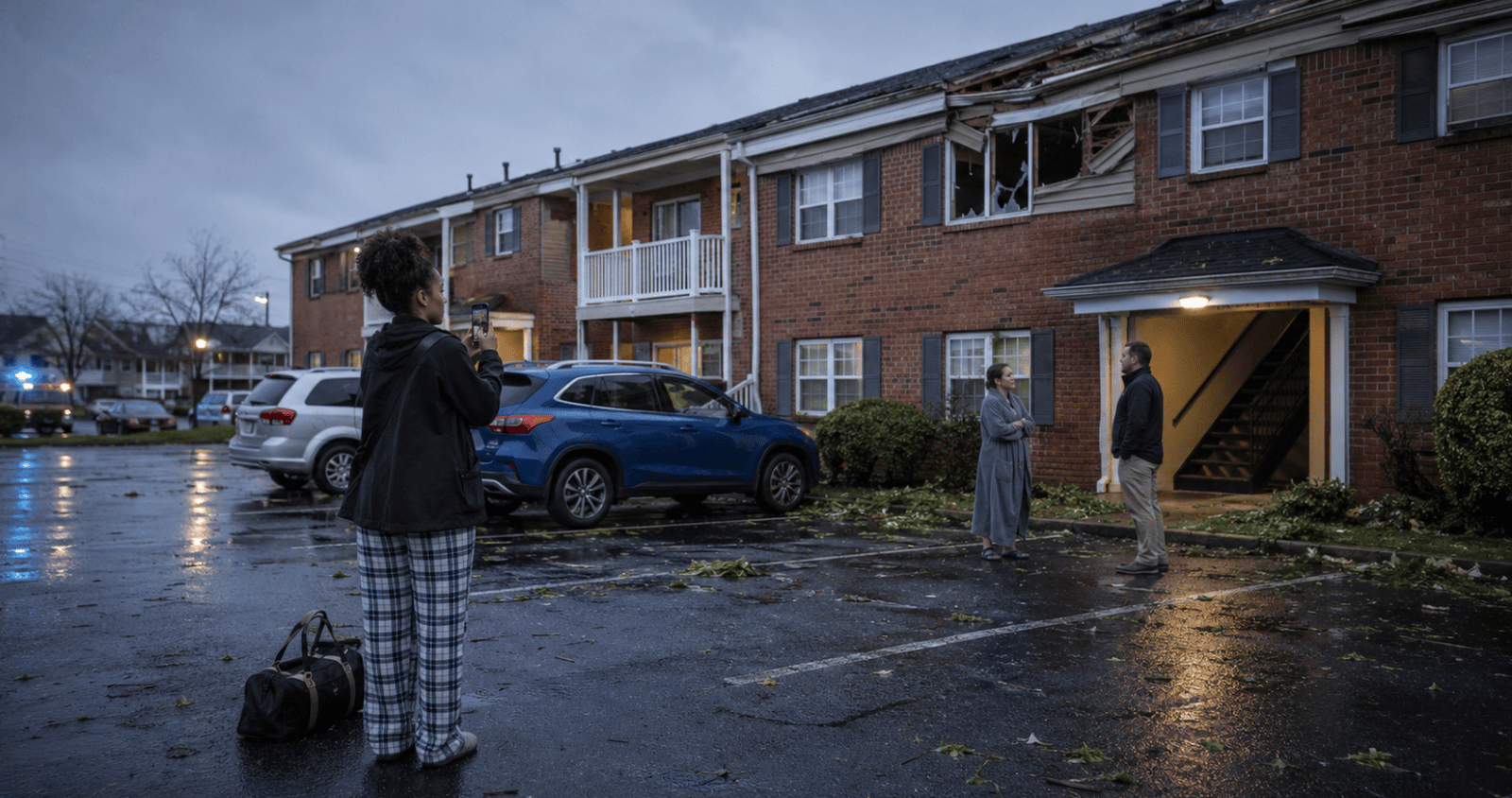
The March 2020 Nashville tornado tore through apartment buildings along its path and displaced hundreds of renters overnight.
The people with renters insurance had their hotel bills and their replacement costs covered. The people without faced expenses they had no way to absorb.
Same storm, same buildings, same night. The difference was a policy costing somewhere around fifteen to twenty five dollars a month.
The Tornado Detail Tennessee Shares With The Deep South
Middle Tennessee sits in the southern extension of the tornado corridor, and the state sees active tornado risk statewide.
The dangerous characteristic here is timing. Tennessee experiences nocturnal tornadoes, storms that strike at night without the visual warning that daylight provides.
A tornado you cannot see gives you no time to gather documents, unplug electronics, or move anything. Whatever preparation exists has to have happened already.
That is why the documentation habit at the end of this page matters more here than in a state where storms announce themselves.
Wind Is Covered
The good news is straightforward. Tornadoes and windstorms are covered perils under a standard renters policy.
If a tornado destroys your furniture, electronics, and clothing, that is a covered personal property claim up to your limit. Hail and severe thunderstorm wind are covered the same way. Wind driven rain entering through an opening the wind created is generally covered too.
The building is your landlord's responsibility through their policy.
Check your declarations page for a separate wind and hail deductible before spring. Some Tennessee policies apply a different figure for those perils, occasionally as a percentage of your coverage rather than a flat amount.
Flooding Is Not Covered
Tennessee has real flood exposure and none of it sits inside a standard renters policy.
Nashville renters near the Cumberland River, Memphis renters near the Mississippi, and anyone in a low lying area or river basin face risk that standard coverage excludes entirely.
Water rising from outside is flood, regardless of which storm produced it. It requires a separate policy through the National Flood Insurance Program or a private carrier.
Renter flood policies cover contents only, which makes them considerably cheaper than the homeowner version. Check your address on the FEMA map before deciding it does not apply.
The New Madrid Question In West Tennessee
Western Tennessee sits near the New Madrid Seismic Zone, and standard renters policies exclude earthquake damage entirely.
Most Middle Tennessee renters skip earthquake coverage given the low event frequency, and that is a defensible choice.
Memphis and West Tennessee are a different conversation. The exposure is real, the coverage is inexpensive for a renter because you are insuring contents rather than a building, and the scenario it addresses is displacement from a building declared unsafe rather than a broken television.
If you rent in West Tennessee, it is worth one phone call to price it before dismissing it.
What Tennessee Renters Actually Pay
Published figures disagree, and the reason is worth explaining.
One analysis puts Tennessee at fifteen dollars a month, or one hundred seventy eight a year, for twenty thousand dollars of personal property coverage, placing the state slightly below the national average.
Federal rate data puts it around eighteen dollars a month, or two hundred thirteen a year, for roughly thirty thousand dollars of coverage, placing Tennessee above the national average near one hundred eighty five.
Others land between fifteen and thirty dollars monthly, with a state average near two hundred eighty seven.
Both of the first two are accurate. They describe different amounts of coverage. Twenty thousand dollars of protection and thirty thousand dollars of protection are not the same product wearing the same label.
That is the single most useful thing to understand about any published average, in any state.
The City Spread Is Narrow
Location moves the number less here than in most states.
Spring Hill runs lowest at around fourteen dollars a month. Memphis runs highest at around eighteen. Nashville and Memphis both sit above the state average on urban risk, while Knoxville and smaller markets run lower.
That is roughly a four dollar monthly spread across the state, which is narrow. Carrier choice will do more for your premium than your address.
Get three quotes at matched limits and let that be the exercise.
Picking Your Coverage Tier
A genuinely useful set of numbers for this market.
Most Tennessee renters choose between twenty thousand and fifty thousand dollars in personal property coverage.
At the twenty thousand level you are looking at roughly fifteen dollars a month. At one hundred thousand dollars of coverage the average climbs to around thirty nine dollars a month, though the cheapest carrier at that tier comes in considerably lower.
That tells you something important. Coverage does not scale linearly with price, and the cheapest carrier at one tier is often not the cheapest at another.
So decide your coverage amount first based on what your belongings actually cost to replace, then shop that specific number. Shopping a tier you do not need is how people end up either underinsured or overpaying.
Walk the apartment and total replacement costs before you pick. Most renters guess low.
The Sublimit That Catches People
Your total limit is not the ceiling for every category.
Jewelry commonly caps around fifteen hundred dollars for the entire collection combined, not per piece. Art, collectibles, and high end electronics carry their own caps.
An engagement ring alone can exceed that figure.
Scheduling individual items on a personal property endorsement removes the cap and usually adds coverage for accidental loss rather than theft alone. It costs roughly one to three percent of the item's value per year.
Roommates Need Their Own Policies
Common in Nashville and Knoxville with large student and young professional populations.
Unless a roommate is specifically named on your policy, their belongings are not covered. Each person should carry their own, and most insurers will not let unrelated roommates share one anyway.
Separate policies also keep a roommate's claims history off your record, which matters more than people expect when you shop for coverage years later.
Liability In Multi Family Housing
Nashville has added tens of thousands of apartment units over the past decade, and most Tennessee renters live in shared wall buildings.
A kitchen fire in one unit reaches the units beside and above it. Your landlord's insurer can then pursue you for the cost of repairing all of it, and your liability coverage is the only thing standing between you and that bill.
Most policies default to one hundred thousand dollars, and adding it typically costs only a few dollars a month. Raising it to three hundred thousand usually costs a few dollars a year beyond that.
In a state where the legal environment gives renters less cushion, having a liability limit above the minimum is a reasonable form of self protection.
What Your Lease Will Say
Tennessee does not require renters insurance by law.
Landlords can require it as a lease condition and the requirement is enforceable. The practice is especially common in Memphis, Nashville, and other active rental markets across the state.
Read the insurance clause before you shop, then buy to match it. Most property managers want a minimum liability figure and ask to be listed as an interested party, which is informational rather than a grant of coverage.
Getting The Price Down
Bundle with auto. Usually the largest single discount available.
Shop the tier you actually need. Carrier rankings shift by coverage level, so the cheapest company at twenty thousand may not be cheapest at fifty.
Raise your deductible if you can absorb it, though this does nothing about a separate wind and hail deductible.
Claim security and safety features. Alarms, deadbolts, and working smoke detectors factor in at most carriers.
Check your credit based pricing. It moves premiums more than most renters expect.
Before Storm Season
Video every room with closets and drawers open, narrating what things are and capturing serial numbers. Store the file in cloud storage, not on a laptop that could be destroyed.
In a state with nighttime tornadoes, this is the whole preparation. There is no gathering things when a storm arrives at two in the morning.
Find three numbers on your declarations page. Your standard deductible, any separate wind and hail deductible, and your loss of use limit.
Divide your loss of use limit by what a week of local hotel and meal costs would run after a major storm, when housing gets scarce and prices climb. If the answer is under a month, raise it.
The Practical Summary
Tennessee gives renters a fast moving rental market, real weather exposure, and a legal environment that leans toward property owners. That combination puts more weight on your policy than it would carry elsewhere.
Three things settle most of it. Decide your coverage tier based on an actual inventory rather than a default. Shop that specific number across carriers, since rankings change by tier. And film your apartment tonight, because the storms here arrive in the dark.
This article is for general educational purposes and is not legal or insurance advice. Cost figures reflect published surveys with differing coverage assumptions and will not match your quote. Coverage terms, deductibles, and legal provisions vary by insurer and can change.
Some images in this article were generated using artificial intelligence and are for illustrative purposes only.