Mitigation Decides Whether You Get A Policy At All
The framing most homeowners bring to this is wrong in a way that costs them coverage rather than money.
They treat defensible space and home hardening as a discount question. In high risk areas it has become an eligibility question.
Documented defensible space and hardening now appear on most carriers' discount checklists at typically five to twenty five percent, and in many high risk ZIP codes they determine whether a carrier will write the policy at all.
Which reframes the whole exercise. A hardening discount only helps if a carrier will write you, and increasingly the same work is what produces the offer in the first place.
That is the reason to do this even where the premium saving alone would not justify it.
The Three Zones
Defensible space is managed in bands extending outward from the structure, and the standard in most high hazard areas is one hundred feet around structures or to the property line.
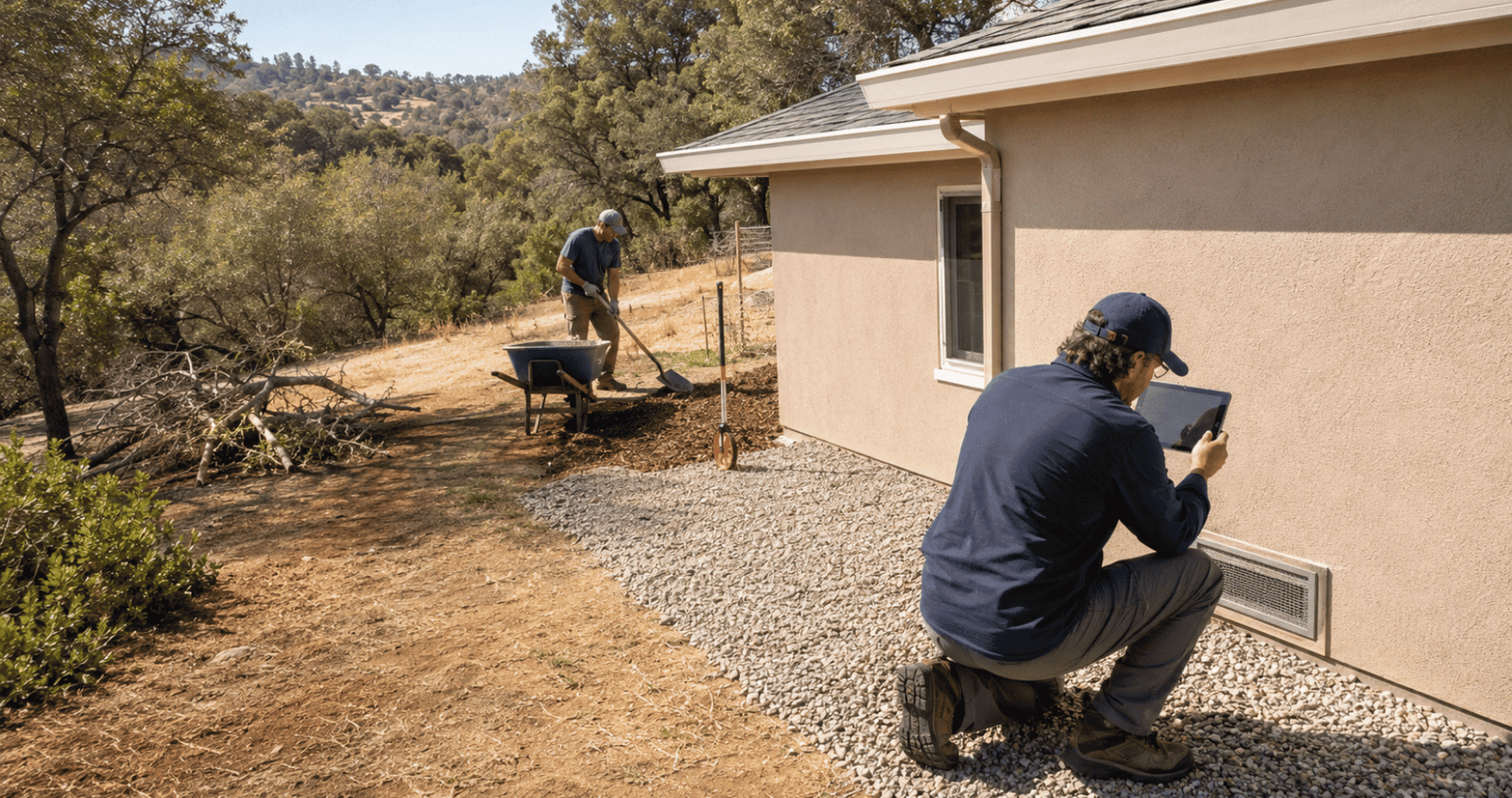
Zone 0, the first five feet, which must be ember resistant. No bark mulch, no woodpiles, no combustible fences touching the house, and no flammable plants in that band.
Zone 1, from five to thirty feet, described as lean and green. Reduced and well maintained vegetation.
Zone 2, from thirty to one hundred feet, focused on reducing fuel volume.
The first five feet does more work than its size suggests, because embers landing against a structure are the leading cause of home ignition during a wildfire rather than direct flame contact.
Which is why guidance consistently identifies clearing Zone 0 and retrofitting vents as the two highest value actions available.
What Insurers Actually Credit
Where regulation exists, the credited measures are specific rather than general.
One state framework identifies twelve mitigation measures organized into three categories, covering community level designations, defensible space measures, and home hardening measures.
Insurers pricing on wildfire risk must recognize each qualifying measure in their rate filings and disclose to policyholders which discounts apply to their property.
The structural measures that carry the most weight.
A Class A fire rated roof, described as the single biggest structural factor. Wood shake roofs are effectively uninsurable in any fire zone.
Ember and fire resistant vents, along with enclosed eaves, to stop ember intrusion.
A non combustible Zone 0 around the structure.
Defensible space across the outer zones.
Community programs, including recognized neighborhood wildfire preparedness designations.
Qualifying roofing materials are tracked on an approved building materials list that insurers reference when verifying a claim, which means the specific product matters rather than the general description.
Each Measure Files Separately
A structural detail that changes how you should approach the work.
Each measure files independently, which means a homeowner completing several steps can stack credits rather than qualifying for one flat discount.
Which produces a different strategy than treating hardening as a single project. Completing three measures earns three credits, and partial progress earns partial credit rather than nothing.
For a household that cannot fund a roof replacement this year, that matters. Vents, Zone 0 clearing, and deck debris removal are inexpensive and each files on its own.
The Numbers On Loss Reduction
Context explaining why insurers care.
Catastrophe models built for wildfire ratemaking project loss reductions of up to forty percent for defensible space and thirty percent for a fire resistant roof.
Those are the figures behind the credits, and they explain why the two cheapest actions and the one expensive one all appear on every checklist.
Discount outcomes vary considerably. Analysis of insurer responses found that homeowners adopting both maximum hardening upgrades and defensible space received premium reductions ranging from a few percent to over fifty percent depending on the insurer and the loss reduction standards adopted.
That spread is itself the argument for shopping. The same completed work is worth very different amounts at different carriers.
The Last Resort Plan Now Discounts Too
A development worth knowing for anyone currently on a state plan.
One state's plan of last resort implemented a wildfire hardening discount program for policies dated November 2025 or later, offering up to twelve individual discounts applied to the wildfire portion of the premium.
Dwelling fire policyholders qualifying for all twelve can save up to roughly fourteen percent, with commercial policies reaching over sixteen percent.
The discounts divide into immediate surroundings measures, structure measures, a property level completion discount, and a community discount.
Two implications.
Being on a last resort plan does not mean discounts are unavailable. Many policyholders assume otherwise and never submit documentation.
The same documentation strengthens your case to move back to a standard market carrier, which is the more valuable outcome.
Modeling Changed What Counts
A shift that benefits homeowners who did the work recently.
Before catastrophe models were approved for wildfire ratemaking, pricing relied on historical data, which could only look backward and had no way to credit a roof replaced last spring.
Model based pricing scores the actual attributes of a property, meaning recent work counts immediately rather than waiting to appear in loss history.
Which changes the timing calculation. Work completed this year can affect this year's pricing rather than eventually influencing it through claims experience.
Ask your carrier whether they price using a wildfire model and whether recent mitigation has been reflected, because the answer determines whether your work has been counted yet.
The Standard Is Not Fixed
An important qualification for anyone planning work.
State law now directs regulators to regularly review and update mitigation standards to reflect advances in wildfire science and technology.
Which means the checklist is expected to expand, particularly around ember resistant fencing and attic ventilation standards still being refined.
It also means insurers cannot treat an older baseline as permanent, since a rate filing has to account for whichever version of the standard is current when the filing is submitted.
Two practical consequences.
Check the current standard before starting work, rather than working from guidance published a few years ago.
Revisit periodically, since measures that were not credited previously may be credited now.
Zone 0 Rules Are Still Settling
Honest treatment of a moving target.
Statewide regulation of the ember resistant five foot zone has been in rulemaking with various proposed timelines, and no finalized statewide enforcement date has been confirmed in some jurisdictions, with updated drafts and phased rollouts still emerging.
But the underwriting credit for doing the work already exists.
Which produces a clear instruction. Do not wait for a regulation to be finalized before clearing the first five feet, because the insurance benefit is available now and the work is among the cheapest and most effective available.
Check your state forestry board or fire marshal directly for current requirements rather than relying on a fixed date from any article.
Grants Exist And Are Underused
Funding that reduces the cost of the most expensive measures.
New grant programs have been established specifically to help eligible residents afford critical home hardening measures, including fire safe roofs and Zone 0 mitigation, described as among the most effective and most costly steps available.
More broadly, many states fund defensible space and hardening through cost share grants, rebates, and tax credits, with one state offering a mitigation tax credit at twenty five percent.
Two steps worth taking before paying for anything.
Check your state insurance department and forestry agency for current grant programs.
Ask contractors whether they handle grant paperwork, since several programs require documentation submitted in a specific form.
For a household facing a roof replacement, a grant program can change the arithmetic entirely.
Certification Turns Work Into Evidence
The step that determines whether completed work produces any benefit.
Independent certification programs assess and document hardening and defensible space, and that documentation is what counts toward insurance discounts.
The reason certification matters is administrative rather than technical. An underwriter cannot credit work they cannot verify, and a homeowner's description is not verification.
Three forms of documentation to keep.
Dated before and after photographs of every measure completed.
Contractor invoices identifying the specific materials and work.
Any formal certification or official evaluation your state or program recognizes.
Store all of it together and submit it proactively rather than waiting to be asked.
Discounts Are Not Automatic
The failure mode that wastes completed work.
Where regulation requires insurers to offer mitigation credits, the credit still depends on the insurer knowing what you did.
Which means a homeowner who cleared brush, replaced vents, and upgraded a roof, and then never told anyone, is paying full price for a hardened home.
Two actions close that gap.
Contact your agent or broker before renewal with your documentation package.
Ask which specific discounts apply to your property, since insurers pricing on wildfire risk are required in some states to disclose that.
If you have been non renewed, the fastest route back to any coverage is documenting Zone 0 and hundred foot defensible space work to your local fire district and state standards.
Insurers Weight This Differently
The reason to shop rather than accepting one answer.
Mitigation credits vary by state filing rather than by any corporate wide program, which means asking a national carrier about their wildfire discount frequently produces a redirection to whatever discount menu applies in your specific state.
Combined with the finding that maximum mitigation produces anywhere from a few percent to over fifty percent depending on the insurer, the conclusion is straightforward.
The same house with the same completed work is worth very different premiums at different carriers, and an independent broker holding multiple appointments is the practical way to find which one values it most.
Check The Parcel, Not The Town
A caution worth stating plainly.
Hazard designations are assigned at parcel level, and a town with a reputation for safety can contain large hillside areas designated as very high hazard.
Which means checking your specific parcel's hazard designation matters more than any general impression of the area, and it affects both your insurance options and the mitigation standards that apply to you.
State fire agency mapping tools provide this at address level and take minutes to check.
The Order To Work In
Six steps, arranged by cost and effect.
Clear Zone 0, the first five feet, removing mulch, woodpiles, combustible fencing, and flammable plants. Cheapest and among the highest value.
Retrofit vents with ember resistant screening, and address enclosed eaves.
Clear vegetation and debris from under decks, which collect fuel directly against the structure.
Establish defensible space across the outer zones to the standard in your area.
Plan the roof, since a Class A fire rated roof is the single largest structural factor and the most expensive. Check grant eligibility before scheduling it.
Document everything and submit it, because none of the above earns a credit the insurer does not know about.
What To Do This Month
Check your parcel's hazard designation on your state fire agency's mapping tool.
Clear the first five feet, which costs a weekend and addresses the leading cause of home ignition.
Photograph everything before and after, with dates.
Ask your agent which specific discounts apply to your property and what documentation they need.
Check grant eligibility before committing to expensive measures.
Get a competing quote, because the same work is valued very differently between carriers.
In high risk areas the question is no longer only what a hardened home costs to insure. It is increasingly whether an unhardened one can be insured at all, and that is a considerably better reason to start than a percentage discount.
This article is for general educational purposes and is not insurance advice. Mitigation standards, discount requirements, grant availability, and hazard designations vary by state and are being actively revised. Confirm current requirements with your state insurance department, fire agency, and a licensed broker.
Some images in this article were generated using artificial intelligence and are for illustrative purposes only.