The Owner's Policy Names You As Excluded
Renting a room in someone's house feels less formal than leasing an apartment. Shared kitchen, the owner down the hall, sometimes no lease at all.
The insurance is not informal, and it is more pointed than most room renters realize.
Standard homeowners policies exclude the property of roomers, boarders, and other tenants by name. Not by implication, by name.
The theft peril goes further and carves out the portion of the home you rent. So a burglary of the room you pay for sits outside the owner's coverage specifically because it is your room.
That is not the owner being unhelpful. It is how the form is written, and it means your belongings in that room are protected by exactly nothing unless you arrange it yourself.
What That Looks Like In Practice
The house burns. The owner's policy rebuilds the structure and replaces the owner's furniture.
Your clothes, your laptop, your books, your bedding, and everything else in the room are outside the claim entirely.
Someone breaks in and takes property from your room. Same result, and the theft carve out makes it explicit.
You injure a visitor. The owner's liability protects the owner rather than you.
One fire, and everything you own is gone with nothing behind it. That is the whole case for carrying your own policy, and it does not change because the arrangement felt casual.
Are You A Lodger Or A Tenant
This distinction matters more than people expect, because it determines your legal position as well as the insurance picture.
A lodger lives in the home and shares accommodation and facilities with a resident owner. Shared kitchen, shared bathroom, owner living there.
A tenant occupies space the owner does not live in. If your part of the property has its own entrance, or is an annex sharing only a hallway, that generally reads as a tenancy rather than lodging.
Why it matters. Lodgers and tenants have different statuses in law, and in many places lodgers have weaker protections around notice and eviction than tenants do.
It also determines what the owner needs. A resident owner with a lodger may be able to use an endorsement on a homeowners policy. An owner not living there generally needs a landlord policy.
Ask which category you are in before signing anything, and get the answer in writing if there is any ambiguity.
Yes, You Can Insure A Room
A common assumption is that renters insurance requires renting a whole unit. It does not.
A renters policy covers your belongings wherever they are, and it covers your liability. Renting a bedroom in someone's house is a normal situation for a carrier to write.
Two things are different from insuring an apartment.
You need less personal property coverage. You are insuring a room's worth of belongings rather than a household. Count what you actually have rather than accepting a default.
Your liability limit should not shrink. Liability protects other people from you, and that exposure does not reduce because your living space did. Three hundred thousand is the sensible target regardless of how small the room is.
Shared Spaces Complicate Liability
The kitchen, the bathroom, the hallway, the living room. You use them, the owner uses them, and sometimes other roomers do.
Three practical implications.
Your liability follows your conduct, not your square footage. If you leave a pan unattended and the kitchen catches fire, that is your liability regardless of whose kitchen it is on paper.
Your belongings in shared spaces are still yours. A bike in the garage, food in the shared fridge, a coat in the hall. Covered as your personal property.
Injuries in shared spaces are murkier than in an apartment building. In a professionally managed building, common areas belong to the landlord. In an owner occupied house, responsibility depends on who controlled the condition and, sometimes, on your written agreement.
That murkiness is another argument for a written agreement even in a casual arrangement.
The Threshold The Owner Is Working Against
Worth knowing because it affects your stability as a renter.
Homeowners policies typically tolerate a small number of roomers. Guidance commonly puts the limit around two, with liability coverage for the rental arrangement disappearing at three.
Other sources put the workable range at two to three before an owner needs to restructure the policy or buy different coverage.
So if you are the third person renting a room in an owner occupied house, the owner may be outside what their policy contemplates, whether or not they know it.
That is their problem legally and your problem practically, for reasons in the next section.
Non Disclosure Is Your Problem Too
Here is the risk room renters never consider.
Many owners renting a spare room have not told their insurer. It feels like having a friend stay rather than operating a business, and the paperwork never happens.
Insurers view it differently. Renting part of a home is using it to generate income, which changes the risk profile. Carriers may reprice, require a different policy form, add an endorsement, or decline to cover the home once it is partly rented.
And there is a sharper version. If the owner is not permitted to have a lodger, whether by a mortgage condition, a lease, a homeowners association, or local rules, an insurer might not pay a claim at all even where the right coverage appears to be in place.
Why that reaches you. If the house suffers a fire and the owner's claim is compromised, the repairs stall, the owner's finances take the hit, and your housing situation becomes unstable regardless of what your own policy does for your belongings.
Your policy protects your things. It cannot protect the roof over them.
Questions To Ask Before Moving In
Five, all reasonable, and all easier to ask before money changes hands.
Have you told your insurer you rent this room? A straightforward yes is what you want. Hesitation is information.
Am I a lodger or a tenant? This shapes your legal protections.
Are you permitted to rent a room here? Mortgage terms, association rules, and local ordinances all restrict this in some places.
How many other rooms are rented? Because of the threshold above.
Is there a written agreement? Even a one page document naming the rent, the room, the shared spaces, and the notice period.
An owner who has handled all of this competently will answer easily. One who becomes uncomfortable is telling you something worth knowing.
Put It In Writing Anyway
Renting a room to or from someone you know feels like it does not need paperwork, and that informality is exactly what causes trouble later.
Guidance for owners is direct on this point. Treat it like the business arrangement it is. Name the rent, name the space, and require proof of renters insurance before move in.
The same advice serves you from the other side. A written agreement establishes what you are paying for, what space is yours, what notice applies, and who is responsible for what.
It also matters at claim time. An adjuster asking what you were doing living in someone else's house has a much easier time with a document than with a description.
If The House Becomes Unlivable
An interaction specific to this arrangement.
If a covered event damages the house, the owner loses access and so do you. That can effectively end your arrangement whether or not anyone intended it.
Two coverages matter.
Your loss of use pays for your temporary housing, subject to your limit, if a covered peril made the residence uninhabitable. This is a genuine reason not to skip a policy in a room rental.
The owner's coverage may or may not include obligations toward you depending on your agreement and their policy. Some arrangements leave an owner responsible for a displaced tenant's accommodation.
Neither of those is something to work out during the emergency. Ask in advance what happens if the house becomes unlivable, and write the answer into the agreement.
Theft Within The House
Uncomfortable and worth addressing plainly, because shared housing raises it.
Theft by a person residing in the same home is treated differently than a break in by a stranger, and policies frequently limit or exclude losses involving other residents.
Two practical responses that are not accusations.
A lock on your room door, which most owners will permit and which also matters for the security device discount some carriers offer.
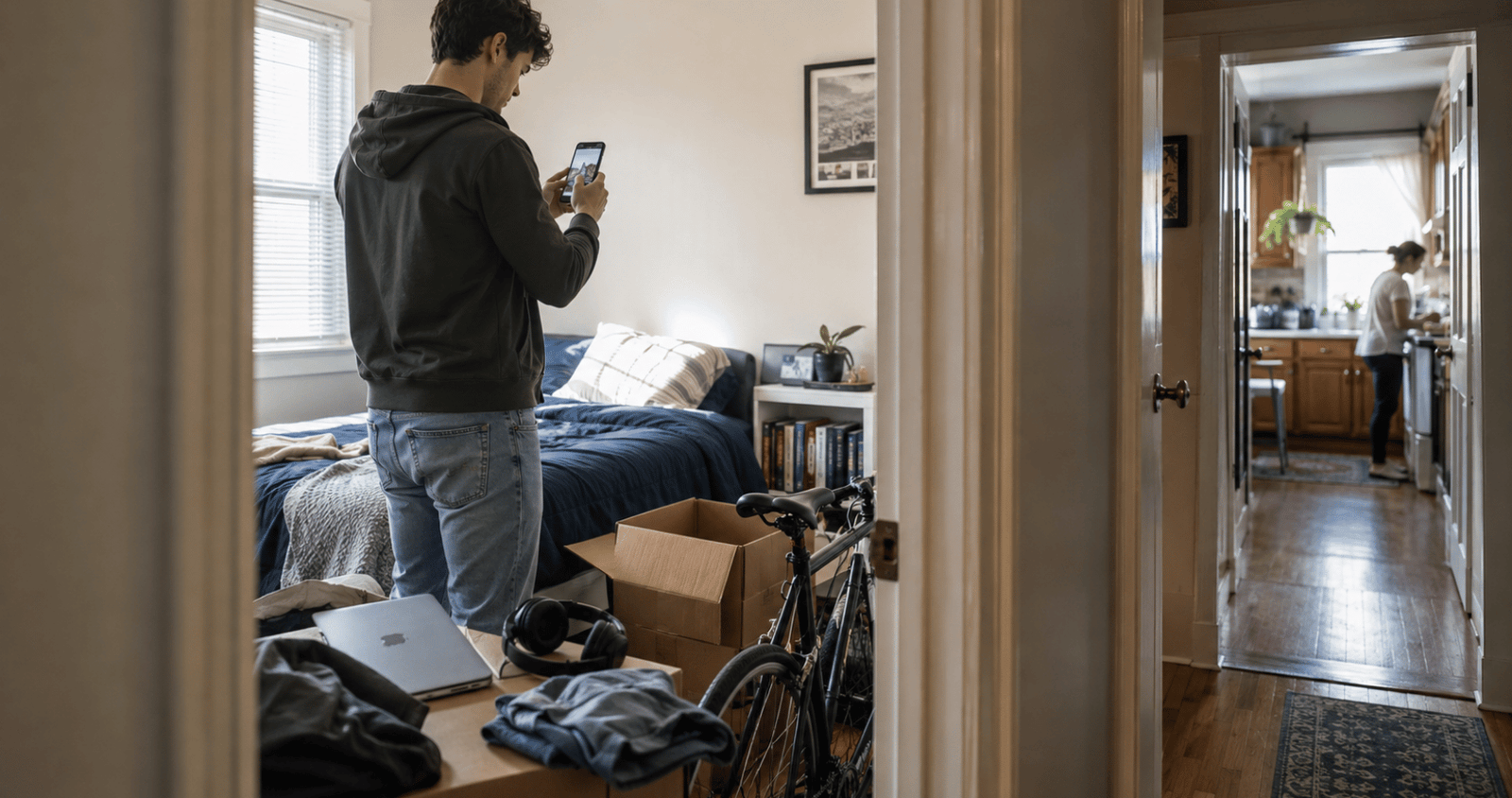
Documentation of what you own, photographed and stored in cloud storage, which is useful regardless of what happens.
If you are moving in with strangers rather than friends, ask your insurer specifically how their form treats theft by another resident.
Renting A Room To Family Or A Partner
Worth separating, because the category question changes the answer entirely.
Insurance guidance draws a clear line here. A partner who shares your life is not a roomer. Someone paying rent for a spare bedroom is.
Household members may be covered under an owner's policy, and some carriers offer an endorsement covering other members of a household who are not relatives.
Rent paying roomers are a different category, and the exclusions described earlier apply.
The complication is that real living arrangements do not always sort cleanly. A partner who contributes to the mortgage. An adult child paying token rent. A friend staying long term while contributing to bills.
Where you fall determines whether the owner's policy reaches you at all, and only the insurer can classify it. The practical instruction is the same for everyone. Ask the agent which category applies, because that single answer decides everything downstream.
If the answer is roomer, buy your own policy. If the answer is household member, get the confirmation in writing and check what limits apply to you.
When The Arrangement Ends
Room rentals end faster and more informally than apartment leases, and two insurance details get overlooked.
Move your policy rather than cancelling it. A gap in coverage follows you into future quotes and pricing tiers, and the few days between places is when belongings are least protected. Update the address instead.
Take photographs on the way out, the same as on the way in. Room rentals produce deposit disputes at a higher rate than apartments, partly because the walkthrough at move in was casual and partly because shared spaces blur responsibility.
If your agreement was verbal, a short email confirming the move out date, the condition of the room, and the deposit expectation creates the record you never made at the start. It is late, and it is better than nothing.
Setting Your Numbers
Four decisions, scaled for a room rather than an apartment.
Personal property. Count what is actually in the room and in shared spaces. Usually far less than a full apartment and rarely trivial.
Liability at three hundred thousand, unchanged by the size of your space.
Replacement cost rather than actual cash value, since a room renter's belongings skew toward clothing and electronics, both of which depreciate fast.
Loss of use, which matters here because the whole house becoming unlivable ends your housing immediately.
Before You Hand Over A Deposit
Three things.
Buy your own policy, because the owner's explicitly excludes you and one fire removes everything you own.
Ask whether the owner disclosed the arrangement to their insurer, since a compromised claim on their side becomes your housing problem.
Get something in writing, even one page, even with a friend.
Renting a room is often the most affordable way to live somewhere expensive, and that trade is a reasonable one. It only goes badly when the informality of the arrangement gets mistaken for informality of the risk.
This article is for general educational purposes and is not insurance or legal advice. Policy language, lodger and tenant classifications, disclosure requirements, and local rules vary significantly by insurer and by jurisdiction. Confirm details with your insurer and, for legal questions, a local tenant resource.
Some images in this article were generated using artificial intelligence and are for illustrative purposes only.