Two Exclusions Stack Against A Delivery Worker
Someone earning a living on an e-bike faces a coverage problem most renters never encounter, and it comes from two directions at once.
The motorized vehicle exclusion. Many renters policies classify anything with independent motor propulsion as a motorized vehicle, and motorized vehicles are excluded from personal property coverage.
The business use exclusion. If you use the bike for paid delivery or courier work and your policy excludes business use, a stolen work bike may not be covered even if the bike itself would otherwise qualify.
So the asset you depend on to earn money can be excluded twice over, for two independent reasons, on a policy you are paying for every month.
That is the problem. Here is how the classifications actually work and what closes the gap.
The Class System That Decides It
E-bikes fall into a federal three class system and insurers lean on it heavily.
Class 1, pedal assist only with no throttle, generally topping out around twenty miles per hour. Many carriers cover these under standard personal property limits, treating them like traditional bicycles.
Class 2, throttle capable, meaning the bike moves without pedaling. These are almost universally excluded, because a throttle looks like a motor vehicle to an underwriter.
Class 3, pedal assist reaching around twenty eight miles per hour. Treatment varies and coverage may not extend, depending on state policy language.
High wattage models above a carrier's threshold, and stand up electric scooters, are almost universally excluded regardless of class.
One carrier's published eligibility criteria give a concrete picture. To be added as scheduled property, the device must have no throttle, a motor no greater than one thousand watts, and be incapable of exceeding twenty miles per hour on level ground. Class 3 bikes may not qualify depending on the state.
Why State Law Will Not Help You Here
An important and frustrating point.
Many states treat e-bikes, particularly Class 1 and Class 2, more like bicycles than motorcycles for traffic and registration purposes.
Insurance contracts do not necessarily follow those definitions. A device that is legally a bicycle where you live can still be a motorized vehicle under your policy language.
Which means the sentence you want is not what does my state say. It is what does my policy say, and the phrases to look for in the exclusions section are motorized land vehicles, business property, and property used for business purposes.
Scheduling Helps, Within Limits
If your e-bike qualifies, scheduling it as separate personal property is the standard fix and it is a substantial upgrade.
A scheduled e-bike typically covers theft at home and away, accidental damage from a crash regardless of fault, mysterious disappearance, fire, and vandalism, often with a zero deductible.
That is broader than standard renters coverage in every dimension.
Three things it still will not cover.
Battery fires from modification or improper charging.
Commercial use.
Wear and tear.
The second of those is the one that matters most to a delivery worker, and it means scheduling alone does not solve the gig work problem.
The Battery Fire Point Is Worth Its Own Paragraph
This is a safety issue before it is an insurance issue.
Lithium battery fires from modified batteries, mismatched chargers, or damaged cells are a genuine and growing hazard in apartment buildings, and they burn fast and hot.
Coverage generally excludes fires arising from modification or improper charging, which means the highest risk version of this event is also the uninsured version.
Four habits reduce both the risk and the coverage problem. Use only the manufacturer's charger. Do not charge overnight or while asleep. Do not charge in a hallway or across an exit route. And stop using any battery that has been damaged, swollen, or dropped hard.
Many buildings now restrict indoor charging entirely, and where a lease does, violating it creates a coverage problem on top of a safety one.
The Commercial Use Problem
Back to the exclusion that actually defines this situation.
Personal renters insurance is written for personal use. Once an item is used to earn income, it moves toward business property, where standard policies restrict coverage severely, commonly to around twenty five hundred dollars, and where a business use exclusion may remove it altogether.
That applies to more than the bike.
Insulated delivery bags and carriers.
A phone used primarily for work, and any mount, battery pack, or accessory.
Cameras, lighting, or tools if your gig work involves them.
A laptop used for freelance work, which is covered in more detail elsewhere but sits in the same category.
A business property endorsement raises the limit, and published guidance puts the cost of getting to five thousand dollars at under twenty five dollars a year. That is the cheap partial fix.
It does not solve an e-bike excluded as a motorized vehicle, and it does not solve a full business use exclusion. Ask your insurer specifically how they classify your work.
What Actually Closes The Gap
Three routes, and most gig workers need a combination.
A business property endorsement on your renters policy for equipment, bags, and devices. Cheap, and worth doing regardless.
A standalone e-bike or bicycle policy. Specialty insurers exist precisely because standard renters coverage handles these badly. Published pricing for one specialist runs around seventeen dollars a month at a fixed rate regardless of e-bike type, and specialty policies often pay full value without depreciation on a theft or total loss.
An inland marine endorsement, which is the traditional insurance mechanism for portable high value property and which some carriers will use for an e-bike where a standard schedule will not fit.
When you call, use the words. Say you use the bike for paid delivery work, and ask whether the policy or endorsement covers commercial use. An answer obtained now costs nothing. The same answer obtained after a theft costs the bike.
Two Gaps Outside The Renters Policy
Worth flagging because gig workers frequently have all three problems at once.
Your personal auto policy may exclude delivery driving. Most personal auto policies exclude commercial use, and delivery work is commercial use. Platforms often provide some coverage during active deliveries, with gaps between the moment you accept a job and the moment you deliver. A rideshare or delivery endorsement on your auto policy closes that, and it is a different product from anything discussed here.
Liability while working is not your renters liability. If you injure someone during paid work, your personal liability coverage may exclude the claim as business activity. General liability coverage is the product for that, and whether you need it depends on the work.
Renters insurance is one of three conversations for a gig worker, and it is the one covering your things at home rather than your work on the road.
What Renters Insurance Still Handles
Not all bad news, and worth stating.
Your ordinary belongings are covered. Furniture, clothing, kitchen equipment, personal electronics used personally.
Your liability at home for a guest injured in your apartment.
Your temporary housing if a covered event makes the unit unlivable.
Theft of personal property away from home, subject to off premises limits.
The gaps are specific to work equipment and to devices the policy classifies as vehicles. Everything else works normally, and the policy is still worth having.
Where You Store It Matters
An exclusion category that catches riders who did everything else right.
Some policies tie coverage to where the bike is kept, and two situations recur.
Common building areas. A bike in a shared hallway, stairwell, or unsecured bike room may fall outside coverage or into a reduced limit, depending on the policy language.
Parked on the street overnight. Some forms exclude or limit theft from a public street after hours.
Neither is universal, and both appear often enough to warrant a specific question.
There is also a negligence dimension. Insurers can deny a theft claim where a bike was left unlocked, treating it as a failure to take reasonable care. Lock it even inside a building bike room, and keep a photograph of it locked if you want an uncomplicated claim.
For a delivery rider making dozens of stops a day, that habit is genuinely inconvenient and it is also the difference between a paid claim and an argument.
The Off Season Question
Gig work fluctuates, and coverage decisions should follow it.
If you stop riding for a season, the bike is still an asset sitting in your apartment. Cancelling a specialty policy to save money leaves it exposed to exactly the theft and fire risks that do not care whether you are working.
If you stop delivering permanently and the bike becomes personal transport again, tell your insurer. The commercial use exclusion that was blocking coverage may no longer apply, and a standard schedule may become available at a lower cost than a specialty policy.
Either way the instruction is the same. When the nature of the use changes, the classification should change with it, and that only happens if you say so.
What To Photograph Tonight
Documentation matters more here than for most renters, because you own portable, expensive, frequently stolen equipment.
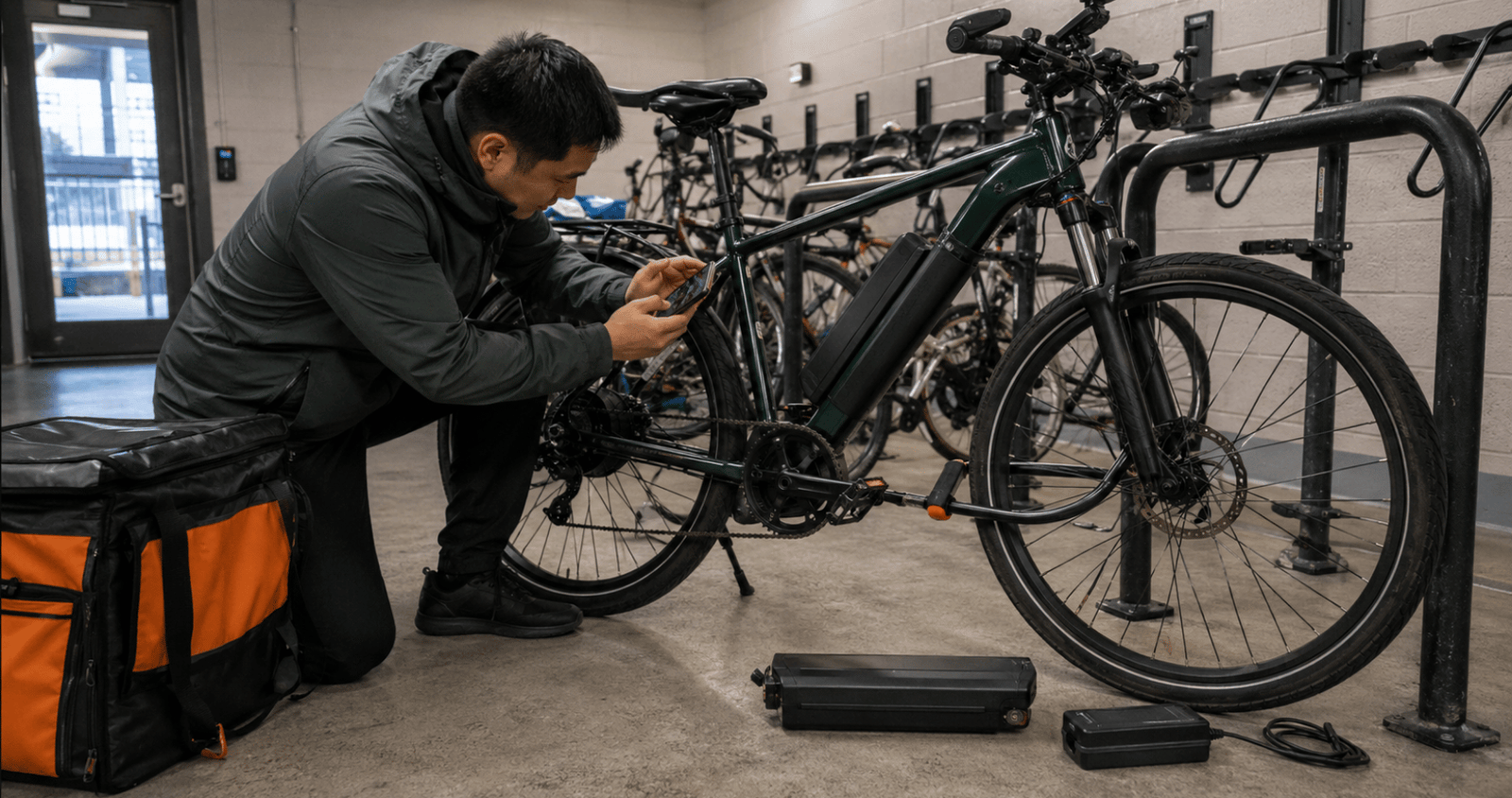
The bike, including the serial number, which sits under the bottom bracket where the crank arms meet. Photograph the label rather than transcribing it.
The battery and charger, with model numbers.
Every accessory, including bags, mounts, lights, and locks.
Your receipts, stored in cloud storage rather than on the phone you carry while working.
Register the serial number with a national bike registry, which is free and meaningfully improves recovery odds.
Setting Your Numbers
Four decisions.
Personal property, counted honestly and including work equipment even if you suspect it is limited.
Business property endorsement, which is inexpensive and covers the equipment category standard policies restrict.
The e-bike, separately. Determine its class and wattage, ask your carrier whether it qualifies, and if the answer involves commercial use, price a specialty policy.
Liability at three hundred thousand, which costs little and applies to your personal life regardless of what your work coverage does.
The Short Version
If your e-bike has a throttle or serious wattage, your renters policy probably classifies it as a vehicle and excludes it.
If you use it to earn money, the business use exclusion can remove it regardless of class.
So the honest answer for a delivery rider is that renters insurance covers your apartment and your belongings, and a separate specialty policy covers the bike you work on.
Two calls settle it. Ask your renters carrier what they classify your bike as and whether commercial use is excluded. Then get one specialty quote and compare. Between them, the equipment you earn a living with stops being the least protected thing you own.
This article is for general educational purposes and is not insurance advice. Classifications, wattage thresholds, business use exclusions, and specialty policy availability vary significantly by insurer and by state. Confirm your specific situation in writing with your carrier.
Some images in this article were generated using artificial intelligence and are for illustrative purposes only.