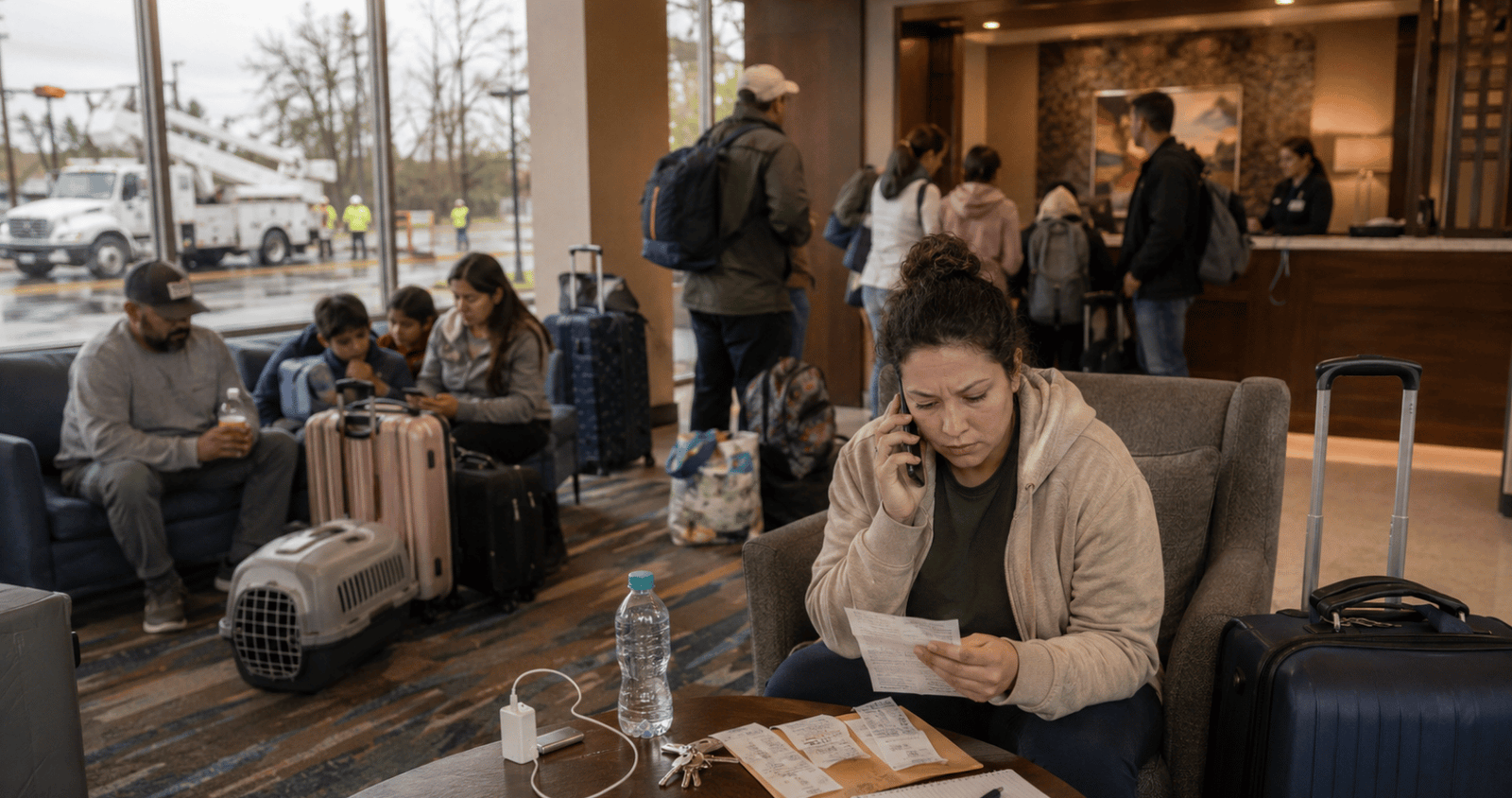
When Your Claim Is One Of Thousands
A single apartment fire and a regional hurricane produce the same policy language and completely different experiences.
In an isolated loss, an adjuster inspects within days and the process runs at a normal pace.
After a major disaster, thousands of claims arrive at once, adjusters are mobilized from other states, local housing fills within days, and a category of people arrives specifically to take advantage of everyone in the affected area.
That environment changes what you should do and in what order. Here is how a catastrophe claim actually works and how to avoid the things that go wrong around it.
File Early, Because Position Matters
The single most useful action in the first day.
When a storm or disaster is significant, insurers mobilize teams of claims adjusters specifically to speed the process. Those teams work through a queue.
Early filers move through faster, and the gap widens as volume builds. A claim opened on day one is handled in a different environment than one opened on day ten.
You do not need a complete inventory to file. Report the loss, get a claim number, and supplement the detail afterward.
Call the number on your declarations page rather than one you were given by someone in person.
The First Check Is Often An Advance
This is the fact that prevents a bad decision under pressure.
The first payment from an insurer after a disaster is frequently an advance rather than a final settlement.
If you are offered an on the spot settlement, you can accept it. And if you later find additional damage, you can reopen the claim and file for more.
Read that carefully, because the fear of accepting money and closing the claim keeps people waiting when they need funds immediately.
Ask explicitly whether a payment is an advance or a final settlement, and get the answer in writing. Then take the advance if it is offered, because in a disaster you will need cash before the full process finishes.
You Have Longer Than You Think, But Not Forever
Most policies require claims to be filed within one year from the date of the disaster.
That is a comfortable window compared with the panic most people feel, and it is not unlimited.
The practical position is to file immediately for the reasons above, and to know that discovering additional damage weeks later is normal and claimable rather than too late.
What Renters Need That Homeowners Do Not
The advice written for disaster claims mostly assumes you own the building. Renters have a different problem.
You are not hiring a roofer. You are looking for somewhere to live, in a market where thousands of other displaced households are looking at the same time.
Loss of use is the coverage that matters most in the first week, and it is the one most people forget to activate.
Call your insurer and ask about an advance for temporary housing specifically. Many carriers will advance funds rather than making you front weeks of hotel costs, and after a regional event this is routine rather than unusual.
Save every receipt from the moment you leave. Hotel, meals above your normal grocery spending, fuel, pet boarding, laundry, storage.
Expect prices to be higher than normal, which is the next problem.
Price Gouging Is Illegal Once An Emergency Is Declared
Worth knowing because it affects exactly what displaced renters buy.
Raising prices for essential goods or services during a declared emergency is illegal in most states. It commonly affects food, water, fuel, medical supplies, temporary shelter, and emergency repairs.
Temporary shelter is on that list, which is the category renters hit first.
Two practical steps. Photograph the prices you are charged, and report gouging to your state attorney general or through the Federal Trade Commission.
Reporting does not lower your bill today. It does contribute to enforcement, and documented prices support a loss of use claim.
Rental Scams Follow Displacement
This is the renter specific fraud and it spikes after every major disaster.
Thousands of people are searching urgently for housing, which is precisely the environment where fake listings work.
The patterns are consistent.
Listings for units that do not exist, or that the person listing does not control.
Requests for a deposit before you can view the property.
Payment demanded by wire transfer, gift card, or cash app, which are the methods that cannot be reversed.
Prices notably below the market, in a market where prices are rising rather than falling.
Pressure to decide immediately, which works because you genuinely do need somewhere tonight.
Do not send money for a unit you have not seen, verify who owns or manages the property where you can, and report rental scams to local law enforcement and to the listing platform.
Verify Anyone Who Approaches You
Fraudulent adjusters and impersonators arrive in disaster zones quickly, and the guidance from state regulators is consistent.
Never deal with a third party claiming to be an insurance adjuster without verifying their identity with your insurance company.
Request official identification and verify licensing with your state insurance department.
Legitimate adjusters and contractors will not ask for cash, wire transfers, or gift cards.
Be cautious of anyone arriving without an appointment.
Federal inspectors already have your information. A FEMA home inspector will already have your registration number and will not ask you for it. Anyone who does is not who they say they are.
If someone contacts you claiming to be from an agency, hang up and call the official number rather than the one they provide. For FEMA specifically, the helpline is 1-800-621-3362.
The Document You Should Not Sign Quickly
A specific warning from state insurance regulators.
After a disaster, contractors and others may ask you to sign an assignment of benefits, which authorizes them to handle all matters with your insurance company on your behalf.
That can sound helpful when you are exhausted and dealing with a claim.
State guidance is blunt about the risk. Signing one may mean giving up some, most, or even all of your rights, including having a lawsuit filed in your name without your approval or knowledge.
Take your time reviewing any such document. Talk to your claims adjuster, ask an attorney to review it, or call your state insurance department.
There is rarely a reason a renter needs to sign one at all.
Public Adjusters, Honestly
They exist, they are legitimate when licensed, and the math matters.
The standard guidance is to try to settle directly with your insurer first, because your insurer provides an adjuster at no charge to you. Ask questions and ask your agent for help before hiring anyone.
If your claim is genuinely complicated and you want representation, you retain the right to hire a public adjuster or an attorney.
Understand the cost. A public adjuster typically takes around fifteen percent of your total settlement, and an attorney as much as thirty percent.
On a renters claim of a few thousand dollars, that is a large share of a modest recovery. On a total loss it can be worth it.
Two cautions. Verify any public adjuster's license with your state insurance department. And be alert to arrangements where an adjuster steers you toward affiliated appraisers or restoration companies, or where the practice appears to be routing clients onward to lawyers rather than working your claim.
Do Not Start Repairs Before Instructions
A sequencing rule that protects your claim.
Do not call anyone to repair or replace your loss without first getting instructions from your adjuster, since a visual inspection may be necessary before repairs begin.
And do not throw away damaged property until your adjuster tells you it is acceptable to do so.
Emergency measures to prevent further damage are different and are expected. Board a broken window, move undamaged belongings out of a wet room, and keep the receipts, since payments for temporary repairs form part of the total settlement.
The line is between stopping further loss, which you should do immediately, and beginning restoration, which waits.
Federal Aid Runs On A Separate Track
Worth separating, because people conflate the two and lose time.
Insurance and federal disaster assistance are different systems. Your policy is a contract. Federal aid is a program with its own eligibility rules, its own application, and its own inspectors.
Insurance generally comes first. Federal assistance is typically designed to help with needs your insurance does not cover rather than to duplicate it, so you will usually be asked what your insurer paid.
Apply for both where a disaster is declared. Waiting for one to finish before starting the other costs weeks you do not have.
Federal aid is not a payout. It covers urgent needs on a capped and means tested basis, which is why the difference between insured and uninsured households after a major event is so large.
Keep the two files separate and keep the reference numbers distinct. When both processes are running at once, mixing up which agency asked for what is a common and avoidable source of delay.
When Your Building Is The Problem
A situation specific to renters that homeowner guidance does not address.
After a major event, your apartment may be intact while the building is not. Structural inspection, red tagging, and utility restoration all sit with your landlord and local authorities, and none of it is within your control.
Three things that help.
Get the uninhabitable determination in writing. Loss of use turns on whether the unit can be occupied, and a written determination from the landlord or a local authority supports the claim.
Ask about your lease. Many states allow a tenant to terminate when a unit is rendered unusable by a disaster, sometimes with a pro rata rent refund and deposit return. Check your state rules before assuming you are bound to a building you cannot enter.
Do not wait for the building timeline to start your own. Repairs involving structural assessment routinely take months. Your loss of use limit will not stretch that far, so plan for a move rather than for a wait.
Keep A File From Day One
Disasters generate an enormous amount of paperwork and it arrives while you are living out of a bag.
Record the names and phone numbers of everyone you speak to. Keep copies of every list and document you submit, and every document the insurer gives you.
Log calls with dates and what was said, then follow important ones with a short email summarizing them.
Store all of it in cloud storage rather than on paper that may be in a hotel room or a car.
After a regional event, files get reassigned between adjusters as teams rotate. Your own record is frequently the most continuous account of the claim that exists.
Where To Report What
Different frauds go to different places.
Insurance related scams, including fake adjusters, to your state insurance department or state attorney general.
Federal agency impersonation to the Department of Homeland Security Office of Inspector General hotline.
Price gouging to your state attorney general or the Federal Trade Commission at their fraud reporting site.
Rental and housing scams to local law enforcement, the Department of Housing and Urban Development Office of Inspector General, and the listing platform where you found it.
Reporting takes minutes and it protects the people behind you in the same situation.
The First Forty Eight Hours
In order.
Safety first, then photograph everything before touching it.
File the claim, using the number on your policy documents, without waiting for a complete inventory.
Ask about an advance for temporary housing, which is the coverage renters need most and activate least.
Start the receipt file and the call log.
Verify anyone who approaches you, and sign nothing on the spot.
A disaster claim is slower, more crowded, and more targeted by fraud than an ordinary one. The parts you control are speed at the front end and documentation throughout, and both are genuinely within reach on a bad week.
This article is for general educational purposes and is not insurance or legal advice. Claim timelines, filing deadlines, price gouging statutes, and reporting channels vary by state and by policy. Confirm details with your carrier and your state insurance department.
Some images in this article were generated using artificial intelligence and are for illustrative purposes only.