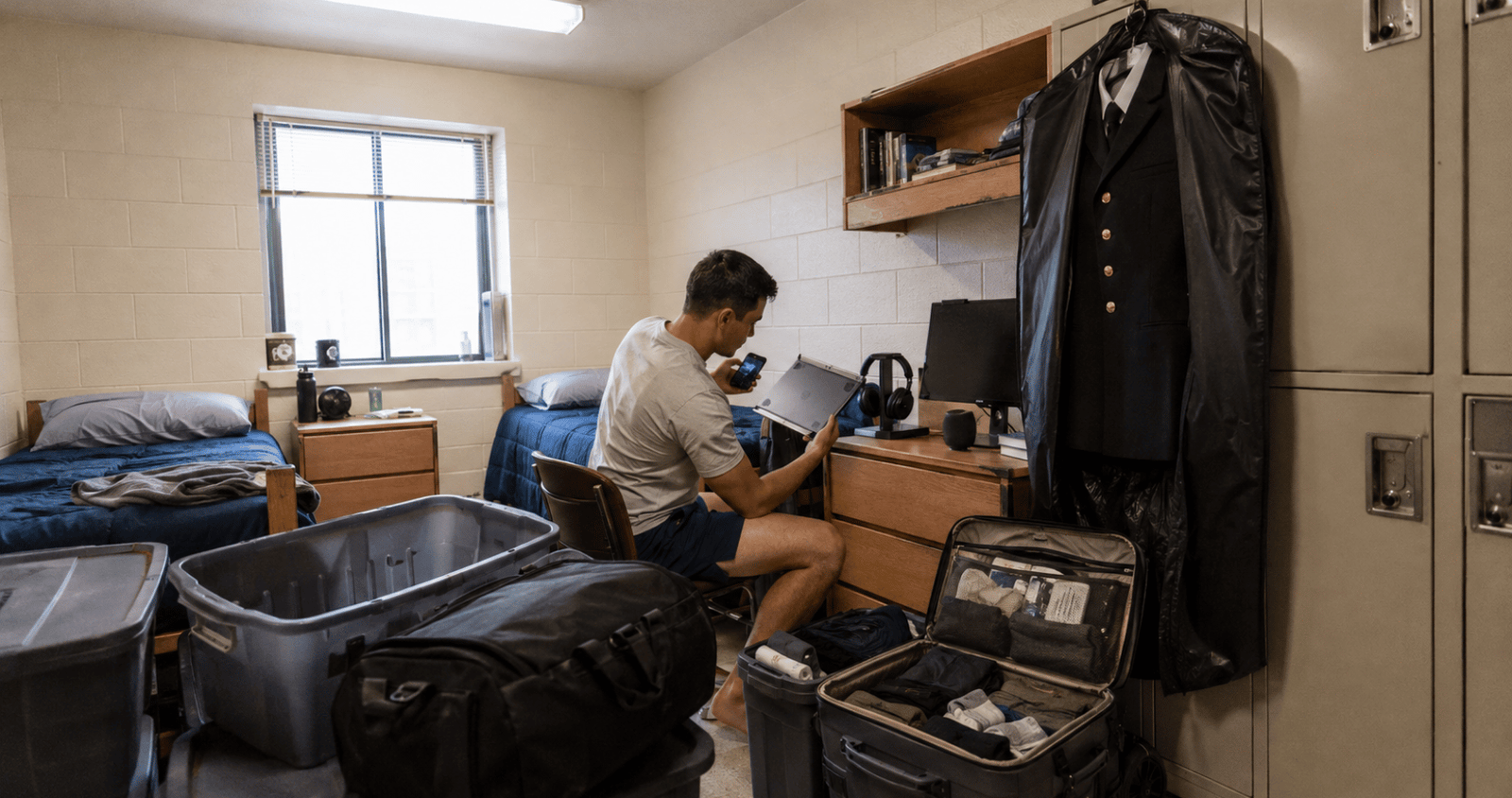
Nobody Is Insuring What Sits In Your Barracks Room
A lot of junior service members assume otherwise, reasonably enough. You live in government housing, on a government installation, under government rules.
None of that covers your belongings. The government does not insure your personal property in barracks rooms.
Your laptop, your civilian clothes, your gaming setup, your gear that was not issued to you. If the room floods or the building burns or something is taken, that is your loss unless you carry a policy.
That is the foundation. Everything else in this article builds on it.
Privatized Housing Often Requires It Anyway
For those living off base or in privatized on base housing, the question is frequently settled for you.
The Department of Defense does not mandate renters insurance across all branches. But many privatized base housing communities require tenants to carry a minimum amount of personal liability coverage as a condition of the housing agreement.
Off base landlords near installations require it at similar rates to landlords anywhere else.
Check the housing agreement or lease for the specific requirement and the minimum limit, then buy to match it.
The Uniform Problem
Here is the coverage question specific to military renters, and it is a real one.
A full set of dress uniforms plus tactical gear runs into the thousands of dollars. That equipment is essential to your job and expensive to replace.
The complication is classification. Standard renters policies restrict business related property, and equipment tied to your occupation can fall into that category depending on how a carrier reads it.
Military focused insurers handle this differently and explicitly. One waives the deductible entirely for claims involving uniforms, insignia, flight cases, headsets, and personal body armor.
That deductible waiver matters more than it sounds. A single damaged uniform item frequently falls below a five hundred dollar deductible, which means a standard policy produces nothing while a military policy pays.
If you carry a standard policy, ask your insurer directly how they classify uniforms and duty gear. Get the answer in writing.
What Military Focused Carriers Do Differently
Several features appear on military policies that standard renters policies do not include as a matter of course.
Worldwide personal property coverage. Your belongings are covered at home, during PCS, during deployment, and everywhere between, rather than at a reduced off premises limit.
Deductible waivers on uniforms and duty gear, as described above.
Coverage for war related loss outside the United States, with no deductible, for property damaged, destroyed, or abandoned.
Reduced rates during deployment, reflecting that an empty apartment carries less risk.
Payment timing aligned to military pay schedules, which is a small administrative thing that matters when everything else is moving.
Replacement cost at current value with no depreciation, which is a meaningful upgrade over actual cash value settlements.
USAA is the best known, and Armed Forces Insurance writes for the same market. Some mainstream carriers partner with military focused underwriters, and Lemonade, State Farm, and GEICO are reasonable comparisons for anyone who does not qualify for the member only options.
Compare at least one military focused quote against your standard options. The pricing is often competitive and the coverage differences are substantive rather than marketing.
Why Worldwide Coverage Matters More Than It Sounds
A standard renters policy typically caps off premises coverage at around ten percent of your personal property limit.
That figure applies while your belongings are in transit, in storage, or anywhere other than your residence.
Now consider a PCS. Your entire household sits in a truck, then possibly in storage, then in a new location, sometimes across an ocean. For weeks.
Ten percent of your limit is not adequate protection for the contents of a household in motion, and PCS moves put nearly every service member in that situation on a recurring basis.
Worldwide coverage without a reduced off premises limit is the single most valuable difference between a military policy and a standard one for anyone who moves on orders.
Coverage During A PCS
Even with good coverage, the same rule applies to military moves as civilian ones.
Named perils travel with your belongings. Theft, fire, and a vehicle accident are covered.
Damage caused by handling is not. If movers drop or break something, that runs through the moving claim process rather than your insurance policy.
For a government funded move, the claims process runs through the transportation office and the carrier rather than through your insurer. Know which channel applies before you need it, and file within the required window, which is often shorter than people expect.
Photograph and inventory everything before packers arrive. This is more important on a military move than a civilian one, because you frequently do not pack your own boxes and the inventory sheet becomes the primary record of what existed.
Storage During A PCS
Belongings routinely sit in storage during a move, sometimes for extended periods.
On a standard policy, storage falls under off premises limits, and some policies apply a time limit for temporary storage during a move.
On a policy with worldwide coverage and no reduced off premises limit, this is a much smaller problem.
Either way, ask two questions before your household goods go into storage. What limit applies, and whether there is a time cap. A PCS that stalls, or an unaccompanied tour, can leave belongings in storage far longer than a civilian move would.
What Happens During Deployment
Three practical points.
Do not cancel your policy. Your belongings still exist, in an apartment or in storage, and an empty unit is not a risk free unit.
Ask about a deployment rate. Some military carriers reduce premiums during deployment, which is money left on the table if you do not ask.
Update the address and status. If you are terminating a lease and putting everything in storage, your insurer needs to know where the property actually is.
Also confirm how your carrier treats an extended vacancy. Some standard policies impose conditions or limitations when a residence sits unoccupied for a defined period, and a deployment can exceed it.
The Lease Right You Cannot Sign Away
Now the legal side, which is where military renters have protections civilians do not.
Under federal law, service members have the right to terminate a residential lease early with no penalty, no early termination fee, and no forfeiture of the security deposit, upon receiving qualifying orders.
That right cannot be waived by a lease agreement.
Qualifying orders include a permanent change of station, regardless of distance or whether the new duty station is domestic or overseas. Deployment orders for ninety days or more. Orders to government quarters that make the rental unnecessary. Pre deployment and mobilization orders requiring you to leave the residence for ninety days or more.
To invoke it, provide the landlord written notice of intent to terminate along with a copy of the orders, generally no fewer than thirty days before the planned termination.
If the lease predates your active duty service, you generally need to show that you signed before entering active duty and that you will remain on active duty for at least ninety days.
Protection begins on the date you enter active duty and generally ends between thirty and ninety days after discharge.
The Waiver Document To Watch For
A warning worth taking seriously.
Some landlords include separate waiver documents in the leasing paperwork asking service members to give up these protections.
Military OneSource is explicit about this. Signing such a waiver may mean you cannot end your lease early on PCS or deployment orders without significant penalties, when you would otherwise have been entitled to terminate penalty free.
The guidance is equally explicit. Do not sign documents that take away your rights under the act.
If you already signed one, your installation legal assistance office or judge advocate can advise on whether the lease can be updated. That service is free and it exists for exactly this.
Military Clause Versus Federal Protection
These get conflated and they are not the same thing.
The federal protection is law. It applies whether or not your lease mentions it.
A military clause is a customized term negotiated into a lease. It often enhances the federal protection by covering additional situations, such as being ordered into government quarters that become available, but it does not replace the statutory right.
Such clauses are common in housing near installations. If your lease does not have one, it is reasonable to ask whether one can be added.
Two protections layered is better than one, and neither costs anything to have.
Overseas Assignments Add Another Layer
An OCONUS tour changes the picture in ways stateside moves do not.
Confirm your policy actually follows you overseas. Worldwide personal property coverage is standard on military focused policies and is not standard everywhere else. A policy that stops at the border is a policy that stops protecting you the day you arrive.
Ask how war related loss is treated. Some military carriers cover property damaged, destroyed, or abandoned outside the United States due to war, with no deductible. Standard policies typically exclude war entirely.
Understand what happens to property left behind. Household goods in long term storage stateside during an unaccompanied tour need to be covered somewhere, and storage time limits on standard policies can expire mid tour.
Check liability coverage abroad. Liability that applies worldwide behaves differently than liability tied to a residence, and host nation legal exposure is not something a standard policy was written around.
None of this is a reason to avoid an overseas assignment. It is a reason to make the coverage conversation part of the outprocessing checklist rather than something handled on arrival.
Spouses And Family Members
Two points that come up constantly.
A spouse living with you is generally covered under the same policy, since household family members named on it are insureds.
A spouse who stays behind during an unaccompanied tour creates a two household situation. If belongings are split across two addresses, or one party stays in the original unit while the other is elsewhere, tell your insurer. A policy listing one address while property sits at another is a problem at claim time.
Dependent children away at college may also carry coverage under the family policy at a reduced limit, subject to conditions around age and residency. Confirm rather than assume, particularly for off campus housing on the student's own lease.
Setting Your Coverage
Do the inventory rather than accepting a default. Furniture, electronics, civilian clothing, kitchen equipment, and gear.
Then look at three things.
The personal property limit, measured against what you actually own rather than a quoting screen default.
The settlement basis. Replacement cost rather than actual cash value, particularly for electronics and gear.
The liability limit. Most policies default to one hundred thousand dollars. Liability protects your pay and savings from a judgment, and raising it to three hundred thousand typically costs a few dollars a year.
That last point deserves emphasis for anyone early in a career. A judgment can reach future earnings, and a military career is a long earnings trajectory.
Three Things To Do Before Your Next Move
Get one military focused quote alongside your standard options. The worldwide coverage and uniform deductible waiver are substantive differences, not marketing language.
Photograph and inventory everything before packers arrive. On a government move you often do not pack your own boxes, which makes your own record the only independent one.
Read the lease for a waiver document and for a military clause. Refuse the first, ask for the second, and involve legal assistance if anything looks wrong.
Everything else about a renters policy works the same for you as for anyone. Those three items are where military renters actually lose money.
This article is for general educational purposes and is not legal or insurance advice. Coverage terms, carrier features, housing requirements, and the application of federal protections vary by situation. Consult your installation legal assistance office for legal questions and your insurer for coverage questions.
Some images in this article were generated using artificial intelligence and are for illustrative purposes only.