Fair Housing Protects Your Tenancy, Not Your Policy
Two systems govern renting with a disability and they do not talk to each other.
Fair housing law binds your landlord. It requires reasonable accommodations and permits reasonable modifications, and it protects assistance animals from pet policies, fees, and breed restrictions.
Insurance contracts bind your carrier. They are written under a different body of law, and a federal housing protection does not amend a policy exclusion.
That gap produces most of the confusion in this area, and it produces one specific conflict that courts are actively working through right now.
Here is where the two systems diverge, and what it means practically for animals, equipment, modifications, and the harder problem of displacement.
What Your Landlord Must Do
The housing side is relatively clear.
Assistance animals, including service animals and emotional support animals, must be permitted even in a building with a no pets policy, as a reasonable accommodation. Federal guidance states that breed, size, and weight limitations may not be applied to an assistance animal.
Landlords cannot charge pet rent, pet fees, or pet deposits for an assistance animal.
For a service animal, a landlord is generally limited to asking two questions. Whether the animal is required because of a disability, and what tasks it is trained to perform. They cannot demand medical records, access to your health history, or proof from an online registration database.
Other recognized accommodations include accessible parking, allowing an aide to reside in the unit, transferring to a ground floor unit, and using a cosigner where a disability has affected credit.
What Your Insurer Can Still Do
Now the divergence.
Your own renters policy is a contract between you and a carrier. Fair housing protections apply to housing providers, not to insurers, and a policy exclusion is not overridden by your landlord's obligations.
So a carrier may still maintain breed restrictions that exclude your assistance animal, decline to cover a dog with a bite history, or apply higher premiums.
And your personal liability is unchanged in every case. If your assistance animal injures someone, you owe their medical expenses and any damages regardless of the animal's legal status in housing law.
That is not a criticism of fair housing protections. It is a description of what they cover, which is your right to live somewhere, not your financial exposure if something goes wrong.
The practical response is the same as for any dog owner. Some carriers do not use breed lists at all and evaluate animals individually. If one declines, shop rather than assuming you are uninsurable, and consider standalone animal liability coverage.
The Live Legal Question
Worth knowing because it may affect a conversation you are having with a landlord.
Some landlords deny an assistance animal accommodation by citing their own insurance, saying their carrier prohibits the breed.
Courts have been skeptical of that defense. The general expectation is that a landlord must seek alternative insurance or demonstrate that no carrier will write them before using insurance as grounds to deny an accommodation, and the burden of proof sits with the landlord.
The question is also being litigated further up the chain. In a 2025 federal district court decision, a court declined to dismiss a fair housing claim brought against an insurance broker where a landlord had been told the property's insurer prohibited renting to a tenant with an emotional support dog of a restricted breed.
That case is one decision in one district and the law here is developing rather than settled. But the useful takeaway for a renter is that a landlord saying my insurance will not allow it is not automatically the end of the conversation.
If you encounter that, a local fair housing organization or a tenant advocacy group is the right next call.
You Are Still Responsible For Damage
A point stated plainly in tenant guidance and worth repeating without discomfort.
Assistance animals are exempt from pet fees and deposits. They are not exempt from consequences. If your service animal damages a unit, you are responsible for the associated costs.
Two mechanisms handle that, and neither is the pet deposit you were not charged.
Your security deposit, which covers damage to the unit beyond normal wear and tear.
Your liability coverage, for damage to other people's property, though not to the unit you occupy, which liability generally excludes.
So the accommodation removes a fee. It does not remove responsibility, and budgeting as though it did is a mistake.
Modifications You Paid For
This is where an interesting coverage question arises that nobody addresses.
Reasonable modifications are physical alterations to the unit. Widened doorways, grab bars, a roll in shower, lowered countertops, a ramp.
In most private rentals, the tenant pays for these unless the landlord receives federal funds. And landlords can require that modifications be reversed when you move out.
So you may be funding permanent alterations to a building you do not own, with an obligation to undo them later.
Three questions worth asking your insurer.
Are tenant funded improvements covered under my policy, and up to what limit. Some renters policies include a small amount of coverage for alterations or improvements made to a rental, often expressed as a percentage of your personal property limit.
What happens if a covered loss destroys them. A fire that damages a bathroom you paid to modify raises the question of who funds the rebuild of the modification specifically.
Does removable equipment count as property rather than improvement. A portable ramp or a shower chair is your personal property. A widened doorway is not.
The answers vary and asking in advance is considerably better than discovering them during a claim.
Durable Medical Equipment
Reassuring on the whole, with one thing to check.
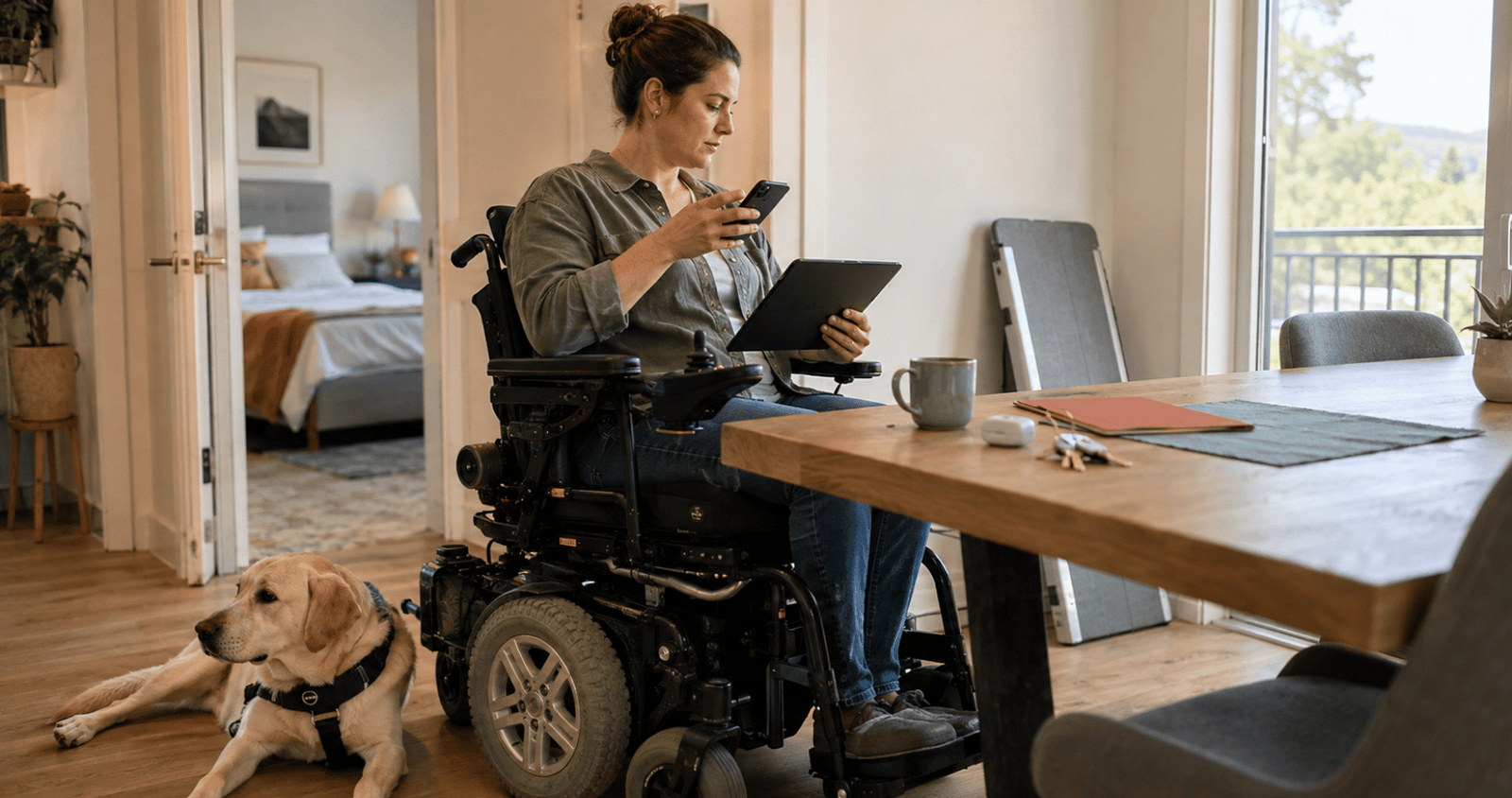
Renters insurance typically covers personal medical equipment as personal property, up to your policy limits. Wheelchairs, walkers, hearing aids, mobility scooters, lifts, hospital beds, and shower chairs.
That matters because the numbers are large. A power wheelchair can run into five figures on its own, and hearing aids into the thousands.
Two limits to confirm.
Whether anything exceeds a category cap. Most medical equipment sits under general personal property, but confirm for anything particularly expensive.
How coverage works away from home. Off premises limits are typically around ten percent of your total, and medical equipment travels with you. That is a real gap for a power wheelchair damaged at an airport or a scooter stolen from outside a building.
If your equipment represents a large share of what you own, scheduling it individually is worth pricing. Scheduled items bypass category caps, usually cover accidental loss and damage rather than named perils only, and often carry no deductible.
That last point matters here. A repair to a mobility device may fall below a five hundred dollar deductible while still being unaffordable, and a zero deductible scheduled item avoids that.
A Live In Aide Is Its Own Question
Allowing an aide to reside in the unit is a recognized reasonable accommodation. The insurance treatment is less clear and worth sorting out.
The question is which category the person occupies.
A household member may be covered under your policy if named.
A roomer or boarder is a different category, and homeowners and renters policies treat rent paying occupants differently.
An employee raises further questions, since a paid caregiver working in your home may be treated as a worker rather than a guest, and liability coverage for injuries to home health providers varies.
Three practical steps. Ask your insurer which category applies to your specific arrangement. Ask whether the aide's agency carries its own liability and workers compensation coverage, since agency employed caregivers usually are covered and privately hired ones frequently are not. And be cautious about hiring privately, which can place you in an employer position a personal policy was not written for.
The Displacement Problem
This is the section that matters most and it is the one nobody writes.
Loss of use coverage pays for temporary housing when a covered event makes your home uninhabitable. Standard limits are commonly a flat three to five thousand dollars, or twenty to thirty percent of your personal property coverage.
Those limits assume you can find a comparable temporary unit quickly.
Accessible housing is scarce. A renter who needs a ground floor unit, a roll in shower, wide doorways, or accessible parking cannot simply take the first available hotel room or short term rental. Options are fewer, they cost more, and after a regional event they disappear faster.
Repairs also take longer where accessibility features have to be restored rather than merely replaced.
Which means the standard loss of use limit is systematically undersized for a renter with accessibility needs, in a way it is not for other renters.
Two things to do. Divide your loss of use limit by what a genuinely accessible temporary unit costs in your area, and if the answer is a few weeks rather than months, ask what raising it costs. It is usually inexpensive.
And keep a short list of accessible temporary options, because researching that under pressure is far harder than researching it now.
Setting Your Numbers
Four decisions, weighted for this situation.
Personal property, counted including all equipment, which is frequently a larger share of the total than for other renters.
Loss of use, raised above the default for the reasons above.
Liability at three hundred thousand, particularly if you have an assistance animal.
Scheduling for expensive mobility or communication equipment, which removes category caps and usually the deductible.
Three Conversations Worth Having
With your insurer. Ask how they treat your assistance animal, your equipment, any tenant funded modifications, and a live in aide. Four questions, one call, and get the answers in writing.
With your landlord. Get accommodation and modification agreements in writing, including any restoration obligation at move out.
With yourself, in advance. Identify where you would go if the unit became unlivable tomorrow, and set your loss of use limit against what that would actually cost.
The insurance side of renting with a disability is mostly ordinary, and the parts that are not are concentrated in equipment values and displacement. Both are fixable with a phone call, and both are considerably harder to fix afterwards.
This article is for general educational purposes and is not legal or insurance advice. Fair housing obligations, insurance treatment, and the developing case law in this area vary by jurisdiction and by carrier. For rights questions, consult a fair housing organization or an attorney.
Some images in this article were generated using artificial intelligence and are for illustrative purposes only.