The Policy That Stands Between You And A Thirty Five Thousand Dollar Bill
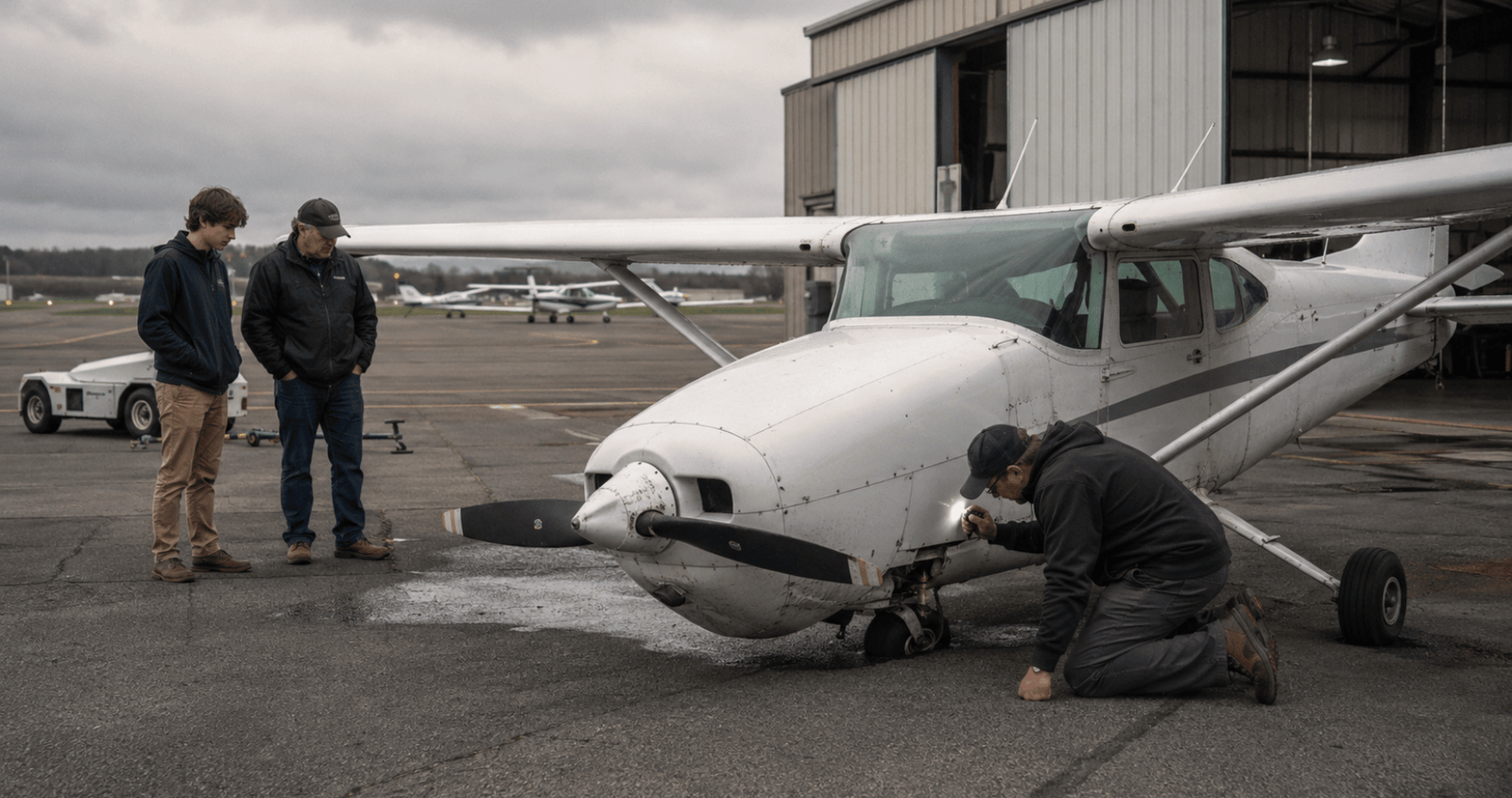
A student pilot on a first solo cross country lands hard. The wind shifted on approach and the nose gear collapses.
Damage to the Cessna 172 comes to thirty five thousand dollars.
The flight school carries hull insurance with a ten thousand dollar deductible. Their insurer pays twenty five thousand for the repair, and then sends the student a subrogation demand for the twenty five thousand they just paid out. Separately, the school bills the student for the ten thousand dollar deductible.
Total exposure, thirty five thousand dollars. To a student pilot. On what was supposed to be the best day of training.
A non owned aircraft policy costing around two hundred fifty dollars a year would have covered both.
That gap is the entire subject of this article.
The Misunderstanding At The Center Of It
Ask most renter pilots whether they are covered and they will point at the flight school.
Flight schools, FBOs, and aircraft owners all carry insurance. That insurance is written to protect their airplane and their financial interest. It is not written to protect you.
If you are pilot in command when something goes wrong, the owner's insurer can pursue you directly to recover what they paid. That right is called subrogation and it is standard.
Pilots discover this after an incident rather than before. Reliably.
What The Policy Actually Contains
Non owned aircraft insurance, also sold as aircraft renters insurance, has two parts.
Liability coverage. Protects you against claims for bodily injury or property damage arising from an accident where you were flying. This includes injuries to passengers and damage to property on the ground.
Hull coverage, sometimes called physical damage. Pays for damage you cause to the aircraft itself, up to your chosen limit. This is what answers the subrogation demand and the deductible bill.
Liability is standard on these policies. Hull coverage is optional and it is the part most pilots undersize.
Getting The Hull Number Right
The rule is straightforward. Match your hull coverage to the value of what you actually fly.
If you regularly rent a Cessna 172 worth around one hundred thousand dollars, carrying five thousand dollars of hull coverage leaves an enormous gap.
That said, requirements vary and it is worth asking rather than guessing. Some flight schools only expect you to cover their deductible. Others, particularly smaller operations without robust fleet policies, may require hull coverage matching a significant portion of the aircraft's value.
Hull coverage is typically available from five thousand up to two hundred thousand dollars.
Liability Limits And The Per Passenger Trap
Liability on these policies commonly starts at two hundred fifty thousand dollars per occurrence, limited to twenty five thousand per passenger.
Read that second figure carefully.
A policy advertised as carrying two hundred fifty thousand in liability may cap each individual passenger at twenty five thousand dollars. If you fly with three people aboard and something happens, that sublimit governs, not the headline number.
The industry standard recommendation is one million dollars per occurrence with one hundred thousand per passenger. Top tier options reach one million per occurrence with two hundred thousand per passenger.
Most flight schools and flying clubs require one million in liability as a minimum, so this is usually settled for you.
Smooth limits, meaning a single limit without a per passenger sublimit, are the cleanest structure if available.
The Charge Nobody Expects
When an aircraft is down for repairs, the FBO is not earning rental revenue on it. Many will bill you for that lost income while the airplane sits.
One real example involves a Cessna 172 where a pilot damaged the prop and nose gear during landing. The FBO's insurance handled the aircraft, and the pilot received a bill for seven thousand two hundred dollars covering the deductible plus loss of use.
A two hundred fifty dollar policy would have covered the whole amount.
Make sure loss of use is included when you buy. It is not always automatic, and it is a meaningful share of what these bills look like.
What It Costs
The pricing here is genuinely modest relative to the exposure.
| Coverage Level | Approximate Annual Premium |
|---|---|
| Liability only | 80 to 120 |
| Liability plus 5,000 hull | 150 to 200 |
| Liability plus 50,000 hull | 250 to 350 |
| Liability plus 100,000 hull | 400 to 500 |
| Liability plus 200,000 hull | Around 1,663 |
Most renter pilots pay under thirty dollars a month.
Real world policy examples give a clearer picture.
A student pilot flying a Cessna 172 with two hundred fifty thousand liability and five thousand hull runs about one hundred eighty dollars a year.
A private pilot in a Piper Archer with one million liability and fifty thousand hull runs about two hundred ninety.
A CFI in a Cirrus SR20 with one million liability and one hundred thousand hull runs about four hundred thirty.
A business pilot in an SR22T with smooth one million limits and one hundred thousand hull runs about four hundred ninety.
Premiums move with your total time, your ratings, the aircraft you fly, and your claims history.
Three Questions For Your Flight School
Before you buy anything, ask these directly. The answers tell you exactly how much coverage to carry.
What is your deductible? This is the minimum hull coverage you need at absolute bare minimum, because that bill is coming to you.
Do you waive subrogation for renters? If they do, your exposure drops considerably. If they do not, and most do not, the full repair cost can land on you.
What are your minimum coverage requirements? Many schools now require non owned coverage before permitting solo flight, and they will specify limits.
Get the answers in writing if you can. Verbal assurances from a desk staffer are not a defense against a subrogation demand two years later.
Students And Instructors Need Specific Wording
Two groups need to check policy language rather than assuming.
Student pilots. Confirm the policy covers dual instruction and solo flight under supervision. Many schools now require coverage before first solo, which means the timing matters as much as the coverage.
Certificated flight instructors. CFIs need instruction specifically covered, since giving dual in an aircraft owned by a school or a private owner is a different activity than renting for personal flying. Some policies handle it and some do not.
If you are transitioning from student to CFI, revisit the policy rather than letting it renew unchanged.
Additional Insured Requests
Many FBOs require being named as an additional insured on your certificate before they will rent to you.
Your broker can arrange this. It is routine.
One note carried over from other lines of insurance. A certificate of insurance is evidence that a policy exists. Additional insured status is an endorsement on the policy itself. If a school requires the endorsement, confirm it was actually added rather than assuming the certificate satisfied it.
Flying Clubs Work Slightly Differently
Club members often assume membership includes coverage. Usually it does not, at least not the part that protects them.
A club's fleet policy insures the club's aircraft and the club's interest. Depending on how the club is structured, members may or may not be named insureds on it, and even when they are, the policy may still permit recovery against a member who caused damage.
Three things to confirm with your club before relying on anything.
Are members named insureds on the fleet policy? If yes, ask whether that extends to hull damage or only liability.
Does the club waive subrogation against members? Some do as a matter of policy. Many do not.
What deductible applies to member caused damage? In some clubs this is charged directly to the member responsible, and it can be substantial on a higher value aircraft.
The answers vary enough between clubs that a member policy at one club may be genuinely unnecessary while at another it is essential.
Renewal Is Worth Ten Minutes
These policies renew quietly and most pilots let them.
Two things change year to year that should prompt a review.
Your flying changed. New rating, new aircraft type, transition from student to private, or private to instructor. A policy written for a student in a trainer may not respond correctly when you are giving dual in a Cirrus.
The fleet changed. If your school or club upgraded aircraft, your hull limit may no longer reflect what you are flying. A limit that covered a older trainer will not cover a newer glass panel aircraft.
Ten minutes at renewal, checking your limits against what you actually fly now, is the cheapest risk management available in general aviation.
What Moves Your Rate
Four things dominate.
Total time and ratings. More hours and higher certificates generally price better.
Aircraft type. A complex or high performance airplane costs more to insure than a trainer.
Coverage limits. Obvious, but the jump from fifty thousand to two hundred thousand hull is proportionally larger than the jump in liability.
Claims and violations. Previous insurance claims or FAA violations can raise rates temporarily, commonly for three to five years.
That last point is worth planning around. A rate increase that persists for five years changes the arithmetic on whether to file a small claim, exactly as it does with any other line of insurance.
If Something Happens
The order matters.
Secure the aircraft and make sure everyone is safe. Everything else waits.
Notify the aircraft owner or flight school immediately. They have their own reporting obligations and delay complicates everything downstream.
Contact your insurer or broker to file the claim. Do this before agreeing to any repair arrangement or acknowledging responsibility for a bill.
Document everything. Photographs, the sequence of events, weather, and any communications with the school.
Do not negotiate directly with the school's insurer without talking to your own broker first. That is what you bought them for.
Common Objections, Answered Honestly
The flight school's insurance covers me. It does not. It protects the airplane and the owner's interest, and their insurer can pursue you.
I only fly a few times a year. Every flight carries the same liability exposure. Frequency does not change the size of a single bad landing.
It is too expensive. Most pilots pay under thirty dollars a month, against exposure measured in tens of thousands.
I have my own airplane and a policy on it. Your owner's policy covers your aircraft. It generally does not protect you when flying aircraft owned by others, which is exactly what non owned coverage addresses.
The Short Version
The airplane you rent is insured. You are not.
For roughly the cost of two hours of dual instruction per year, a non owned policy sits between you and a subrogation demand that can reach the value of the aircraft.
Ask your flight school three questions. Their deductible, whether they waive subrogation, and their minimum requirements. Then buy hull coverage that reflects what you actually fly rather than what fits a budget line.
The student pilot in the opening example did nothing unusual. Wind shifts on approach happen. The only variable that mattered was whether a policy existed.
This article is for general educational purposes and is not insurance advice. Coverage terms, limits, sublimits, territorial restrictions, and pricing vary by carrier and by pilot profile. Confirm requirements with your flight school or club and work with a licensed aviation insurance broker.
Some images in this article were generated using artificial intelligence and are for illustrative purposes only.