What happens to your budget when your paycheck stops?
Imagine being unable to work for several months. Your rent or mortgage still needs paying. Groceries, electricity and other household expenses continue arriving. You might spend less on commuting, but that saving may be small compared with the income you have lost.
The financial problem is not necessarily the treatment bill alone. It is the missing paycheck.
Disability insurance can help address that gap. However, the amount you receive, when it starts and whether you qualify depend on the policy.
This guide explains common U.S. disability income insurance arrangements. It is educational, and policies sold elsewhere may work differently. All financial examples are invented to explain calculations, not quotes, eligibility decisions or guaranteed claim payments.
What is disability insurance?
Disability income insurance replaces part of your earnings when a covered illness or injury prevents you from working under the policy’s definition of disability.
It may be available through an employer or purchased individually. The policy sets the conditions for payment, including the benefit amount, waiting requirements and maximum payment duration.
Think of three questions when reviewing a plan:
- What must happen for me to qualify?
- How much money could become available?
- How long would I need to manage before receiving it?
A policy description that answers only one of those questions does not give you enough information to understand the protection.
Short-term and long-term disability: what is the difference?
Short-term coverage generally provides benefits for a shorter period. Long-term coverage can continue for the longer duration specified in its contract. Neither label, by itself, guarantees a particular payment schedule.
| Detail | Short-term coverage | Long-term coverage |
|---|---|---|
| Main purpose | Address a shorter interruption in earnings | Address a longer interruption in earnings |
| Payment duration | Limited to the policy’s shorter benefit period | Limited to the policy’s longer benefit period |
| What to verify | When payments start and stop | When payments start, stop and undergo review |
| Budget question | How will I manage the first months? | What happens if the interruption continues? |
If you have both types, put their dates on one page. Ask whether there could be a gap between them. Do not assume one begins immediately when the other ends simply because both appear in an employee benefits package.
The definition of disability matters more than the label
A medical condition does not automatically satisfy every insurance contract. The insurer applies the definition in the policy.
Two common approaches are:
- Own occupation: Generally considers whether a covered condition prevents you from performing your usual occupational duties.
- Any occupation: Generally considers other work for which you are qualified through education, training or experience.
Some policies change their test after an initial benefit period.
Even “own occupation” has variations. Some versions allow benefits while you work in another occupation; others impose different conditions. Read the full definition rather than relying on the marketing phrase.
Make the question specific to your work
Write down your main duties before speaking with an insurer. Include activities that would be difficult to replace or delegate.
For example, your work might require prolonged concentration, regular travel, lifting equipment, speaking with customers or performing precise tasks with your hands.
Then ask: “How would this contract evaluate an inability to perform these duties?”
The purpose is not to predict approval. It is to understand what the insurer would assess and what information might be relevant.
How much income could a policy replace?
Disability benefits may follow a percentage-of-earnings formula or a specified amount. A policy can also impose a maximum payment and account for other income.
Consider a simplified example:
| Item | Illustrative amount |
|---|---|
| Covered monthly earnings | $6,000 |
| Replacement percentage | 60% |
| Percentage-based result | $3,600 |
| Policy’s monthly maximum | $3,000 |
| Benefit before other adjustments | $3,000 |
Although 60% of $6,000 equals $3,600, the cap reduces the modeled payment to $3,000.
This example assumes the claim qualifies and the earnings figure matches the contract’s definition. Taxes, offsets or other provisions could change the amount available to spend.
When reviewing a quote, ask what “earnings” includes. Do not assume your salary, overtime, commissions and bonuses are all treated alike. Request an explanation using your actual pay structure.
Compare the possible benefit with essential expenses
Your salary and your household spending are different numbers. Build a budget before deciding whether a proposed benefit would address your needs.
Start with expenses that would continue during an interruption:
| Monthly expense | Illustrative amount |
|---|---|
| Rent or mortgage | $1,600 |
| Food and household essentials | $650 |
| Utilities and communication | $250 |
| Necessary transport | $200 |
| Minimum debt payments | $450 |
| Insurance and other essential commitments | $550 |
| Total | $3,700 |
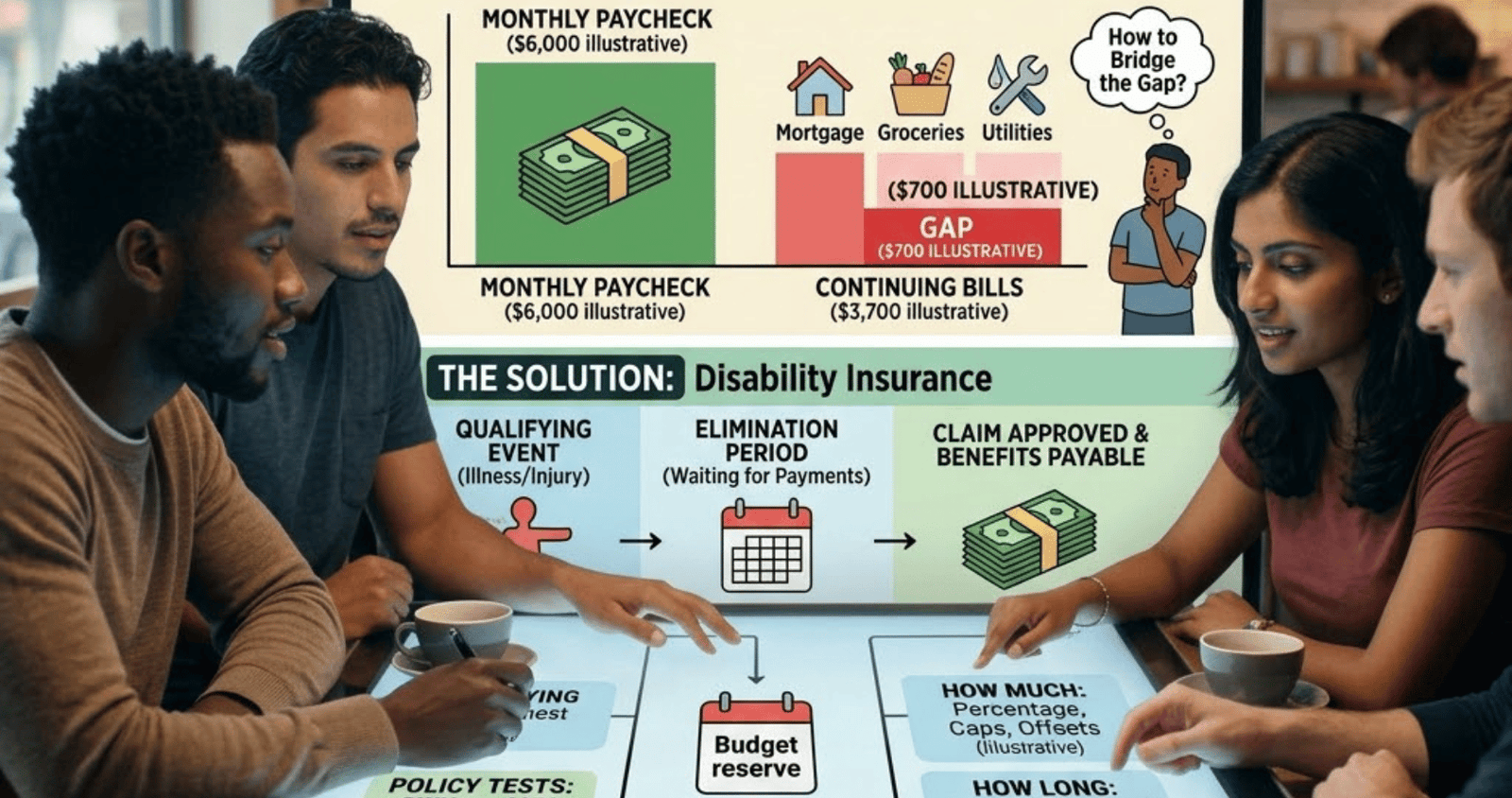
Now suppose the amount actually available from a benefit is $3,000 each month. The example household still has a $700 monthly gap.
Over six months, that difference totals $4,200. This does not establish how much insurance someone can buy or whether a claim would pay. It shows why a percentage of salary needs to be translated into a household budget.
Use your own expenses. Separate costs that could realistically fall from costs you merely hope would disappear.
What is an elimination period?
An elimination period is a specified period after disability begins that generally must pass before benefits become payable. A longer period can reduce the premium, but it leaves more time for you to fund yourself.
Ask the insurer:
- When does the period begin?
- Must the qualifying days be consecutive?
- How are recurring periods of disability treated?
- When would the first payment actually arrive?
- Are benefits paid in arrears?
The last two questions matter for cash flow. A date on which benefits become payable is not necessarily the date money reaches your account.
A waiting-period budgeting example
Assume you need $3,700 monthly for essential expenses and have $7,400 available for that purpose.
That reserve covers two months of the example budget.
If you need to bridge roughly three months before benefits become available, the three-month expense total is $11,100. The difference between that amount and the reserve is $3,700.
This simplified calculation excludes other income and unexpected expenses. Its purpose is to reveal a timing gap before you rely on the policy.
How long can payments continue?
The benefit period specifies the maximum duration of payments under the contract. Continuing payment also depends on continuing to meet the policy’s requirements. A long maximum duration is not an unconditional promise to pay for that entire time.
Ask what happens at important milestones. Is there a change in the disability definition? Are updated records required? Does the stated duration depend on age or the cause of disability?
Write the answers beside the benefit period. A number such as “five years” becomes more useful when you understand the conditions attached to it.
Also compare the potential interruption with your longer-term plans. A household preparing for retirement may ask different budgeting questions from someone supporting young children. Those differences should inform the discussion without replacing an assessment of the actual policy.
Can other benefits reduce the insurance payment?
Some disability policies contain offsets that reduce their payment when you receive specified income from other sources, such as Social Security disability benefits. Coordination rules differ.
Imagine a policy provides a $3,000 benefit before an applicable dollar-for-dollar offset. You then receive $1,200 from another source that the contract treats as deductible income.
The illustrative calculation is:
$3,000 − $1,200 = $1,800 from the insurer
Combined with the other payment, the total is $3,000 not $4,200.
Before adding multiple benefits together in your budget, ask the insurer how they interact. List each potential source separately and mark whether its availability and treatment have been confirmed.
Are disability benefits taxable?
For U.S. federal income tax purposes, the treatment generally depends on how the premiums were paid.
The IRS explains that benefits attributable to employer-paid premiums are generally taxable. If you paid the entire premium with after-tax money, disability benefits under the relevant accident or health insurance arrangement generally are not included in income. Shared funding can require allocating the benefit between taxable and nontaxable portions.
Do not assume a quoted $3,000 benefit means $3,000 of spendable money. Ask payroll or a tax professional how your premium arrangement affects the benefit.
Record whether the estimate you are using is before or after tax. Otherwise, you may accidentally compare a pretax benefit with expenses normally funded from take-home pay.
Is employer coverage enough?
Start by finding out what you already have. Ask for the plan documents rather than relying on a brief enrollment summary.
Use this checklist:
| Question | Information to record |
|---|---|
| Am I currently covered? | Eligibility and effective date |
| What earnings count? | Salary, commissions and other compensation |
| What could it pay? | Percentage, maximum and adjustments |
| When could it start? | Elimination period and payment timing |
| How long could it last? | Benefit period and changing definitions |
| What happens if I leave? | Continuation or conversion provisions |
| Who pays the premium? | Employer, employee or shared arrangement |
Group coverage may end when you leave the employer or association, depending on its terms. Do not assume it follows you automatically.
The question is not whether employer coverage is inherently sufficient or insufficient. It is whether its confirmed terms fit the gap you are trying to address.
How is Social Security disability different?
Social Security Disability Insurance is a federal program with its own work-history and medical eligibility requirements. Its definition is different from private insurance.
The Social Security Administration generally requires a qualifying condition that has lasted, or is expected to last, at least twelve consecutive months or result in death. It does not pay benefits for partial or short-term disability under that program.
An approval under one arrangement therefore does not automatically establish eligibility under another.
When budgeting, distinguish confirmed benefits from benefits you might apply for. A potential application is not the same as an approved payment, and different programs may use different timelines.
What if you can still work, but earn less?
Recovery may involve reduced hours, fewer responsibilities or a different workload. Ask whether the proposed policy addresses that situation through partial or residual disability benefits.
Instead of asking only “Does it cover part-time work?”, ask:
- What reduction in duties or earnings would qualify?
- How would the benefit be calculated?
- Which records would support the income comparison?
- Does returning to work change another part of the claim?
- How long can any reduced benefit continue?
These are questions to resolve before you depend on that feature. Do not assume the insurer simply pays the difference between your old earnings and your new earnings.
For a personal planning exercise, calculate several possible income levels. Keep those calculations separate from an insurer’s confirmed benefit formula.
Which exclusions need attention?
Policies can limit or exclude claims related to specified pre-existing conditions or other circumstances. Some cover accidental injury without providing the same protection for sickness. Read the exclusions alongside the benefit description.
Tell the insurer accurately about the information requested during application. If a question is unclear, ask how to answer it rather than guessing.
For any exclusion attached to an offer, ask for the exact wording and an explanation of its scope. A policy can still have value while leaving a particular risk uncovered, but you need to know what remains outside it.
How much does disability insurance cost?
There is no single premium suitable for every reader. The benefit amount, payment duration and waiting period help shape the price of coverage.
Compare actual quotes using equivalent assumptions.
Suppose one quote costs $70 monthly and another costs $95. The difference is $25 monthly, or $300 annually.
That calculation alone does not tell you which offers better value. Identify what changes: perhaps the elimination period, the benefit amount or the definition of disability.
Write the difference beside the price. You can then assess a concrete choice rather than comparing two premiums with unexplained benefits.
Prepare for a claim before you need one
Keep the policy, benefit schedule and claim contact details somewhere accessible. Add employment and earnings records that would help you explain your work and income.
If you need to claim, ask the administrator for its current requirements, submission method and deadlines.
Build a factual record containing:
- The relevant dates.
- Your usual work duties.
- The duties affected by the condition.
- The records requested from your treating professional.
- Earnings information requested by the insurer.
- Copies of forms and correspondence.
Keep observations separate from assumptions. A clear description of what you can and cannot do is more useful than an exaggerated statement intended to sound convincing.
If the insurer requests more information, note exactly what is missing and who needs to provide it. Keep a record of submissions so you can follow up without rebuilding the file.