The Discount That Can Move In Both Directions
Almost every discount on an auto policy is one directional. You either qualify or you do not, and failing to qualify costs you nothing beyond the missed saving.
Usage based programs are different, and that is the detail buried in the marketing.
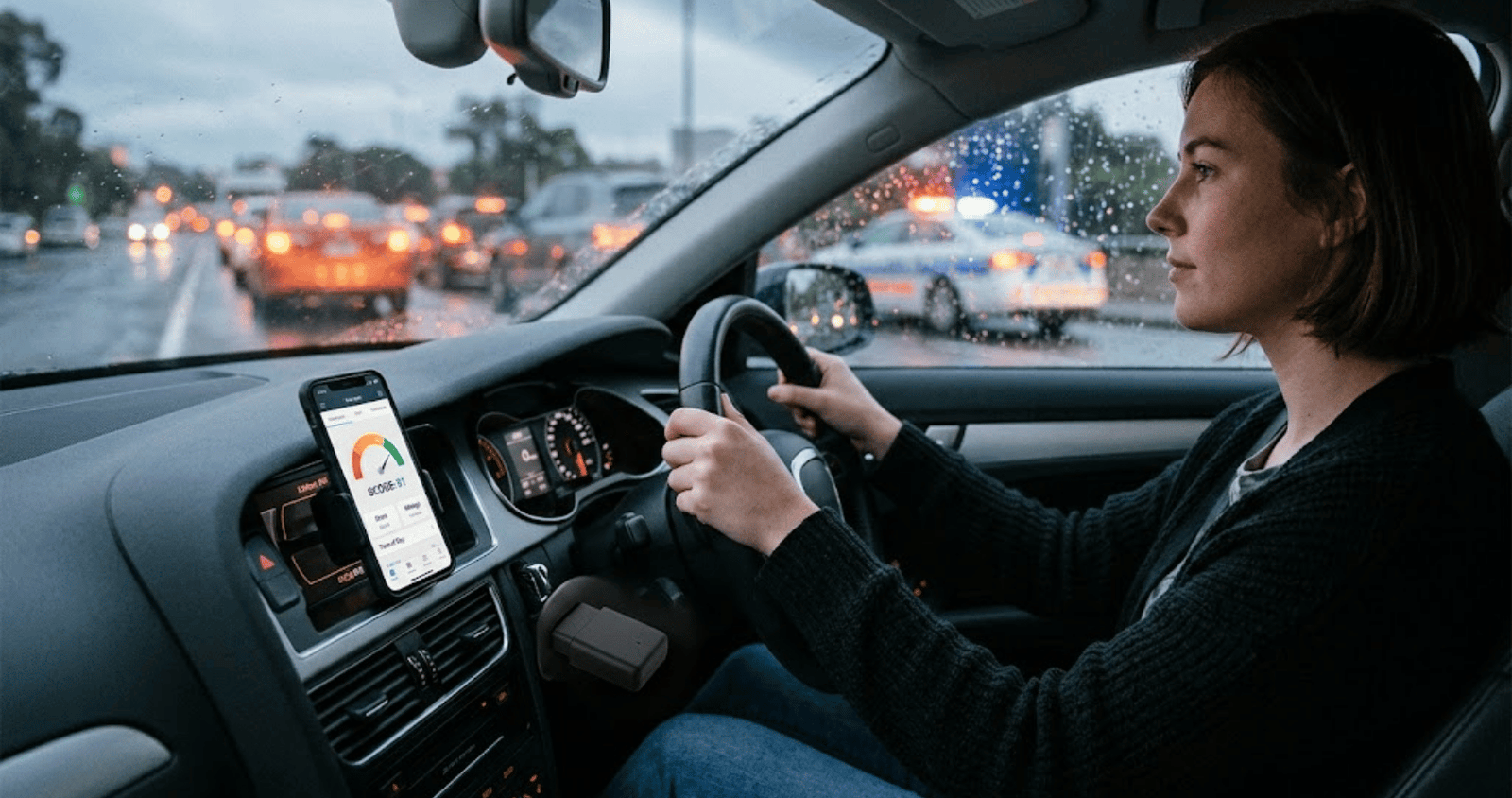
These programs monitor how you actually drive and price accordingly. Safe drivers can typically save between ten and forty percent. Some insurers will penalize phone use behind the wheel, and a few will raise rates for drivers the program judges risky.
One analysis of a major program found roughly twenty percent of participants seeing their rates increase after enrolling.
So the honest framing is that this is not a discount you claim. It is a test you sit, and some versions have a failing grade attached.
Here is what they measure, which programs cannot raise your rate, and who should genuinely enroll.
What They Actually Watch
Broader than most people expect, and knowing the list changes how you drive.
Hard braking, which is the behavior most programs weight heavily and the one most drivers are surprised by.
Rapid acceleration.
Speed, and in some programs speed relative to the limit rather than absolute speed.
Fast cornering.
Phone use behind the wheel, which several programs now detect directly.
Time of day, with late night driving scored as higher risk.
Mileage, total distance and sometimes hours driven.
The app or device generates a score based on risky behaviors observed against safe ones, and that score drives the discount.
Two of those deserve attention. Phone handling is penalized even when you are stopped in traffic on some programs. And hard braking is frequently triggered by other people's driving rather than your own, which matters for the next section.
Three Kinds Of Discount In One Program
A structure worth understanding before enrolling, because the headline number rarely arrives on day one.
An enrollment discount, typically five to ten percent, granted simply for signing up.
A performance discount, applied at renewal after a monitoring period, and this is where the large numbers live, commonly up to thirty or forty percent.
A mileage based rate in some programs, replacing conventional pricing with a per mile charge, which suits drivers logging under roughly seven thousand five hundred miles a year.
Which means a program advertising forty percent is describing a ceiling reached at renewal by drivers who scored well, not a discount applied when you install the app.
Ask two questions before enrolling. What the enrollment discount is, and what the monitoring period is before the performance discount applies. Common periods run around ninety days.
Some Programs Cannot Raise Your Rate
This is the single most useful thing to establish, and carriers differ sharply.
Several major programs are structured so that participation cannot increase your premium. Two well known ones state explicitly that rates will not rise as a result of the monitoring, which removes the downside entirely.
Others can increase rates for risky driving in certain states, and the participant figures cited earlier come from those.
Which produces a simple rule. Ask directly whether the program can raise your rate, and get the answer in writing before installing anything.
If the answer is no, enrolling is close to free money. If the answer is yes, the calculation depends on how you actually drive rather than how you think you drive.
Be Honest With Yourself First
The advice that prevents a bad outcome.
Review your driving patterns honestly before enrolling, particularly if the program can penalize you.
Four patterns that score badly and are not about being a bad driver.
A congested commute, where stop and go traffic generates hard braking events constantly. Notably, at least one major program does not penalize hard braking, which makes it a better fit for this exact situation.
Night shift work, where late hours are scored as elevated risk regardless of how carefully you drive.
High mileage, since distance is exposure and some programs weight it directly.
Frequent phone handling, even hands free interaction with a mounted device, depending on how the program measures it.
None of those make you unsafe. All of them can produce a poor score, which is why matching the program to your circumstances matters more than picking the biggest advertised number.
What The Savings Look Like In Dollars
Percentages are abstract, so here are figures.
One major program reports average annual savings of around three hundred twenty two dollars for safe drivers, with an immediate saving of roughly one hundred sixty nine dollars just for signing up.
Across the market, telematics discounts run five to forty percent, and one carrier's program tops the range at up to forty percent for safe driving.
Enrollment discounts of ten to fifteen percent at signup are common, with renewal discounts of up to thirty percent following a monitoring period.
On a policy costing eighteen hundred dollars a year, a thirty percent performance discount is five hundred forty dollars. That is the largest single discount available on most policies.
It Stacks With Everything Else
A feature that multiplies the value.
Telematics discounts generally apply on top of other savings rather than replacing them.
One carrier's enrollment discount stacks with multi car, good student, and bundling discounts, potentially combining for total savings in the region of thirty five to forty five percent.
Ask your insurer specifically whether the telematics discount stacks, because a program that replaces your existing safe driver discount is a smaller gain than it appears.
Also check the cap. Many carriers limit total discounts regardless of how many you qualify for, so a large telematics discount may push you against a ceiling and render smaller discounts worthless.
Not Available Everywhere
A practical constraint.
Telematics savings are not offered in every state. California is a notable exclusion for several programs, and some programs also exclude Massachusetts and Rhode Island.
Regulation varies too. Only a couple of states enforce strict statewide rules on how insurers collect, store, and share telematics data.
Which leads directly to the part people skip.
Read The Privacy Terms
The trade you are making, stated plainly.
Telematics savings require giving up a degree of privacy, and in most states a carrier's privacy policy may permit sharing or selling driving data to third parties.
Programs vary considerably in how much they collect. One major program tracks more data points than any other on the market.
Three questions worth asking before installing anything.
What data is collected, specifically, rather than in general terms.
Whether it can be shared or sold to third parties, and under what conditions.
How long it is retained, and what happens to it if you leave the program.
For many drivers the trade is worth several hundred dollars a year. For some it is not. The point is making that decision knowingly rather than by clicking through an installation screen.
App Or Device
A small practical difference.
Phone based programs use an app and require no hardware. Simpler to start, and they depend on the phone being with you and permissions being granted correctly.
Plug in devices connect to the vehicle's diagnostic port. More consistent measurement, and one more thing to install and eventually return.
Some carriers run both, and some have moved app based tracking into their main application rather than a separate one.
If a program uses a phone app, check whether it tracks you as a passenger in someone else's car, and how to flag trips where you were not driving. Misattributed trips are a common and fixable source of a poor score.
Who Should Definitely Consider It
Four groups where the case is strong.
Households with a teen driver. Insurers price teens on the average sixteen year old, and telematics is the fastest way for a careful one to prove otherwise. Some programs also report whether a young driver was handling a phone.
Low mileage drivers. Anyone driving well under average, particularly since remote work reshaped commuting. Dedicated low mileage programs exist and pay for distance rather than behavior.
Drivers with a clean record and rising premiums, who have nothing to demonstrate through claims history because there is nothing there.
Anyone offered a program that cannot raise rates, since the downside is removed and the only cost is the privacy trade.
Who Should Think Twice
Three groups.
Long distance commuters in heavy traffic, unless the program does not penalize hard braking.
Anyone who drives late at night regularly for work or otherwise.
Drivers who are genuinely uncomfortable with the data collection, which is a legitimate position rather than paranoia.
If you fall into the first two but the program cannot raise your rate, enrolling still costs nothing beyond the privacy trade. The risk only exists where penalties do.
An Extra Feature Worth Knowing About
A side benefit that rarely appears in the marketing.
Some telematics apps include crash detection, which can identify that a collision has occurred, check in with the driver, and help summon emergency assistance.
For a driver who commutes alone, or a parent whose teen drives independently, that feature has value separate from the discount.
Ask whether the program you are considering includes it.
Ask For Discounts You Have Not Been Offered
A broader point, because telematics sits within a larger picture.
Industry guidance encourages drivers to ask about discounts both when shopping and throughout the policy term, since many carriers do not list every available discount on their websites and some add new ones during the year.
Two carriers reportedly offer more than twenty distinct discounts each, and most drivers claim a handful.
The practical version is a single question at renewal. What discounts am I eligible for that are not currently applied, and is there a cap on the total.
The Three Questions Before You Install
Can this program raise my rate? If no, the downside disappears and enrolling is close to a free trial.
What is the enrollment discount and how long is the monitoring period? So you know what arrives now and what arrives at renewal.
What data is collected and can it be shared? So the privacy trade is one you made rather than one you accepted by default.
Three questions, one phone call, and the answers decide whether the largest discount on your policy is worth taking.
This article is for general educational purposes and is not insurance advice. Program availability, discount amounts, rate increase risk, tracked behaviors, and data practices vary significantly by insurer and by state and change over time. Confirm current terms with your carrier before enrolling.
Some images in this article were generated using artificial intelligence and are for illustrative purposes only.