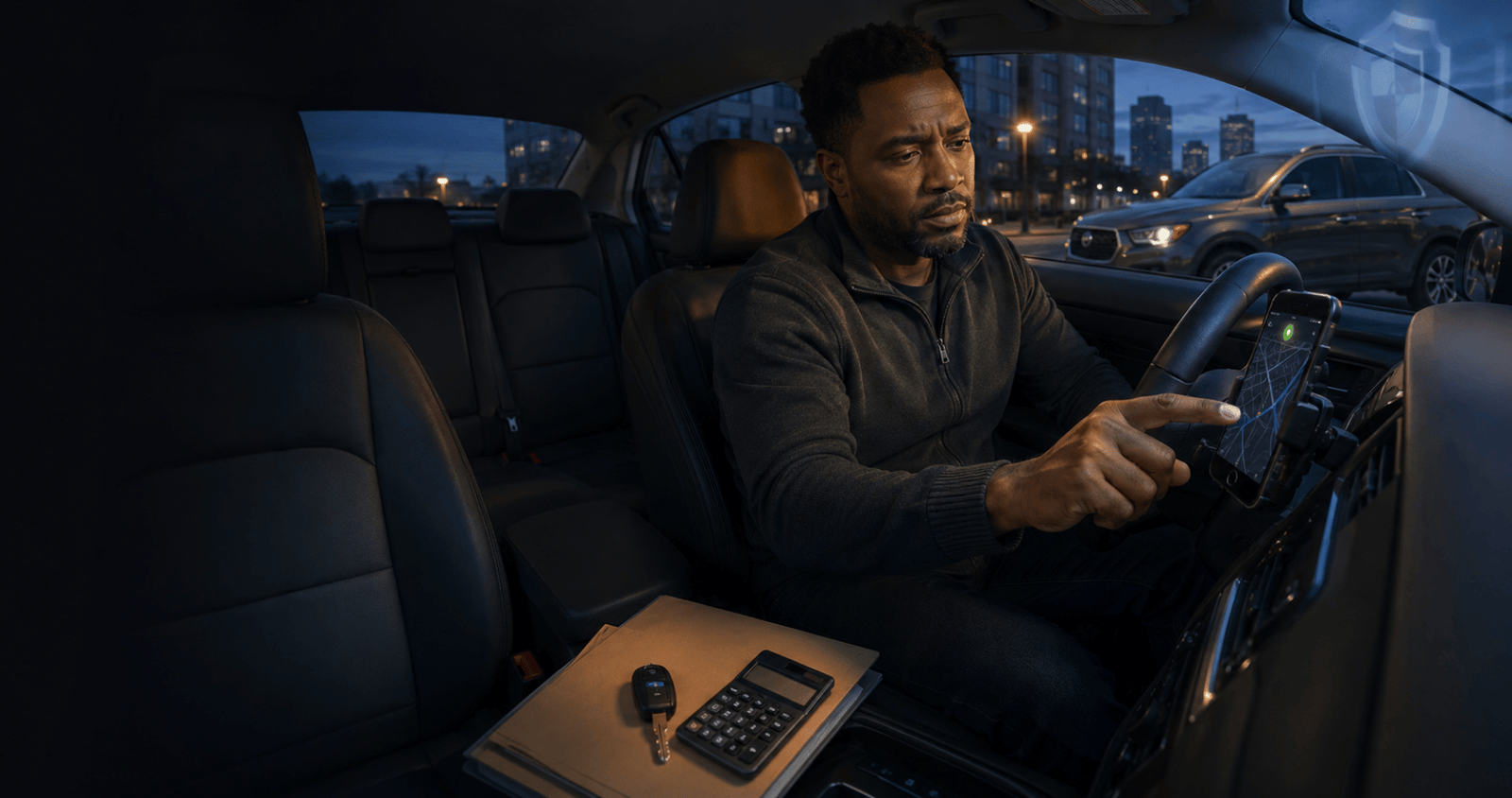
The App Goes On And Your Policy Goes Off
There is a moment every rideshare driver passes through several times a day without noticing it.
You tap the app to go online. At that instant, in the eyes of your personal auto insurer, you become a commercial driver.
Almost every standard personal policy explicitly excludes paid passenger transport through what is called a livery exclusion. Personal auto insurance stops covering you the moment the app goes live.
What replaces it is thinner than most drivers assume, and it produces a gap that has a name in the industry.
Period 1. App on, no ride accepted yet, and nobody's insurance is doing what you think it is.
The Three Periods
The structure every rideshare driver operates inside, whether or not anyone explained it.
Period 1. The app is on and you are waiting for a request. Uber and Lyft provide contingent liability only, at fifty thousand per person, one hundred thousand per accident, and twenty five thousand property damage. No collision or comprehensive on your own car. Your personal policy may deny the claim entirely.
Period 2. You have accepted a request and are driving to the pickup. One million dollars in third party liability activates, along with contingent physical damage coverage if you carry collision and comprehensive on your personal policy.
Period 3. The passenger is in the car through to dropoff. The same one million dollar protection stays active.
Then the part that surprises people. Once the passenger exits and the trip ends, coverage reverts immediately to Period 1 limits.
Which means a driver working a long shift spends a substantial share of it inside the weakest coverage period of the three.
Why Period 1 Is The Real Problem
Two failures stack in the same window.
Your own car has no coverage. No collision, no comprehensive. Damage to your vehicle in Period 1 is yours unless your personal policy responds, which it may not.
The liability limits are thin. Twenty five thousand in property damage sounds adequate until you consider what is on the road.
One illustration makes it concrete. A driver who rear ends a sixty thousand dollar SUV during Period 1 exhausts the twenty five thousand property damage limit instantly, and the remaining thirty five thousand comes out of the driver's pocket where no rideshare endorsement is in place.
That is not an exotic accident. It is an ordinary one involving an ordinary vehicle, and it produces a personal liability in the tens of thousands.
The Deductible Nobody Budgets For
The second financial shock, and it applies during the periods drivers assume are covered.
Uber charges a one thousand dollar deductible during Periods 2 and 3 for comprehensive and collision claims. Lyft charges two thousand five hundred, with Uber's figure reported elsewhere as ranging from one thousand to two thousand five hundred.
Compare that against the five hundred dollar deductible on most personal auto policies.
Which means an accident with a passenger in the car, fully inside the platform's one million dollar coverage, still costs the driver two thousand five hundred dollars out of pocket before anything is repaired.
For a driver earning a few hundred dollars in a shift, that is weeks of income against a single incident.
Deductible gap coverage exists specifically for this, and it is covered below.
What An Endorsement Costs
Considerably less than the exposure, and the range is wide.
Endorsements generally run ten to thirty dollars per month, with a broader range of six to forty across carriers, and fifteen to forty in most states.
Some carriers price it as a percentage of your existing premium rather than a flat amount, commonly fifteen to twenty percent, and one carrier's addendum is described as adding about twenty five percent to the policy.
One example puts a major carrier's endorsement at roughly twenty eight dollars a month for a typical driver.
Against a thirty five thousand dollar uncovered liability or a two thousand five hundred dollar deductible, that is among the strongest value ratios available in personal insurance.
What The Endorsement Actually Buys
Two distinct benefits, and carriers differ on which they provide.
Extending your personal coverage into Period 1. A rideshare endorsement extends your personal collision, comprehensive, uninsured motorist, and medical coverage into the gap period.
The strongest versions go further. One major carrier's endorsement extends your personal policy's exact limits into all three periods, meaning a five hundred dollar collision deductible stays five hundred dollars even with a passenger in the car.
Deductible gap reimbursement. Where you file through the platform in Periods 2 or 3, the carrier reimburses the difference between the platform's deductible and your personal one.
The arithmetic on that second one is straightforward. Where the platform deductible is two thousand five hundred and your personal deductible is five hundred, deductible gap coverage reimburses the two thousand dollar difference.
Ask which of the two you are buying, because some endorsements close Period 1 without addressing the deductible, and some do the reverse.
Not All Endorsements Cover All Periods
A limitation worth checking before assuming you are protected end to end.
One carrier's endorsement helps close the Period 1 gap but does not cover Periods 2 and 3, on the reasoning that the platform's insurance covers those.
Which is defensible for liability and leaves the deductible problem in place, unless deductible gap coverage is included separately.
Another carrier extends coverage through Period 1 as a gap product added to a standard personal policy rather than as a commercial policy.
Two questions to ask any carrier.
Which periods does this cover, specifically?
Is deductible gap reimbursement included, and how much of the difference does it reimburse?
Do not accept a general assurance that rideshare driving is covered.
Delivery Is A Separate Question
An important distinction, because the platforms differ.
Some delivery platforms provide coverage only during active deliveries, which leaves the same Period 1 gap a rideshare driver faces.
At least one grocery delivery platform is described as providing no coverage for its drivers at all, which makes an endorsement necessary rather than advisable.
Which produces a specific instruction. Disclose every platform you drive for when quoting, since each one changes the endorsement type required.
A driver who mentioned rideshare and omitted delivery may hold an endorsement that does not respond during a delivery run.
Availability Varies By State
A practical constraint worth checking early.
Most rideshare endorsements are not sold in New York or New Jersey, where drivers in some markets typically need a separate commercial policy instead.
Other carriers write rideshare coverage in a limited list of states rather than nationally.
Which means the answer to which endorsement is best depends heavily on where you live, and a product recommended widely online may simply be unavailable to you.
Two steps. Ask your existing carrier first, since adding to a policy you already hold is usually cheapest. Then work with an independent agent if the answer is no, since specialty carriers write these routinely.
Rules Are Changing In Some States
Context that affects the coverage stack.
One state reduced the uninsured and underinsured motorist coverage that rideshare platforms must provide during Period 3, moving it from one million dollars to sixty thousand per person and three hundred thousand per incident.
That is a substantial reduction in a protection drivers may have assumed was fixed.
The practical response for drivers in affected states is to confirm that their personal uninsured motorist coverage is adequate rather than assuming the platform's limits fill the gap.
More broadly, regulatory changes at the state level directly affect what drivers and passengers pay and what protection exists, which makes an annual review of the endorsement worthwhile rather than a one time purchase.
Do Not Hide It From Your Insurer
The mistake that produces the worst outcome available.
Some personal policies void entirely upon discovering rideshare activity, rather than merely declining a single claim.
Which means a driver who never disclosed rideshare work risks losing coverage for personal driving as well, on top of the claim denial that prompted the discovery.
Two protections.
Verify your personal policy does not exclude rideshare use before you start driving.
Disclose the activity when you buy or renew, and get the endorsement attached.
One carrier's positioning makes the point directly, noting that with the endorsement in place you do not have to worry about being dropped for driving for a rideshare platform.
That is a real risk being described rather than a marketing line.
Why Carriers Price This The Way They Do
Context that explains the premium.
One analysis found rideshare drivers seventy three percent more likely to be in an accident than the general driving population.
Which is not a comment on skill. It is exposure. More hours on the road, more unfamiliar routes, more urban driving, and more time spent looking at a phone mounted on a dashboard.
That figure is also the reason the endorsement is a reasonable purchase rather than an insurer's opportunism. The underlying risk is genuinely higher, and the pricing reflects it while remaining modest in absolute terms.
What A Complete Setup Looks Like
Four components for a driver working platforms regularly.
Adequate personal liability limits, since Period 1 exposure lands on your own policy where an endorsement extends it. State minimums are inadequate against modern vehicle values.
A rideshare or delivery endorsement covering the platforms you actually drive for.
Collision and comprehensive on your personal policy, since contingent physical damage during Periods 2 and 3 depends on you carrying it.
Deductible gap coverage, which addresses the two thousand five hundred dollar exposure during covered periods.
That third item is easy to miss. A driver carrying liability only has no contingent physical damage coverage even in Periods 2 and 3, because the platform's coverage is contingent on your own.
Three Things To Do Before Your Next Shift
Call your carrier and ask whether your policy excludes rideshare use, and whether they offer an endorsement.
Ask two specific questions about any endorsement. Which periods it covers, and whether deductible gap reimbursement is included.
Disclose every platform you drive for, since rideshare and delivery are treated differently and each changes the endorsement required.
The gap costs ten to thirty dollars a month to close. Leaving it open costs a thirty five thousand dollar liability in the wrong accident, or two thousand five hundred dollars for a deductible in what you thought was a covered one.
This article is for general educational purposes and is not insurance advice. Platform coverage terms, deductibles, endorsement availability, pricing, and state regulations vary and are changing. Confirm current details with your carrier and your platform's insurance documentation.
Some images in this article were generated using artificial intelligence and are for illustrative purposes only.