The Sentence That Causes The Most Trouble
Two words spoken at the scene create more problems than almost anything else in an auto claim.
I'm sorry.
Most people say it reflexively, because someone has just been frightened and the instinct is decent. But fault in a collision is a legal determination made after an investigation, not something either driver settles on the roadside.
Apologizing for the situation is human. Accepting responsibility for the crash is a statement that follows the file, and you may not have all the facts yet. The other driver may have been speeding, running a light, or looking at a phone, and none of that is visible to you in the first minute.
Check on people. Be decent. Do not narrate fault.
That is the first rule. Here is the rest of the process, in the order it actually happens.
The First Ten Minutes
Everything else depends on getting these right.
Check for injuries in your vehicle and the other one, and call emergency services if anyone is hurt or if you are unsure.
Move to safety if you can. If the vehicles are drivable and you are on a live roadway, getting to the shoulder or a nearby lot prevents a second collision. If they are not drivable, get yourself away from traffic rather than standing between cars.
Turn on hazard lights and, if you have them and it is safe, put out warning triangles.
Call the police. Requirements vary by state and by damage threshold, and a report is useful even where it is not required, because it creates an independent record neither driver wrote.
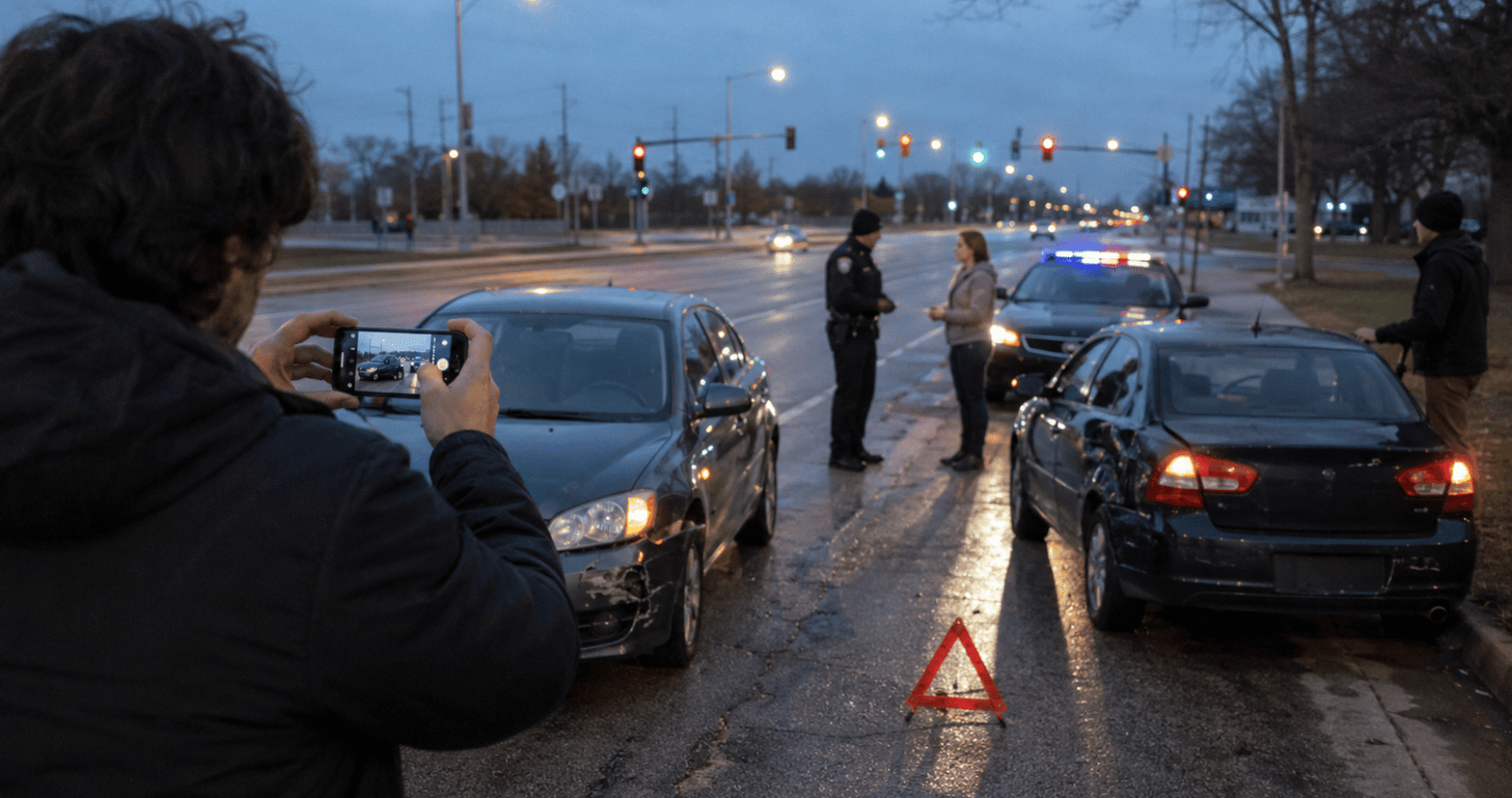
Do not move a vehicle before photographing it unless safety requires it. Once the cars have moved, the positions that show what happened are gone.
What To Collect Before Anyone Leaves
Six things, and the last two are the ones people forget.
The other driver's details. Name, phone number, address, license number, insurance company, and policy number. A photograph of their insurance card and license is faster and more accurate than writing it down.
Vehicle details. Make, model, color, and license plate for every vehicle involved.
The police report number and the officer's name and badge number.
Photographs. Damage to every vehicle from multiple angles, the wider scene showing positions and road layout, traffic signals and signage, skid marks, debris, and road conditions. Wide shots first, then close.
Witnesses. Names and phone numbers. A witness who leaves without giving details is a witness who never existed, and independent accounts carry weight that driver statements do not.
Conditions. Time, weather, light, and anything unusual about the road. Write it down while it is fresh, because these details evaporate within hours.
If there is dashcam footage, save it that day rather than letting it overwrite.
Call Your Insurer Regardless Of Fault
A step people skip when they believe the other driver was responsible.
Report the accident to your own insurer even if you are confident it was not your fault, and even if you are not sure whether you will claim.
Three reasons.
You may hold coverages that help. Collision, medical payments, personal injury protection, and uninsured motorist coverage all sit on your own policy and none of them can respond if nobody knows about the accident.
Your insurer needs the details to protect you. If the other driver later claims injuries or disputes fault, your carrier is defending you, and a first they have heard of it is a bad starting position.
Your policy probably requires it. Notice obligations are a standard condition, and failing to report can create a coverage problem separate from the accident itself.
Reporting and claiming are different acts. You can report an incident and decide later whether to pursue anything.
File Promptly
Timing affects outcomes more than most drivers expect.
Statutes of limitation for accident related claims run from around one year to several depending on the state, and some insurers limit repair payments to the year in which the accident occurred.
The practical problems arrive sooner than any legal deadline. Witnesses become harder to find, memories blur, damage gets muddled with subsequent wear, and the other driver's account hardens without anything to test it against.
Open the claim the same day where you can. Ask for two things on that first call, the claim number and the adjuster's name and direct contact.
The Adjuster And What They Handle
Understanding the role removes a lot of the anxiety.
An adjuster is assigned to investigate. They will examine the damage, review the police report, take statements, evaluate any injury claims, and determine what your policy covers.
Their findings form the basis of the settlement, which is why the evidence you supply matters. An adjuster with photographs, a police report number, and a coherent timeline reaches a conclusion faster than one reconstructing events from two conflicting phone calls.
Expect requests for additional documents during the review. Responding quickly is the single biggest thing within your control on the timeline, because incomplete files stall.
Keep a log of every call, who you spoke to, and what was said, then confirm important conversations by email. In a claim that runs weeks and changes hands between people, your own record is frequently the most continuous account that exists.
You Choose The Repair Shop
A right many drivers do not know they have.
You have the right to select the repair facility of your choice, and this is written into law in a number of states. Even where an adjuster recommends a specific body shop, you can use a different one.
Two sensible questions rather than a fight.
Ask why they recommend that shop and whether there are benefits to using it. Network shops sometimes carry a repair guarantee, direct billing, and a faster scheduling path, and those are genuine advantages worth weighing.
Ask what happens if your chosen shop estimates higher. In some cases you may be responsible for the difference between your shop's estimate and what the insurer considers a fair price, so establish that before work begins rather than after.
Get the estimate and the approval in writing either way.
Read The Estimate Line By Line
The step that recovers money.
An insurer's estimate is built from a system and it reflects what was visible during an inspection. Hidden damage behind a bumper or inside a wheel well frequently is not.
Two things to do.
Compare the estimate against the shop's own assessment. Where they differ, ask the shop to explain the discrepancy in writing.
Expect a supplement. When a shop opens up the vehicle and finds more damage, they submit a supplemental estimate for the additional work. That is a normal part of the process rather than a complication, and it is why the first number is often not the final one.
Ask about parts. Some policies specify aftermarket or used parts while others provide for original manufacturer parts, sometimes through an endorsement. If part quality matters to you, that is a conversation to have before repairs start.
Rental Coverage Has Limits
A detail that produces unpleasant surprises.
If you carry rental reimbursement, your insurer may cover a rental while your vehicle is repaired. If you do not carry it, they generally will not, regardless of whose fault the accident was.
Where the other driver is at fault, their insurer may provide a rental, though that usually depends on liability being accepted first, which can take time.
Three things to confirm early.
Whether you have the coverage at all, which is a line on your declarations page.
The daily limit and the total cap, since rental coverage is typically capped both ways and a long repair can exhaust it.
What happens if repairs run over. Keep the rental agreement, the shop's estimated completion date, and any email from your adjuster approving an extension.
Keep Every Receipt
Broader than the repair bill.
Medical receipts, if you or a passenger were treated, since an adjuster needs copies for evaluation and reimbursement.
Towing and storage charges, which accumulate quickly and are frequently reimbursable.
Any temporary transport you paid for.
Prescriptions and follow up appointments related to the accident.
Claims reimburse what can be documented. An expense you paid in cash without a receipt is an expense you absorbed.
The Deductible And When It Comes Back
A mechanic worth understanding before you are surprised by it.
If you claim on your own collision coverage, you pay your deductible and your insurer covers the rest of the covered repair.
Where the other driver was at fault, your insurer may then pursue their carrier to recover what it paid, a process called subrogation.
If that recovery succeeds, your deductible is typically refunded to you. But it waits until the subrogation completes, which can take months.
Which means paying your deductible does not mean you have lost it permanently in a not at fault accident. It means you have fronted it. Ask your adjuster whether subrogation is being pursued and to notify you when it resolves.
Injuries Change The Picture
A caution worth stating clearly.
Where anyone was injured, the claim stops being a straightforward property matter.
Symptoms from a collision frequently appear a day or two later rather than at the scene, which is why declining medical attention in the moment and feeling worse on Thursday is such a common sequence.
Three practical points.
Get checked even if you feel fine, and mention the accident to the clinician so it appears in the record.
Be careful with recorded statements about injuries in the first days, when you genuinely do not know the extent yet.
Consider legal advice where injuries are significant, since the amounts involved and the deadlines are different from a bumper repair. Many practitioners consult without charge.
What Slows A Claim Down
Five patterns, and four of them are on your side.
Incomplete photographs from the scene. Slow responses to adjuster requests. A missing police report. Repairs started before authorization. And regional claim surges after a storm, which is the one you do not control.
Everything else is documentation and speed, both of which are within reach in the days after a crash even when nothing else feels manageable.
If The Claim Goes Wrong
A short escalation path.
Ask for the reasoning in writing. A denial or a low estimate should come with an explanation you can read and respond to.
Request the supporting detail, including the estimate breakdown and any comparable figures used.
Escalate internally to a supervisor before assuming the answer is final.
File a complaint with your state insurance department, which costs nothing and requires the insurer to respond formally to a regulator.
Speak to an attorney where the amounts justify it, particularly with injuries involved.
Most claims never need any of this. Knowing the ladder exists changes how you approach a difficult one.
The Version To Keep In Your Glovebox
Check on people. Move to safety. Photograph before anything moves.
Collect the other driver's details, the plate, the police report number, and any witness phone numbers.
Say nothing about fault.
Call your insurer the same day, get the claim number and the adjuster's contact, and start a log.
Then keep every receipt and answer every request quickly, because a complete file moves and an incomplete one waits.
This article is for general educational purposes and is not insurance or legal advice. Reporting requirements, repair shop selection rights, deadlines, and coverage terms vary by state and by policy. Confirm details with your carrier or your state insurance department.
Some images in this article were generated using artificial intelligence and are for illustrative purposes only.