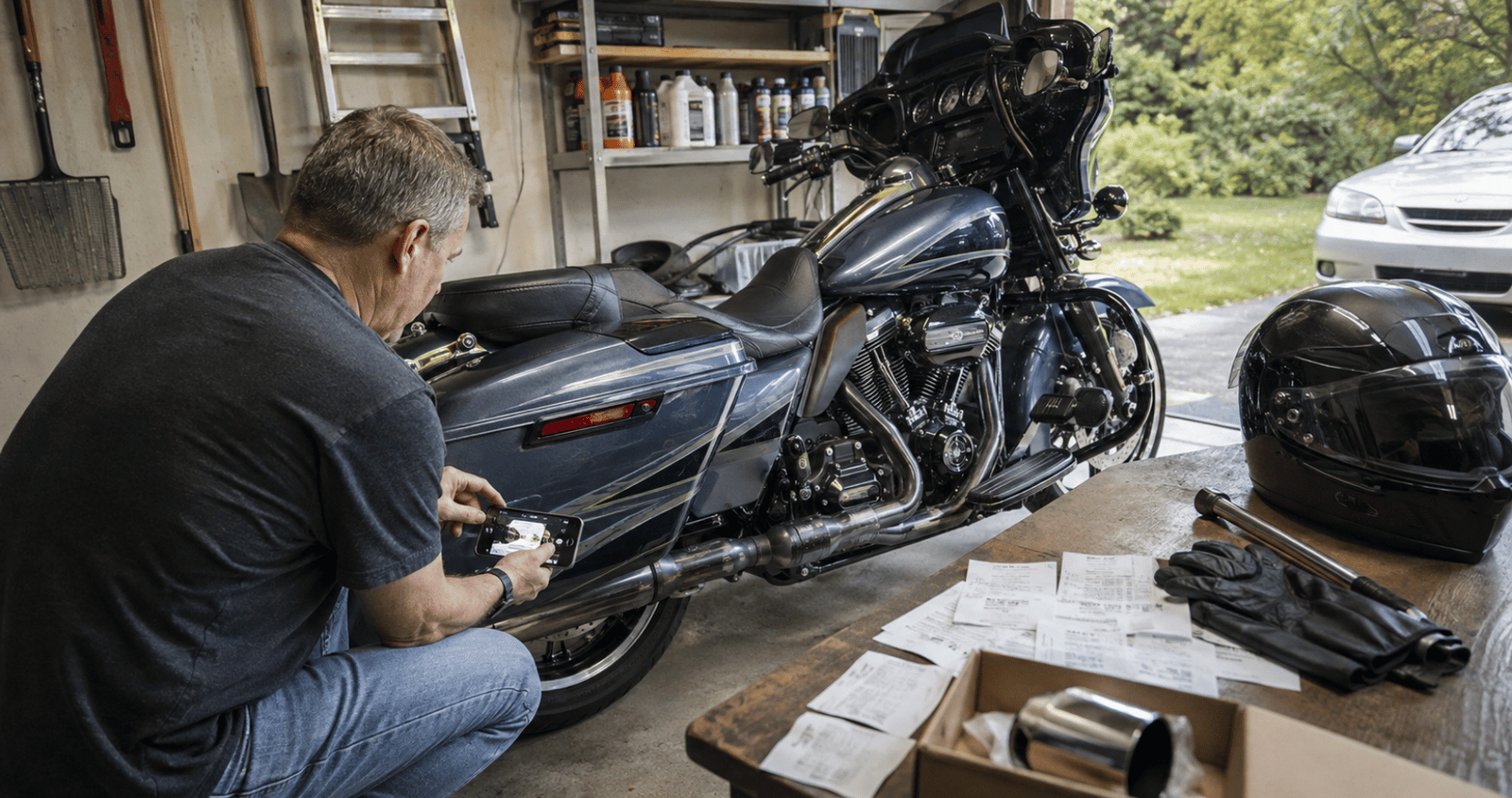
The Money You Spent After Buying The Bike Is Mostly Uninsured
Here is the gap that catches riders hardest, and it has nothing to do with how anyone rides.
Standard motorcycle policies include a small amount of accessory or custom equipment coverage, typically somewhere between one thousand and three thousand dollars.
Now consider what riders actually spend. The average owner of one popular marque puts more than two thousand dollars into accessories in the first year alone, and on a well specified touring bike or a built cruiser the aftermarket additions can easily reach five thousand to fifteen thousand dollars.
None of that is covered by a default limit of one to three thousand.
Which means a rider who spent two years and eight thousand dollars building a bike is insured for the version that left the factory, and the rest is a gray zone discovered at claim time.
Everything else in this article matters. That gap is what most riders should fix first.
What Counts As A Custom Part
Broader than people assume, and the working definition is simple.
Anything not included in the manufacturer's base model price is, by default, in that gray zone.
Which covers exhaust systems, wheels, saddlebags, custom paint, seats, handlebars, fairings, windshields, crash bars, lighting, and audio or electronic equipment.
One category deserves specific mention. Custom paint requires particular documentation, because a factory painted bike and a custom painted one look identical on a policy schedule and very different on an invoice.
If you added it, changed it, or upgraded it after purchase, assume it needs to be listed rather than assuming it is included.
The Endorsement That Closes It
The fix is straightforward and inexpensive relative to what it protects.
A custom parts and equipment endorsement extends the policy to cover aftermarket parts at replacement cost, or an agreed value, up to a limit you select.
Two things about how it is sold.
Some carriers include a base amount automatically when you buy collision and comprehensive, with figures around two thousand to three thousand dollars appearing across the market.
Additional coverage can be purchased well above that, with limits reaching thirty thousand dollars at some carriers.
Photograph and document everything you add, keep the receipts, and give the schedule to your insurer rather than describing it. A claim for parts nobody knew existed is a difficult claim.
Update the schedule as you build. Riders modify bikes continuously and insure them once.
Riding Gear Is Its Own Question
A category riders frequently assume is covered and frequently is not.
Some carriers offer riding gear coverage as a standalone endorsement or as part of a broader accessories package, covering a helmet, jacket, gloves, boots, and protective apparel damaged in a crash.
One clear boundary. Gear damaged in a crash is covered where the endorsement exists. Gear that wears out over time is not, because that is normal wear rather than an insured event.
A full set of quality protective equipment represents a meaningful sum, and replacing it after a crash arrives at the same moment as every other expense.
Ask whether your carrier includes helmet coverage, since several do, and whether it sits inside the accessory limit or alongside it.
The Coverage Stack, In Three Layers
A structure that makes the whole policy easier to think about.
The legal layer. Liability coverage, required in nearly all states, paying for injuries and damage you cause to others. Minimums follow the familiar three number format.
The bike protection layer. Collision, which covers your motorcycle when you crash, and comprehensive, which covers theft, fire, and weather.
The rider and extras layer. Medical payments, uninsured motorist coverage, custom parts, gear, accessories, and gap coverage.
The observation worth carrying from that structure is direct. A rider who buys only what the law demands has insured everyone on the road except themselves.
Guest Passenger Liability
A coverage specific to motorcycles and worth confirming rather than assuming.
Guest passenger liability pays medical expenses for a passenger where you are held liable for an accident.
The complication is that it is handled differently by different carriers. It may be included within bodily injury liability, or it may be sold separately.
Which means a rider who regularly carries a passenger should ask the question explicitly rather than assuming their liability coverage reaches the person behind them.
Some states also exclude passengers from standard liability on motorcycle policies, making this a genuine gap rather than a technicality.
Uninsured Motorist Coverage Matters More On Two Wheels
The coverage that protects the rider rather than the bike.
A motorcyclist struck by an uninsured or underinsured driver faces the same injuries as anyone else and considerably less protection around them.
Since roughly one in three drivers has been found to be uninsured or underinsured, the probability that the driver who hits you cannot pay is meaningful.
Medical payments coverage sits alongside it, paying immediate medical expenses for you and your passengers regardless of fault.
Both are inexpensive and both address the scenario a liability policy never will, which is you being hurt by somebody else.
For a rider, this is arguably the most important part of the policy after liability itself.
What It Costs
Figures vary widely because motorcycles vary widely.
The national average for basic liability coverage has been put around eighty one dollars a month, with full coverage averaging around one hundred seventy nine. Minimum coverage rates start considerably lower, from around sixty eight dollars.
Broader ranges put annual costs between five hundred and fifteen hundred dollars.
The type of bike moves the number more than almost anything else. Sport bikes, particularly high displacement models, carry the highest theft and accident rates and therefore the highest premiums, while cruisers and touring bikes are generally more affordable to insure.
Your own factors apply as they do to any policy. Age, riding experience, location, credit where permitted, and record.
Lay-Up Coverage Is The Seasonal Saving
An option unique to motorcycles and unavailable on car policies.
Riders in colder states can suspend collision and liability coverage during winter storage months, typically November through March, while keeping comprehensive coverage in force.
Two reasons that structure works.
Comprehensive protects the bike where it actually is, covering theft, fire, and weather damage during storage, which is when a garaged motorcycle is genuinely at risk.
It avoids a lapse. Canceling entirely breaks your coverage history, and a gap raises rates when you buy again.
Which is why the standard advice is not to cancel for winter but to restructure for it.
Not every carrier offers lay-up terms, so ask specifically. And some riders combine a lay-up period with a separate storage facility policy where the bike is stored away from home.
Two cautions. Do not ride during the lay-up period, since liability and collision are suspended. And confirm the reinstatement date in advance so spring does not arrive before your coverage does.
Discounts Riders Should Ask For
Motorcycle policies carry credits that car policies do not, and several are easy to earn.
Safety course completion, widely offered and frequently among the larger discounts available.
Rider group or association membership, including owner groups tied to specific manufacturers.
Mature rider discounts, available at several carriers.
Anti theft device installation, which matters given motorcycle theft rates.
Multi bike and multi policy, where you own more than one machine or bundle with auto or home coverage.
Longevity and claim free credits, which accumulate over time.
New bike discounts, offered by some carriers on recent purchases.
Ask for each by name. Motorcycle discount lists are longer than most riders realize and carriers apply only what they know about.
Ask What Parts They Will Use
A detail that separates carriers and rarely appears in a price comparison.
Some insurers commit to using original equipment manufacturer parts for repairs after a covered incident, and to using custom parts where the bike is customized.
Others default to aftermarket alternatives.
For a stock commuter bike that distinction may not matter much. For a built machine where the parts were chosen deliberately, it matters enormously.
Ask before buying rather than discovering the answer during a repair, and get the commitment in writing where a carrier makes one.
Extras Worth Pricing
Four optional coverages that suit specific riding patterns.
Roadside assistance, covering towing, battery service, flat tire assistance, and fuel delivery. Confirm the towing distance allowance, since not every shop services every marque.
Trip interruption protection, which covers costs when a breakdown strands you away from home. Genuinely useful for touring riders and pointless for a short commute.
Rental reimbursement, relevant where the motorcycle is your primary transport rather than a second vehicle.
Transport trailer coverage, included within some accessory packages, which matters if you trailer the bike to events.
Buy the ones matching how you actually ride rather than the full list.
Document The Bike Before You Need To
Ten minutes of work that decides how a claim goes.
Photograph the motorcycle from every angle, in good light, including close shots of every aftermarket part.
Photograph the odometer and the VIN plate.
Keep receipts in one place, ideally cloud storage rather than a drawer in the garage that may be involved in the same fire.
Record part numbers and serial numbers for expensive components, particularly exhaust systems, electronics, and wheels.
Repeat it annually, or whenever you complete a meaningful modification.
An adjuster valuing a modified bike works from what you can prove. Photographs taken before a loss and invoices matching them turn an argument about what the bike was into a schedule of what it contained.
Theft claims particularly depend on this, because there is no wreckage to inspect and the entire valuation rests on documentation.
A Non-Owner Option Exists Here Too
Worth knowing for riders between bikes or borrowing regularly.
Non-owner motorcycle coverage provides liability protection to a rider who does not own a motorcycle, which suits someone who borrows or rents bikes.
It also serves a second purpose. A rider required to maintain a state filing after certain offenses can keep that filing active without owning a machine.
Two limitations mirror the car equivalent. It is liability only, so it does nothing for damage to the borrowed bike. And insurers generally decline where you have regular access to a motorcycle in your own household.
For a rider who sold a bike and intends to buy another, it also preserves continuous coverage history, which prevents the rate increase a lapse produces.
Where Riders Underinsure
Three patterns that recur.
State minimum liability, which on a motorcycle protects everyone except the rider and is inadequate against modern medical and vehicle costs.
Default accessory limits, as covered above, which are the single most common gap on a modified bike.
No uninsured motorist coverage, which removes the only protection available when an uninsured driver causes serious injury.
Each of those is cheap to fix relative to what it addresses, and each is skipped for the same reason, which is that the quote came back lower without them.
Four Things To Sort This Week
Total what you have added to the bike and compare it against your accessory limit. If the first number is larger, that is the gap to close first.
Confirm guest passenger liability if anyone ever rides with you.
Add uninsured motorist coverage if it is not already there, because it is the only coverage protecting you from a driver who cannot pay.
Ask about lay-up terms before winter, since suspending the right coverages beats canceling and starting over.
A motorcycle policy priced on the bike that left the factory does not describe the bike in your garage. Closing that distance takes one conversation and a folder of receipts.
This article is for general educational purposes and is not insurance advice. Coverage availability, accessory limits, lay-up terms, passenger liability treatment, and pricing vary significantly by insurer and by state. Confirm details with your carrier.
Some images in this article were generated using artificial intelligence and are for illustrative purposes only.