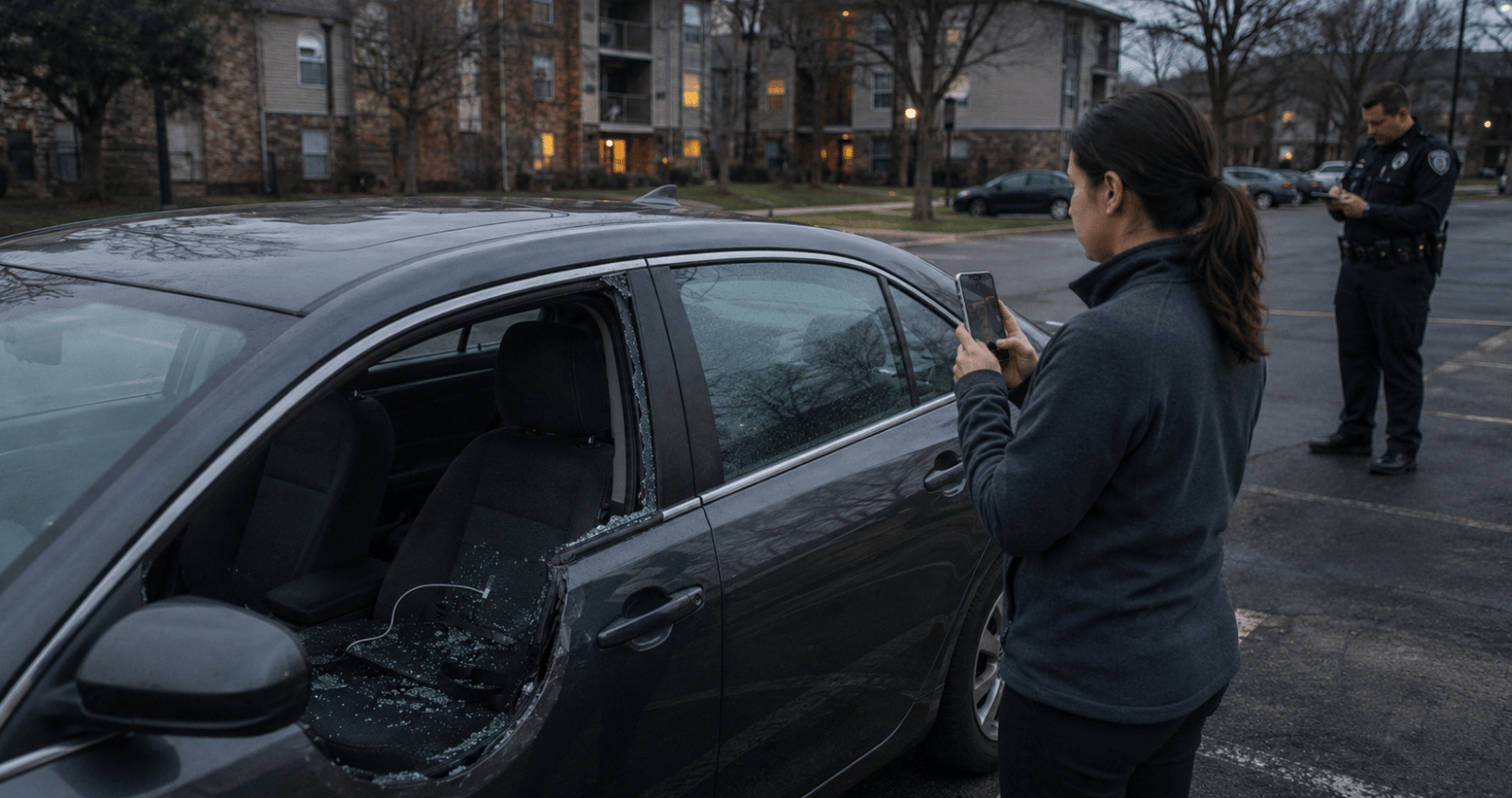
One Broken Window, Two Insurance Companies
You come back to glass on the pavement. The window is gone, your laptop is gone, and a gym bag with your headphones went with it.
That looks like one crime. To the insurance world it is two separate claims filed with two different companies, and most people call the wrong one first.
Your auto policy handles the car. Your renters policy handles everything that was sitting inside it. Neither one will touch the other's territory.
Sorting The Wreckage
Here is how a single break in splits apart.
| What Was Damaged Or Taken | Which Policy Responds |
|---|---|
| Smashed window and door damage | Auto, comprehensive coverage |
| The car itself if stolen | Auto, comprehensive coverage |
| Catalytic converter | Auto, comprehensive coverage |
| Factory installed stereo | Auto, comprehensive coverage |
| Your laptop from the passenger seat | Renters, personal property |
| Gym bag, headphones, clothing | Renters, personal property |
| Aftermarket stereo you installed | Depends, ask both insurers |
That last row genuinely varies. Anything bolted in at the factory belongs to the vehicle. Anything you added yourself sits in a gray zone that carriers treat differently.
The Reason This Surprises Everyone
People assume comprehensive auto coverage protects what is in the car, because the car is the thing being insured.
It does not. Auto insurance covers the vehicle. Full stop. Your possessions inside it are just possessions, and possessions are what a renters policy is for, wherever they happen to be sitting.
Renters coverage follows your belongings around. Coffee shop table, hotel room, rental car, airport, your own back seat. Same protection, same limits, roughly the same claim.
Which means the person without renters insurance who assumed their car policy had them covered is simply out the laptop.
Two Deductibles Against One Incident
Now the part that decides whether any of this matters.
You have an auto deductible and a separate renters deductible. Filing both claims means paying both.
Say the window costs four hundred dollars and your auto deductible is five hundred. That claim is dead. The laptop is worth eight hundred and your renters deductible is five hundred, leaving three hundred, which then has to be weighed against a claims record and a possible premium increase at renewal.
A break in that felt like a twelve hundred dollar disaster can produce a three hundred dollar payout and two marks on your insurance history.
Run both numbers before you call anyone. Sometimes the answer is to file neither and just replace the window.
Two Things Worth Knowing Before You File
Borrowed items usually count. If your friend's console was in the trunk, personal property coverage generally extends to property of others in your possession, though often capped around a thousand dollars. Most people assume they are on their own here.
Cash is barely covered. Money taken in a break in typically falls under a small sublimit, often two hundred to five hundred dollars, no matter how much was actually there.
Your roommate's things are not yours. Their stuff needs their own policy, even if you were driving.
Where Payouts Shrink
Two settings on your policy control what actually arrives.
Actual cash value pays the depreciated worth of a three year old laptop, which is a fraction of replacement price. Replacement cost pays what a comparable new one costs today. Check which one you carry, because on electronics the gap is enormous.
Some policies also apply a reduced limit to belongings away from home, or specifically to items taken from a vehicle. That is worth confirming directly rather than assuming your full limit travels with you.
What Happens Next
Call the police before anything else and get a report number. Both insurers will ask for it, and a delayed report weakens the whole claim.
Photograph the scene before you clean up. The broken window, the glass, the empty spot where the bag was.
List what is missing with model numbers where you can. Adjusters value conservatively when documentation is thin.
Then do the deductible arithmetic above and decide which claims, if any, are worth filing.
The Habit That Prevents All Of This
Nothing visible. Not a charging cable, not an empty bag, not a phone mount suggesting there is a phone somewhere.
Most break ins are opportunistic. Someone walking a parking lot looking through windows for two seconds each. A clean interior is a boring target.
Photograph your valuable belongings while they are still yours and store the file in cloud storage. That five minute habit is what turns a vague claim into a paid one.
The Practical Takeaway
Two policies, two deductibles, one bad morning. Knowing the split before it happens saves a wasted phone call and helps you decide quickly whether filing is worth it.
If you drive regularly with anything valuable in the car, look up two numbers tonight. Your renters deductible and whether you carry actual cash value or replacement cost. Those two decide what a break in actually costs you.
This article is for general educational purposes and is not a substitute for reviewing your actual policy documents. Coverage terms, sublimits, and deductibles vary by insurer and by state.
Some images in this article were generated using artificial intelligence and are for illustrative purposes only.