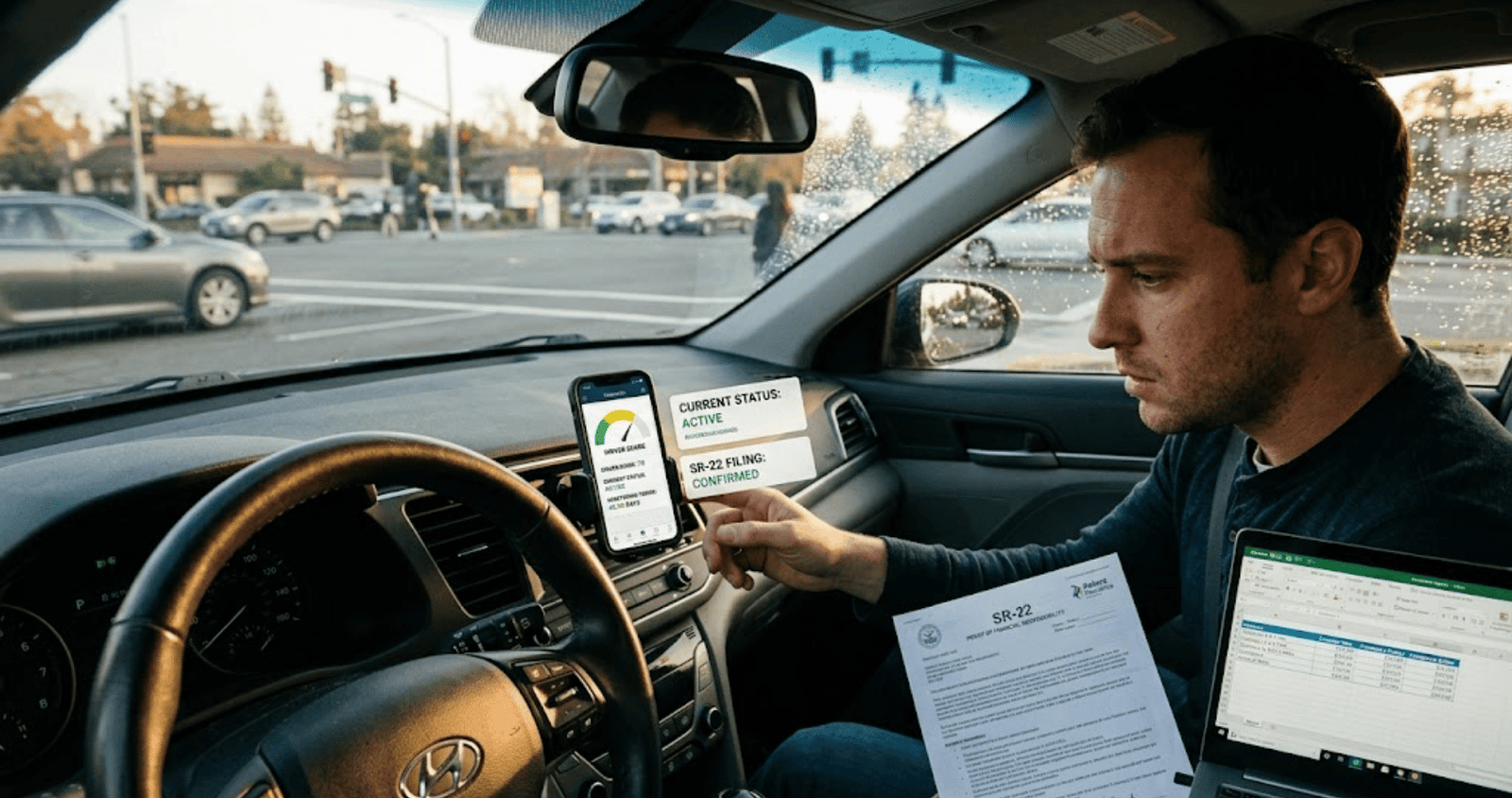
It Is Not Insurance, And The Fee Is Not The Cost
Two misconceptions cause most of the confusion around this, and both are worth clearing up before anything else.
An SR-22 is not an insurance policy. It is a certificate your insurer files with the state confirming you carry at least the minimum liability coverage required by law. The insurance sits underneath it. The form is just proof.
The filing fee is trivial. It typically runs fifteen to thirty five dollars, and most insurers handle the filing for you.
The expensive part is everything around it. The conviction that triggered the requirement marks you as high risk, and that is where the money goes.
One useful way to think about it. A driver who somehow filed the certificate without any conviction behind it would pay almost nothing extra. The paperwork is not the penalty.
What The Premium Actually Looks Like
Figures vary widely by state, by carrier, and by what happened, and the range itself is instructive.
Nationally, drivers required to file typically pay somewhere between eighteen hundred and fifty six hundred dollars a year for liability only coverage, with the average landing near three thousand after a DUI.
Put differently, one analysis puts a pre event average full coverage premium around eighteen hundred dollars and the post DUI figure at thirty two hundred to forty four hundred.
Percentage increases are described as forty to ninety percent in some analyses, and considerably higher in others. California data puts the average DUI increase at around one hundred seventy six percent, meaning drivers frequently pay close to triple what they paid before.
There is also a quieter cost. Drivers labeled high risk commonly lose the good driver discount they had been carrying, which compounds the surcharge.
State Variation Is Enormous
Worth checking before assuming any national figure applies to you.
Coverage for a filing driver averages roughly twenty one hundred dollars a year in one state and exceeds fifty five hundred in another.
Arizona has been described as having extreme premium volatility, with increases averaging anywhere from forty percent to over two hundred percent depending on the carrier. Texas increases have been put in the range of fifty to over ninety six percent.
Some states do not use the SR-22 at all for in state violations, using a different filing or electronic monitoring system instead. Others use a different form entirely for alcohol related offenses, sometimes called an FR-44, which typically requires higher liability limits than the standard minimum.
Which means step one is finding out what your own state requires rather than reading a general guide, including this one.
Why It Was Triggered
The requirement follows a category of serious violation rather than any single one.
Common triggers include driving under the influence, reckless driving, driving without insurance, at fault accidents while uninsured, repeated traffic violations, and license suspension or revocation.
The specific violation matters for pricing. A DUI raises rates more than any other conviction, while an at fault accident while uninsured carries a smaller multiplier.
That distinction is worth knowing when you shop, because carriers price the underlying conviction rather than the certificate.
The Clock Starts Later Than You Think
A detail that catches people and costs them months.
Most states require the filing to be maintained for three years, with severe or repeat offenses sometimes extending it to five.
The important part is when the three years begin. In many DUI cases the period runs from the date your license is reinstated, not from the arrest and not from the conviction.
Which means someone who spent months with a suspended license before reinstatement has not been serving the clock during that time.
Ask your state licensing authority for your specific compliance end date in writing rather than counting forward from a date you assume is correct.
A Lapse Restarts Everything
The single most expensive mistake available in this situation.
Any lapse in coverage while the requirement is active can restart the clock and trigger a license suspension.
The mechanism is automatic. When your policy cancels, your insurer files a cancellation notice with the state, and your license can be suspended within days.
Three practical consequences.
A missed payment is not a minor administrative issue. It is a compliance event with a licensing outcome attached.
A lapse pushes future rates higher independently, because a gap in coverage is itself a red flag insurers price for.
Restarting a three year requirement can mean paying high risk rates for years longer than necessary.
Some insurers require six or twelve months of premium paid upfront in a lump sum for filing drivers, precisely because lapses are common. That is unwelcome and it exists for a reason.
Set up automatic payment, keep a buffer in the account it draws from, and never let a payment fail while a filing is active.
Not Every Carrier Will File
A structural constraint people discover at a bad moment.
Some major carriers simply do not handle SR-22 filings in some states, either because of the paperwork or because they do not want the risk profile.
If your current insurer will not file in your state, you may be pushed toward a high risk specialist, and that transition alone can raise your costs.
Ask your existing carrier first, before assuming you need to start over. If they will file, staying with a company that already knows you is frequently cheaper than moving to a non standard market.
Shopping Matters More Here Than Anywhere
This is the section that saves the most money, and the spread is unusually wide.
Premiums between carriers commonly vary sixty to one hundred percent for the same filing driver, because non standard insurers underwrite high risk pools very differently from mainstream carriers.
Concrete comparisons illustrate it. One carrier has been quoted around twenty seven hundred dollars where another exceeded thirty seven hundred for comparable coverage. In one state, a price leader was quoted near twelve hundred fifty five dollars for minimum coverage while other carriers charged upwards of twenty seven hundred sixty.
Rate variance is described as wider for filing drivers than for almost any other group of customers.
Which produces a clear instruction. Get three or four real quotes within the same week, including at least one high risk specialist and at least one mainstream carrier that files in your state.
A thousand dollars of annual variation between companies for the same driver is normal here rather than exceptional.
If You Do Not Own A Car
An option many people do not know exists, and it is dramatically cheaper.
A non owner policy provides liability coverage attached to a person rather than a vehicle, and it satisfies the filing requirement for someone who needs to reinstate a license without owning a car.
Pricing sits far below a standard policy. Figures cited range from around three hundred to eight hundred dollars a year at the low end, and six hundred to eighteen hundred at the higher end, against fifteen hundred to five thousand or more for standard coverage.
It is the usual solution where a vehicle was sold, totaled, or impounded after the conviction.
Two things to understand. It covers you driving borrowed or rented vehicles, not a car you own. And it keeps the filing continuous, which is what protects the clock.
If you are between cars during a filing period, this is almost always the right product.
What Happens When It Ends
The step that is not automatic.
When the compliance period ends and the state releases the requirement, your insurer files a form notifying them that the certificate is no longer in place.
Two things to do rather than assume.
Confirm the release with your state licensing authority, in writing, rather than relying on a date you calculated.
Shop immediately afterward. The filing requirement ending does not mean your rate resets. The underlying conviction may still be affecting pricing, but you are no longer restricted to carriers that handle filings, which reopens the market considerably.
That second point is where the largest single saving of the whole period frequently sits, and it is missed because nobody prompts you.
The Conviction Outlives The Filing
An expectation worth setting honestly.
The certificate requirement typically runs three years. The conviction behind it stays on your driving record considerably longer, in some states ten to twelve years for a DUI.
Which means rates remain elevated for a period after the filing ends, though they improve as the violation ages.
Two things help during that stretch. Keeping the record clean, since a second violation compounds sharply. And shopping at every renewal, because carriers age a conviction out of their pricing at different speeds and the one that penalizes you least changes over time.
What Actually Reduces The Cost
Six things, in rough order of effect.
Get three or four quotes, for the reasons above. Nothing else comes close.
Ask whether your current carrier files, before moving to a non standard market.
Consider a non owner policy if you do not currently own a vehicle.
Carry minimum liability during the filing period if budget is the constraint, while understanding the exposure that creates. Adding coverage back later is straightforward.
Ask about defensive driving or state approved courses, which some carriers credit even for high risk drivers.
Never let it lapse, which is not a saving so much as avoiding the largest available loss.
What Not To Do
Four things that make it worse.
Do not drive without the filing in place. Driving on a suspended license during a compliance period compounds the original problem substantially.
Do not cancel the policy at the moment you believe the period ended. Confirm the release first.
Do not skip a payment to bridge a tight month. Set up autopay and treat the payment as non optional.
Do not accept the first quote. In this specific situation, that decision costs more than in any other part of auto insurance.
The Four Things To Do This Week
Find your exact compliance end date from your state licensing authority, in writing.
Ask your current insurer whether they file in your state before shopping elsewhere.
Get three or four quotes in the same week, including a high risk specialist, because the spread here is wider than anywhere else in auto insurance.
Set up automatic payment and confirm the account behind it will not fail, because a lapse costs more than every other decision in this article combined.
The filing itself is a form costing less than a tank of fuel. Everything expensive about this situation comes from the conviction underneath it and from how many carriers you bothered to call.
This article is for general educational purposes and is not insurance or legal advice. Filing requirements, compliance periods, forms used, and pricing vary significantly by state and by insurer. Confirm your obligations with your state licensing authority and your carrier.
Some images in this article were generated using artificial intelligence and are for illustrative purposes only.